
OSAP user experiences
Listening to low-income students
You’re reading the March 13, 2026 edition of the Peterborough Currents email newsletter. To receive our email newsletters straight to your inbox, sign up here.
Hi, I’m Currents co-editor David Tough. Welcome to your weekly Peterborough Currents email newsletter!
Trent University is still trying to figure out what the new funding announced in February by the Ford government means for the university’s budget woes; stay tuned for that story in the coming weeks.
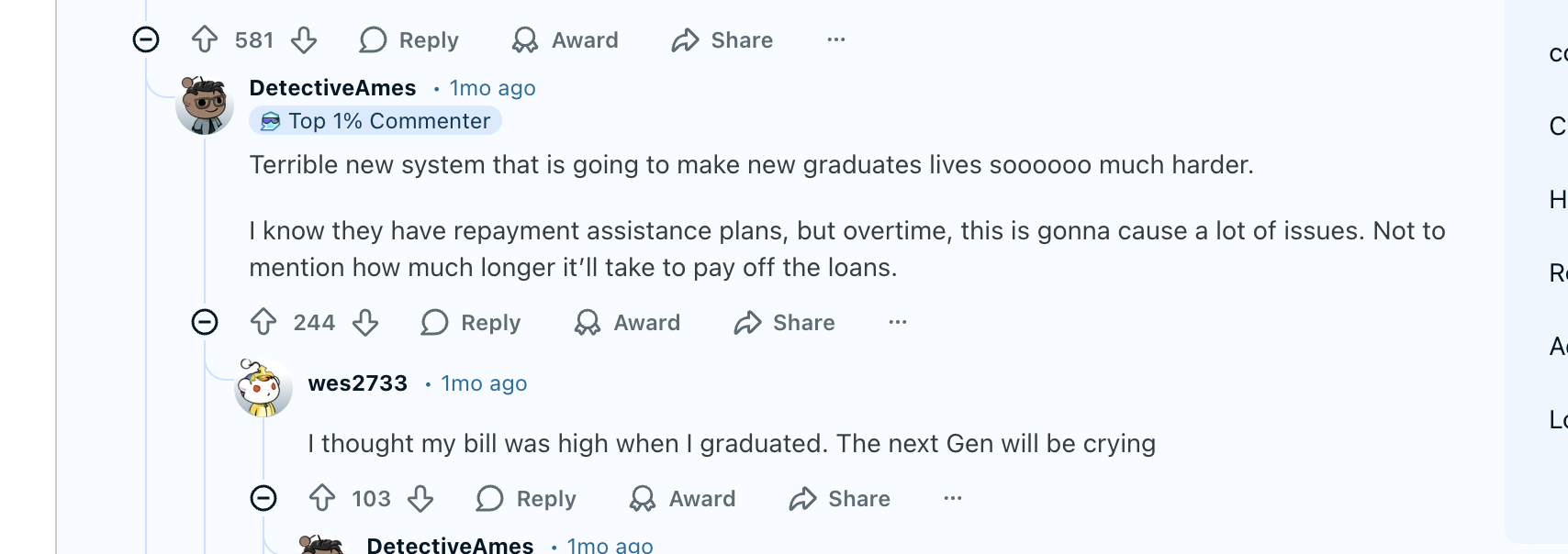
In the meantime, I’ve been checking out reddit.com/r/Ontario/, where students are posting their responses to the changes to the Ontario Student Assistance Program (OSAP) funding – changes that will result in much higher debt for the province’s graduates.
Let’s get right to it!
OSAP user experiences
by David Tough
The other day I heard from a reader that Peterborough Currents has been discussed on local reddit. As you probably know, Canadian news media can’t be shared on the big social media sites due to a prolonged conflict between the federal government and the tech industry over paying news media for content.
The ban has been a huge boon for disinformation, as high-traffic sites like Facebook and Twitter now have a vast volume of commentary and even “breaking” “news” that is misleading if not entirely fabricated. And for those of us in the news game, who remember posting and sharing articles online and getting real-time responses, it can make it hard to know how people feel about what we’re writing.
As it turns out, I didn’t find much discussion of Currents when I checked. But it did make me wonder what users were saying about the recent changes to Ontario’s income-based student funding program, the Ontario Student Assistance Program, or OSAP.
The big headlines have focused on the unfreezing of tuition, but the much bigger story for students is that the bulk of OSAP will now be in the form of a loan, rather than a grant. Currently low-income students can get up to 85% grants; next year will see the maximum drop to 25%.
While higher tuition does ultimately contribute to the cost of education, the 2% increase is relatively small. The shift from grants to loans is remarkably severe, and quite sudden. Students who started their degrees knowing they would incur a small debt are now forced to choose between taking on a much larger debt, or giving up on their degree.
The haste with which such a drastic change was introduced was a key theme in user comments when someone shared a CTV story “Students disappointed by cuts to OSAP grants, tuition freeze lift” a few weeks ago.
“Some of us are in the middle of our degrees,” chasinggeese49 wrote, “having had the expectation of paying back $10k for each year in post-secondary. Not $30k. We can’t afford that. We’re going to potentially give up our education halfway through.”
A user named SaugaAsks wondered “Why is it such a gradual approach to allow schools to raise tuition when it’s a sudden flip with loans and grants?”
“Lifting the tuition cap is a good idea,” Le1bn1z wrote, but “Slashing OSAP at the same time and not giving lead time or bridging funding … that is typical Ford carelessness and sloppiness.”
Another thread, responding to a Toronto Star article “Ontario lifts tuition freeze, unveils OSAP reforms as it adds billions to university and college funding,” featured a lot of partisan jabs at Doug Ford and the government, but also some thoughtful critiques of the timing of the recent announcements.
A user named AlfredRWallace said, “They wait until colleges cut programs and fire people and THEN decide to do something?”
Another user, GirlThatBakes, wrote that they were “accepted into a program on the Friday, then emailed Monday to say it was suspended,” and that they “had less than a week before Feb 1 to find a new program.”
The Ford government might be inclined to ignore complaints like these, dismissing them as predictable grumbling from a constituency that doesn’t support them. But their critiques come from a place of immediate experience, and raise important concerns.

Thanks for reading!
If you value our journalism and want to see it continue, please sign up to support us.
David Tough
Co-Editor
Peterborough Currents
Thanks for reading the Peterborough Currents email newsletter! Here’s where you can sign up to have these sent straight to your inbox.
Author