
Ontario’s snap winter election: On the icy campaign trail in Peterborough-Kawartha
We hit the streets with the Liberals, NDP and the Greens to see how they’re trying to sway voters in this rare winter election
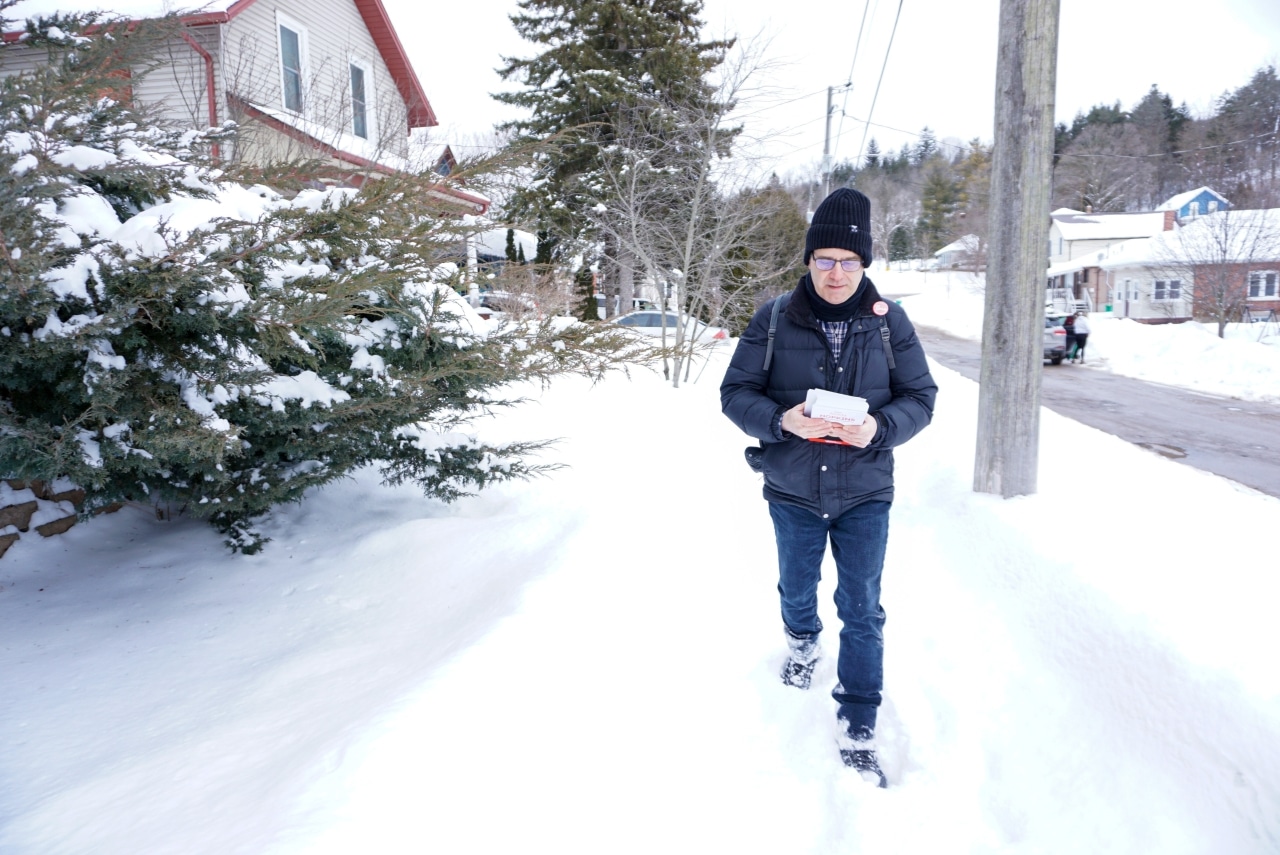
Election campaign signs buried in snow. Volunteers shut inside by snowstorms. Candidates braving unplowed sidewalks to knock on doors. Ontario’s first winter general election in decades has presented many trials for candidates in the Peterborough-Kawartha riding.
Aside from one held on the cusp of spring in March 1981, the province’s last general election in the dead of winter was in January 1905.
Peterborough Currents joined the local Green, Liberal and NDP campaigns as they went door knocking recently, ahead of the snap vote on February 27. A request to tag along with volunteers for Progressive Conservative candidate Dave Smith was denied.
Lucas Graham, local Ontario Green Party candidate, said getting volunteers out during this extra snowy February has been tough. “They don’t want to come in snowstorms, which is completely reasonable,” Graham said as he canvassed on Bolivar Street the day after the first of two major back-to-back snowstorms hit Peterborough mid-campaign.
That same day Liberal candidate Adam Hopkins campaigned in East City, with some of his volunteers walking in the street because the sidewalks were buried in snow. He said he thinks the Progressive Conservatives are hoping this winter weather will work to their advantage.
“I think they’re going to bet on the fact that maybe we have a snowstorm on Election Day and maybe people don’t come out,” said Hopkins. “I think that’s part of their calculation, that it’s going to benefit them, right?”
Some political scientists have said wintry weather could lead to low voter turnout, something that tends to benefit incumbent parties.

Peterborough-Kawartha NDP candidate Jen Deck dodged the snowy sidewalks on Family Day, as Peterborough was digging out from the second major snowstorm in less than a week, by canvassing inside apartment buildings on Talwood Drive.
The second-time NDP candidate said tenants in apartment buildings often tell her it’s rare for a candidate to take the time to knock on their doors.
“It’s only my observation [but] people are saying that they haven’t been meeting other candidates,” she said. “To me, that seems crazy. I think that we should be treating all of the people of Peterborough–Kawartha like their voice matters.”
The NDP ground game: door knocking with Jen Deck’s team
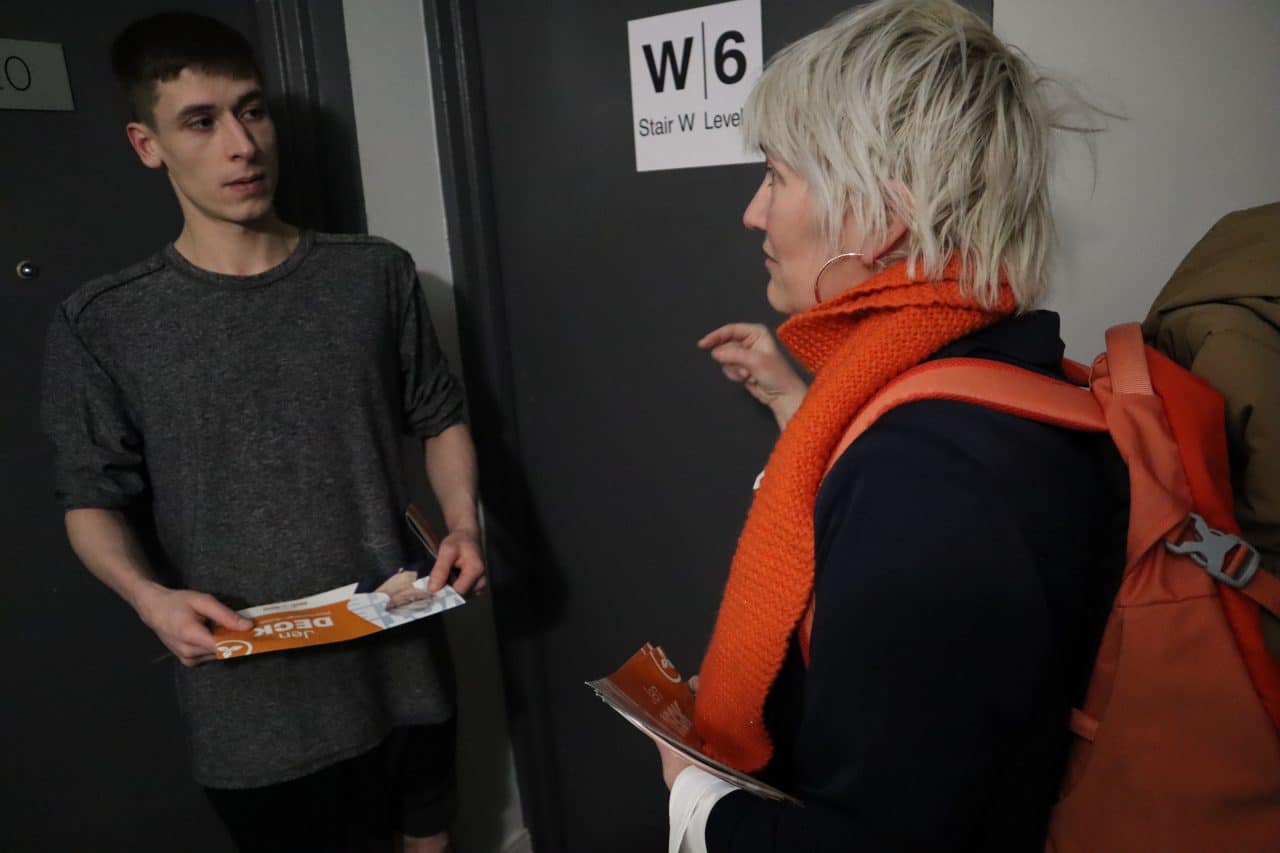
Trent University student Benjamin Hickey has been putting in long days campaigning for Deck in sub-zero temperatures.
“I feel like I’m gonna get trench foot doing this. My boots have stopped being waterproof,” said Hickey while canvassing on Talwood Drive recently.
At one apartment tower, the superintendent asked Hickey and another volunteer to leave, prompting Hickey to pull out a copy of Ontario’s Elections Act and explain that the owner could be fined for denying them entry.
It’s an offence under the act to stop canvassers from entering an apartment building with seven or more units during an election period, within set hours of the day. Fines start at $500. After a call to the property manager, the superintendent let them in.
Hickey said the NDP has focused on canvassing in many lower income neighbourhoods in and around downtown Peterborough and nearby Havelock.
“The reason I’m out here is to try to get the working class in power politically, and get our issues front and centre and hopefully create a society where working class people have total say over the issues that affect them,” he said.
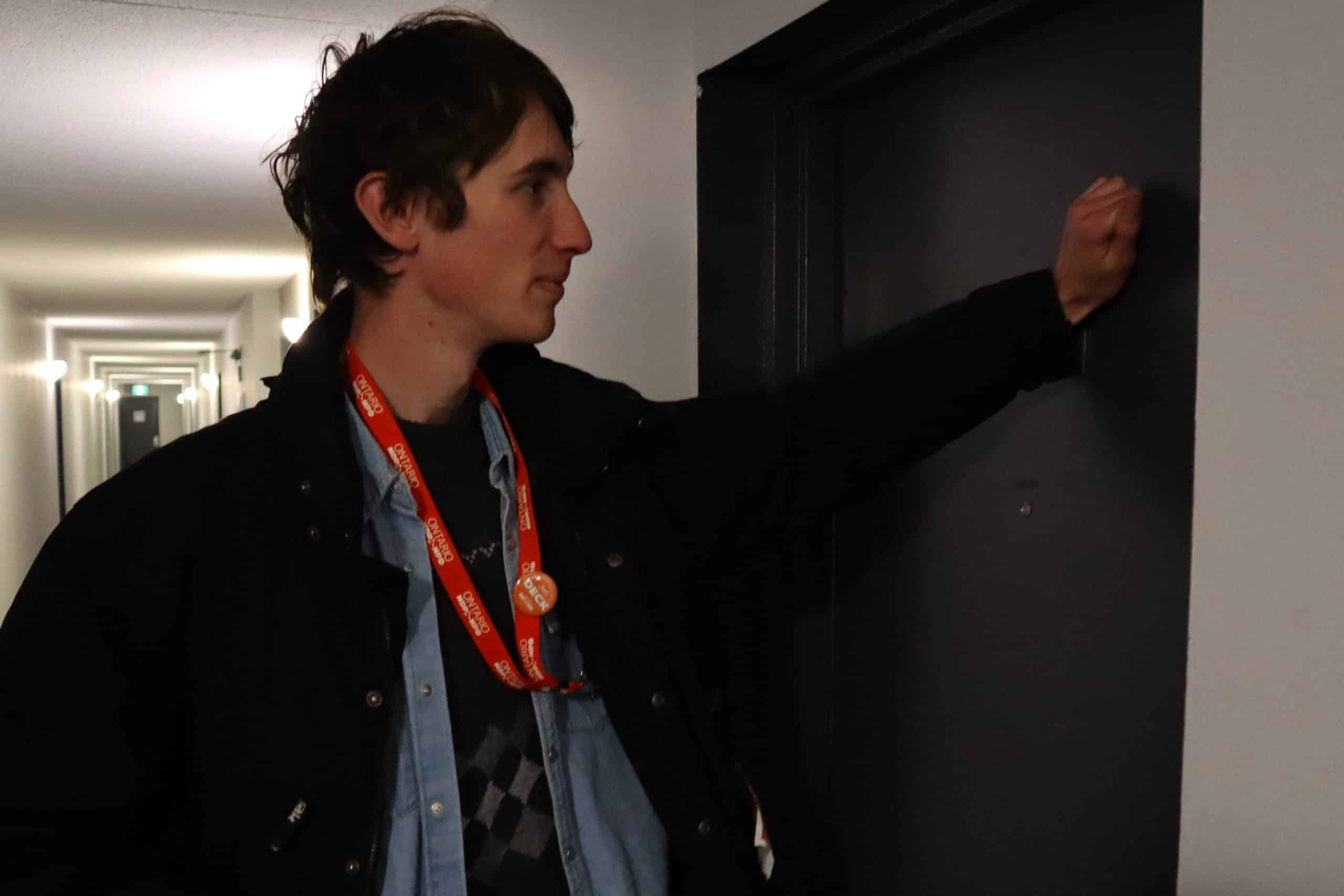
Hickey said high rent prices are a major worry he’s hearing at people’s doors. He said he’s also met people with chronic health conditions who can’t get the help they need because the healthcare system is “crumbling under the PCs,” and people on the Ontario Disability Support Program (ODSP) who say they are struggling because the PCs have kept ODSP rates too low.
Fellow Trent student Connor Belbin voted PC in the last two provincial elections, but this time he’s campaigning for Deck and the NDP.
The Bobcaygeon native said he was turned off from the conservative movement by federal Conservative Party leader Pierre Poilievre, who Belbin said is trying to bring Trump-style politics to Canada. It led him to rethink PC leader Doug Ford, too.
When he started door-knocking for the NDP he was “expecting people to be like, ‘go away, socialists, don’t care’,” he said. But that wasn’t the case. “I think a lot of people just appreciate the olive branch of people coming to the door saying, ‘hey, like, we’re fighting for you, and we have [a candidate] who… genuinely cares about making sure that your interests are represented in Queen’s Park’.”
Belbin said he has hope the NDP can rise above its current third-place standing in province-wide polls. He noted that the majority of voters in Peterborough-Kawartha cast their ballots for centre and left-of-centre parties in the 2022 provincial election.
“So it comes down to Election Day,” he said. “And if we get a sense that there’s a real chance here to flip this riding, then we’re going to keep pushing even harder.”
Belbin said he heard a lot of concerns from voters on Talwood Drive about U.S. President Donald Trump’s tariff threats and annexation taunts against Canada — rhetoric he said has helped lift the PCs in the polls.
“I think [people are] rallying around Doug just because people rally around the flag when they’re under threat,” he said. But in the face of U.S. aggression, Ontarians need a party in power that “understands their actual struggles,” Belbin said.
Volunteers for Liberal candidate Adam Hopkins bring decades of experience to campaign

NDP and Liberal volunteers both said they’re meeting a lot of undecided voters. Many people “want to vote for the person that can get [Ford] out,” but they aren’t sure who that is yet, said long-time Liberal volunteer Bill Bott.
That some people are still weighing their options comes as no surprise to Catherine Brunger, who has been volunteering on Liberal election campaigns in Peterborough for nearly half a century. She said a lot of people don’t get engaged in elections until the week of the vote.
Brunger’s campaign experience stretches back to the 1977 Ontario election.
“I keep saying to my husband, I gotta retire. I gotta start doing more knitting and reading instead of these [campaigns]. But I can’t just walk away from it,” she said as she canvassed for the Liberals in East City.
In decades past, Liberal volunteers tried to knock on every door they could in the riding, she said, sending out canvassing teams in multiple waves per day. “We were out three times a day,” she said. “But you had to have the people.”
“Now the whole theory is fish where the fish are,” she said. That means targeting past Liberal supporters who are in the party’s database to ask for their vote again, she said. Volunteers follow up with a phone call to lock in people’s support.
Hopkins said his team has canvassed all over the riding, but their focus has been on the city. Campaigning in rural parts of the riding within Peterborough County is more challenging, Brunger said.
“The county’s always a problem because it’s such a wide expanse” and voters there tend to vote conservative, she said. “The rule is, if you can’t win the city, you’ve got to win the county, and vice versa.”
She said this time the Liberals want to win two areas outside the city: Lakefield and Curve Lake First Nation.
Brunger said she has an eye on Deck, the NDP candidate, because this is her second time running. “She’s got some recognition now,” Brunger said, “so she may do better than last time.”
Brunger’s husband, Alan Brunger, is another long-time Liberal volunteer. He said Peterborough’s changing demographics have influenced politics. The loss of local manufacturing plants like General Electric has led to fewer unionized workers, a voting block that has historically leaned left, and an aging population is making the riding more conservative, he said.
Fellow volunteer Zach Hatton said people are reluctant to stand in their doorways to talk politics in the cold. But when they do, it’s often about healthcare, he said. “The common themes are that people don’t have a family doctor, and they really want one, and that healthcare is the number one issue for people.”
Green Party’s Lucas Graham hoping for a breakthrough
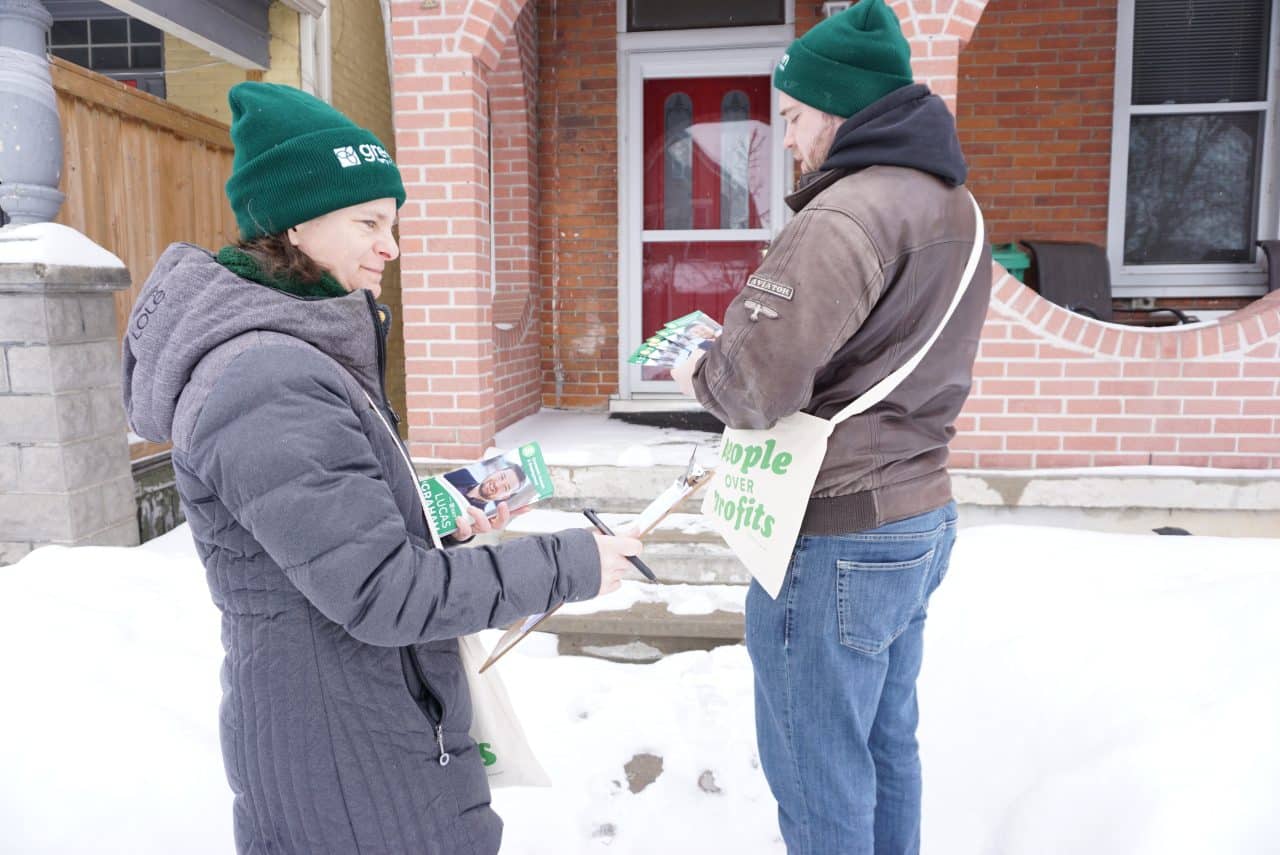
Green Party candidate Lucas Graham said he’s been door knocking for two-to-four hours every day, except when snowstorms are raging. It’s the most effective way for him “to get in front of real people,” he said as he campaigned on Bolivar Street recently.
“With social media you can get your message out there, but if you don’t have a huge budget behind it, it’s not going to compete as well with some of the other [campaigns],” he said.
First-time Green Party volunteer Emmalea Davis, 39, said she was “a little afraid” people wouldn’t be receptive when she started door knocking, but many seemed eager to talk, she said.
She’s voted strategically in the past, but not this time. “I think I’m probably just going to go with the [party] that I agree with the most, and we’ll see what happens,” she said.
The vision for Ontario laid out in the Green Party platform is exactly the kind of province she wants to live in, she said. By contrast, she said she finds “Ford really demoralizing.”
“I don’t want four more years of that,” she said.
Local Green Party volunteer Dara Kennedy has run across some voters who think the party is “just about the environment” and wants to take away people’s cars, she said.
But the Ontario Greens were the first major party to release a fully-costed platform in this election, and the 60-page document doesn’t only include green initiatives.
Kennedy said the party has a lot to offer on housing affordability, for instance, a key issue volunteers are hearing about on people’s doorsteps. She pointed to the party’s pledge to bring back rent control for existing apartment units that were made exempt by the Ford government and all units built in the future.
Kennedy, who has worked on Green Party campaigns in Peterborough since 2016, said her hope for this election is to “hold Ford to a minority government.”
“If the Liberals can do well and the NDP can do well, and [the Greens] can add a few seats, I think we can do that,” she said. “Then we can really stop them from some of their craziest ideas, like building a tunnel under the 401.”
With files from Alex Karn.
Author

Related Articles

“A very important election”: Peterborough voters say casting a ballot has never been more critical
U.S. threats are top of mind in this election, but other important issues are being overshadowed, local voters say

What’s at stake for Peterborough in this week’s provincial election
A guide to some of the key provincial issues facing Peterborough — and what the major parties are saying they’ll do about them

Social assistance rates deemed “wildly insufficient” as United Way releases income inadequacy report
Living wage for Peterborough now pegged at $20.60 an hour
