
Everything Peterborough’s mayor-elect Michael Eamon proposed on the campaign trail
70+ policy proposals, promises, and positions from Peterborough’s new mayor
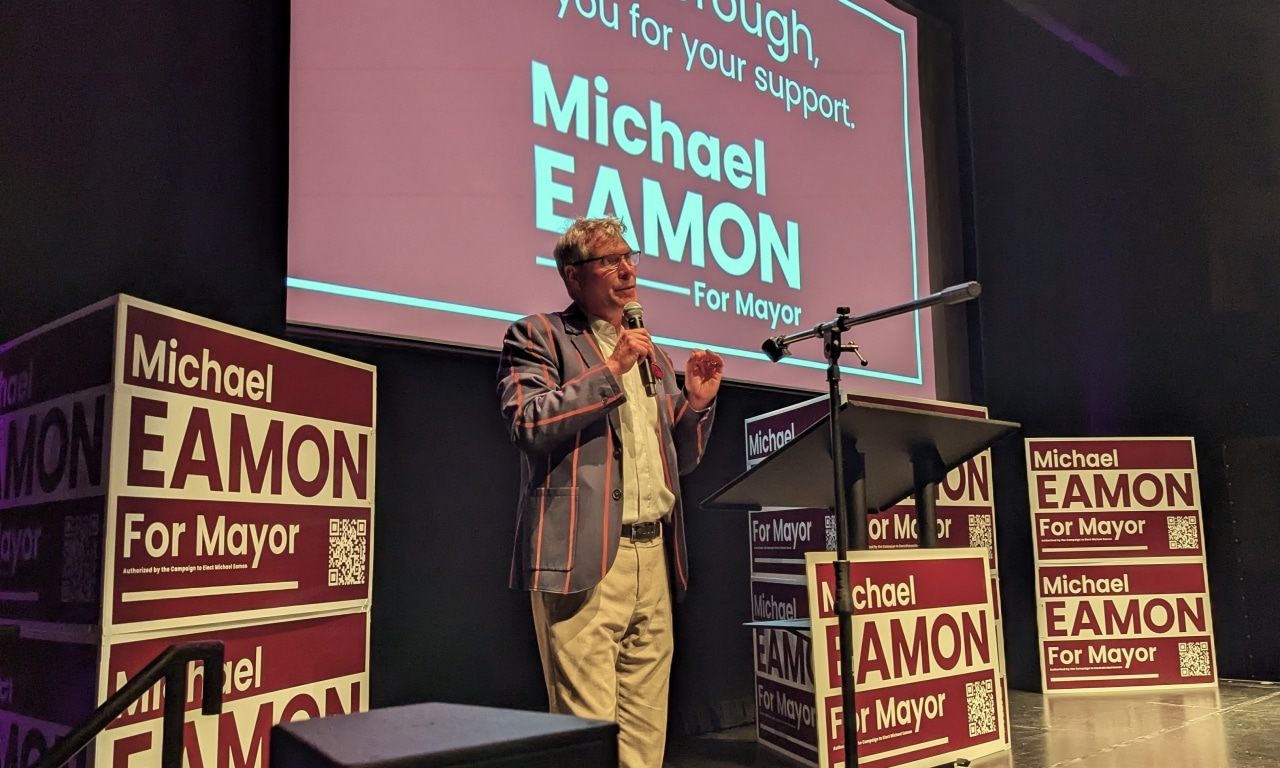
Peterborough elected a new mayor last week. Michael Eamon brings a long history in management and public service, working both with the federal government and as principal of Trent University’s Traill College (a position he will leave to take on the mayor’s office). However, he’s a newcomer to City Hall, never having held elected office, making him a bit of an unknown to many in the community.
Thankfully, before his election night victory came almost a full six months of campaigning, promises, and policy proposals. Eamon has made dozens of policy statements, and those may provide insight into what the next four years will look like.
In general, Eamon presents as a moderate: a “progressive centrist,” he told Trent Arthur[1], and “a team builder… mayor, not king,” he told KawarthaNOW[2]. When asked about his top priority as mayor, Eamon twice said “job creation,”[3,4] at another time said “infrastructure, large tax increases, and the issues of homelessness, mental health, addiction,”[1] and once that his mandate would be addressing “bureaucratic inertia.”[5] He’s also said he wants to be the “arts, culture, and heritage mayor”[6] and the “number one business ambassador.”[7]
On the campaign trail, he referenced “silos” at least a dozen times, as a way of discussing a lack of communication and integration between different departments and levels of government, as well as between government and other businesses and organizations in the community.
It’s no surprise that many of Eamon’s policy proposals start with a round of public consultations, conversations with stakeholders, or other forms of information-gathering before he picks a definitive course of action. Eamon has proposed at least six new committees and boards, multiple new reports and studies, and said that a “blue-ribbon panel” should be involved in all major government decisions going forward.
To delve a bit deeper, Peterborough Currents has looked through Eamon’s public statements, including quotes given to media, public surveys created by local organizations, mayoral debates, and Eamon’s own campaign website (which has since been archived), to offer a comprehensive list of policy proposals and position statements.
This information is presented without editorial comment and in Eamon’s own words wherever possible, with the intention of providing an introduction to the new mayor and a preview of what may be to come, as well as for posterity, to be able to look back on over the next four years.
In addition to his proposals, Eamon’s campaign website laid out a number of four-year plans with timelines and benchmarks for each of his four years as mayor. That information is presented in full, at the end of the article.
Economic development and job creation
Click to expand
Job creation is Eamon’s number one priority.
If I have to pick only one priority, it would be job creation because so much flows from that. More employment helps us tackle a number of challenges at once: the affordability crisis (including the cost of food, fuel and housing); social stability; a more diversified and expanded tax base to boost city revenues…. No mayor and council can create jobs, but they can establish an environment where employers flourish and hire more people, something crucial to Peterborough’s well-being.[3]
Eamon will establish a mayor’s committee on economic development.
The non-profit Peterborough Kawartha Economic Development was dismantled in 2024, but our need to work together on tourism and economic development is just as critical as ever. I wouldn’t return to PKED, but I would establish a mayor’s committee to bring key stakeholders together on a regular basis.[3]
Eamon identifies several sectors where Peterborough should be pursuing employers: agri-business, aviation, warehousing and supply chain management, environmental and electrical engineering, and high tech.
We need to enhance and grow upon our current strengths. Agri-business, aviation, warehousing and supply chain management, environmental and electrical engineering, high tech, should be pursued. In particular, we need blue-collar, entry-level jobs. We also need next-level positions to keep workers, and their families, in the region.[9]
Eamon will build bridges with the county and surrounding townships to establish a regional vision for economic development.
Building bridges with Peterborough County and Townships. Peterborough is not an island and we need to re-establish a regional vision for economic development. The city needs to work with surrounding Cavan-Monaghan, Otonabee South Monaghan and Selwyn townships to find mutually beneficial solutions to expand employment lands.[9]
Eamon will establish a Group of Seven economic development committee, with representatives from the region’s top seven public-sector employers.
Create the Group of Seven, a city-led Mayor’s Public Sector Council with the seven largest employers — the hospital, Trent University, Fleming College, the school boards, Ontario’s Ministry of Natural Resources and the city itself. These public-sector institutions have a lot in common. They have similar provincially mandated obligations to accessibility and service delivery. They all own land and have facilities that are maintained using public funds. This council would emphasize working together, sharing resources, and job creation.[4]
Eamon will create an Invest in Peterborough Summit for potential employers and investors, to take place every two years.
Support city staff creation of Invest in Peterborough Summit. This forum will invite key investors and potential industries to the region to connect with local businesses and discover opportunities.[4]
Other proposals related to jobs and the economy on Eamon’s campaign website include:
- Work with Trent University to bring industry to Cleantech Commons.
- Work with Peterborough Chamber of Commerce and the city’s Economic Development to develop a special program to foster small business.
- Encourage youth employment.
Taxes, budgets, and bureaucratic efficiency
Click to expand
Eamon’s first-day mandate will be to address bureaucratic inertia and inefficiency, working with the city’s Chief Administrative Officer (CAO).
On my first day, I will be establishing that key relationship with the CAO and telling him my mandate is to address bureaucratic inertia and to be looking for areas of ongoing budget savings. Working with the CAO, I am committed to reducing redundant processes, approval bottlenecks, communication and delegation breakdowns, and general overspending. Addressing internal communication issues and operational inefficiencies are key. Likewise, addressing the external communication issue with the County, and the resulting inefficiencies that exist, is also essential.[5]
Eamon’s goal is to bring the tax rate “closer” to the inflation rate.
Bringing the tax rate closer to the actual inflation rate is the goal. Admittedly, this will be no easy feat. Over the next four years, inflation is forecasted to be approximately two per cent a year. It is unreasonable, and potentially financially devastating to expect future tax increases to be below inflation. What the City must do is to clearly demonstrate to the public where their taxes are being spent and offer the highest level of accountability and transparency for that spending.[8]
At the beginning of each year, Eamon will set a budget cap for city spending.
The mayor and council need to set a budget cap at the beginning of each year. This would take into account any scheduled or fixed increases such as salary. Staff would then be asked to work within the cap, highlighting priorities that need the most attention.[8]
By 2028, this budget cap will be set to the rate of inflation.
Set budget cap to the rate of inflation at the start of the [2028] budget cycle.[4]
Eamon will use the Effectiveness and Efficiency Review commissioned by the City earlier this year as a starting point for finding efficiencies.
Examine thoroughly the results and recommendations of the city’s Effectiveness and Efficiency Review. This report, costing $350,000, cannot be shelved. It must be used as the starting point to ensure financial accountability, transparency, clearer reporting structures and more effective public service.[4]
However, Eamon disagrees with several of the recommendations.
The question is, do you like any of them? Which ones would you implement? Which ones would you not? Most of them, I think if they are implementable, they’re going to hurt. We’re going to be penny-wise but pound-foolish with this community. We can’t get rid of snow removal entirely. We can’t be charging people for the zoo. We can’t be charging people for archival services. These are things that don’t make sense.o ensure financial accountability, transparency, clearer reporting structures and more effective public service.[7]
Eamon doesn’t discount the possibility that the process of finding efficiencies may include job losses at City Hall.
We have to look at higher administration and management. We need to make sure the silos we have there are removed. We need to remove some of the higher administrative positions or rejig them in a way that is more cost efficient.[7]
However, Eamon says the first step is to “empower” city staff.
Should we get rid of city staff? Well, we have a lot of great city staff who feel that they’re not empowered, and so I think that’s the first thing. Let’s empower city staff to do what’s right.[6]
Eamon also clarifies he will not use strong mayor powers to dismiss city staff.
Mike will reject the use of strong mayor powers to dismiss city staff without agreement of council.[4]
Other budget-related proposals listed on Eamon’s website include:
- Explore alternate revenue generation streams, including expanding the parking permit system.
- Direct any surplus funds in reserve accounts and unspent funds from all departments towards housing and infrastructure.
- Ensure city has moved to zero-based budgeting (where every expense is reviewed and justified).
- Review all current user fees and fines, including Administrative Monetary Penalty System (AMPS).
- Review Service Peterborough models.
- Assign a designated officer in each city department to improve public service and inter-departmental communications.
- Host community round table on taxes and spending in 2030.
Democracy, council culture, and strong mayor powers
Click to expand
Eamon will insist on “greater civility” from city council.
I would insist on greater civility from council. Industry and commerce — both new and existing — must be assured that the city’s leaders are pulling together to put Peterborough’s well-being first, instead of projecting a discouraging image of a city and council divided.[3]
Eamon believes that city council should set the direction and staff should follow it.
Council is supposed to set the direction — set the vision — of where we’re going and then leave it to staff, who are the experts, to put together a right path forward. if council doesn’t agree with that path, then it’s council’s role to say ‘Take it back and work on it again, but here’s the vision.'[2]
Eamon will establish a “spirit of openness” at City Hall.
I would like to establish what I am calling a Spirit of Openness at city hall, which means ensuring that documentation on operations is easily accessible to the public. Primarily, I would like to see public online dashboards created for every city department. These dashboards would clearly indicate each department’s budget, planned and underway initiatives, and offer key performance indicators (KPIs) to ensure that the goals are being met. These areas would servea secondary purpose of being a portal that would link the public to the core policy, procedural, and budget documents that govern each department.[5]
Eamon will improve public communication and participation.
We need much better public communication and participation in planning processes. Recent missteps and shifting information have eroded public trust. So documenting city operations must be much more transparent. Citizens should have access to not only the decisions of council, but to real costs of operations which will, in turn, better inform subsequent consultations.[3]
Eamon will form “blue ribbon panels” of local experts to consult on all major city programs and developments.
Peterborough has a wealth of citizen expertise going untapped. During canvassing, I met people who were formerly directors, presidents, assistant deputy ministers of major corporations or government departments across the province and the country. For all of this city’s major programs and developments, we need to have blue ribbon panels of homegrown professionals who are not only subject matter experts, but can frame it through their own experience living in Peterborough.[5]
Eamon has repeatedly called strong mayor powers “undemocratic” and “authoritarian” and says he would never use them to overturn council’s wishes.
The problem of strong mayor powers is they’re fundamentally anti-democratic. They’re authoritarian. They are the hammer to push things through when all votes fail. And I think that if I’d ever have to do that, that’s a mark of failure as a leader…. I’d never use them to intimidate or threaten or you know go against you know the will of council.[1]
Eamon acknowledges that there are legislative procedures that require the use of strong mayor powers, and he would follow those.
There are elements of Strong Mayor legislation that might benefit the city without affecting the democratic process. For example, any budget approved before January is automatically deemed a “strong mayor budget” even if it received unanimous consent from council. Passing budgets early can result in cost savings for the city, in getting tenders out sooner, potentially securing better prices for services, etc. In this case, I would consider exercising this strong mayor power.[5]
Homelessness
Click to expand
Eamon’s first action on homelessness will be to conduct a gap analysis on the shelter, housing, and treatment system.
Working with council, I would first commission a review (gap analysis) of the entire shelter, housing and treatment system. It will look at all organizations and levels of government involved., finding both the successes and identifying the key issues. With a complete overview of the system, a strategic plan will be created and implemented immediately.[15]
Eamon will establish a Mayor’s Committee on Housing and Wellbeing.
At the same time of the review, a Mayor’s Committee on Housing and Wellbeing will be created bringing together City, County, non-profit organizations, experts, business leaders and residents. They would be used to create a long-term plan and a co-ordinated sharing of resources. City staff, in consultation with the committee, will explore new treatment and shelter solutions. find ways to better support current programs and find new funding sources from the province and federal government.[15]
Eamon will establish clear public reporting on homelessness and addictions.
Clear, accessible public reporting on those experiencing homelessness for those suffering from mental health and addiction issues must be established.[15]
Eamon will work with public sector partners to find alternate shelter solutions.
We need a comprehensive sheltering system. We need to work with our public sector partners, and I’m talking about Fleming, Trent, the hospital, the MNR, the school boards. There are a lot of organizations that are being funded in whole or in part from the provincial government…. Why are there not spaces that fit the bill for sheltering with those organizations? Are those conversations not happening? Is there some sort of shared use agreements that could be done? I just feel we need to get a little more creative, open it up a little bit more, and try to find sheltering solutions.[1]
Eamon will establish a four-year winter homelessness strategy.
It is ludicrous that, year after year, it comes back to city council to say, “So what are we going to do this winter?” Winter happens every year. Part of the solution in this gap analysis is what will be our winter strategy for the next four years.[1]
Eamon will reduce homelessness by half by 2030.
I would love to see the number of homeless reduced in half in four years. Some people may say that’s not aggressive enough, but I think we have a lot of challenges to face to get there, but I’d love to see the numbers of homeless reduced in half.[1]
Eamon supports the ‘possible’ use of bylaws to remove tenting residents from public parks.
I would hate to displace people unless there is somewhere to put them, but the reality is there isn’t. There may be instances where you would have to displace people if they are negatively impacting upon the other people’s use and safety of the park… There is a possibility I would use [the bylaw] if people have to be evicted. It would be done in the most compassionate way possible.[1]
Eamon believes in a housing-first strategy.
So much can happen when people aren’t on the streets. They can start focusing on all sorts of other issues that they have: on healing, on finding employment, all those types of things. Housing first has to be a priority.[1]
Eamon doesn’t support the shelter system “as it stands.”
Your question was, would I support the current shelter system? Not as it stands, because I don’t think it meets all the holes that are there. I’m not saying get rid of the current system, but I’m saying, how are we going to fill those gaps?[1]
Other proposals listed on Eamon’s campaign website that are related to homelessness and addictions include:
- Review the Community Safety and Well-Being Plan.
- Explore new treatment and shelter solutions, and seek provincial and federal programs to fund them.
Housing
Click to expand
Eamon will focus on the “missing middle” of housing, including Additional Rental Units (ARUs), mixed-use, and multi-unit dwellings.
“There is already a ‘missing-middle’ housing plan that must continue and be expanded,” said Eamon. “Additional Rental Units (ARUs) are an important way to build capacity effectively and more cost-efficiently. ARUs can use existing utilities and services and increase housing capacity on a manageable scale. ARUs can offer young couples an attainable first home and can house someone who was once on the street. They are an important way to intensify existing spaces.”
He said the city also needs to ensure that new developments include more mixed-use and multi-unit dwellings.
“Across the city many adults are renting space in single-family dwellings. These homes were never intended for large numbers of adults and this situation has created several issues with property maintenance, parking, etc. Working with developers, the city must approve the types of housing that are actually needed,” he said.[16]
Eamon will follow the Official Plan’s recommendations for intensification, in the downtown and elsewhere.
The city’s Official Plan outlines where intensification should take place and these recommendations will help guide future decisions. I would like to encourage and expedite projects downtown; however, there are several other neighbourhoods that have been identified for intensification as well.[15]
Eamon will ensure all new subdivisions include an affordability component.
The mayor and council must also ensure that all new subdivisions have an affordable component of townhouse or apartment spaces. For the city’s part, a review of every property it owns must be undertaken and see where more Rent Geared to Income (RGI) and subsidized housing can be built pursuing provincial and federal funds.[15]
Eamon will prioritize housing for domestic violence victims and youth.
Housing — particularly for domestic violence victims and youth — must be made a priority.[8]
Eamon will undertake a workflow analysis to determine where the bottlenecks exist in the building permitting process.
A common complaint (from small homeowners to larger developers) is about how long it takes for permitting, inspections, and other provincially mandated aspects of the building process administered by the city. Delays create additional costs and slow down new home construction. A workflow analysis will be undertaken to identify common bottlenecks and issues encountered. Specific difficulties will be fixed and the process streamlined.[15]
When asked about renter protections, Eamon says that increasing the housing stock is the most important housing priority in the city.
Don’t get me wrong; it’s not that I don’t agree with renters’ protections, but I think we need more housing stock…. That is the challenge, and I think that’s where the city has to really put its focus…. I think would solve most of our problems if people had readily access to attainable, accessible homes.[1]
Eamon will work with the provincial and federal government to secure funding to build affordable housing.
As Mayor I will work with the provincial and federal government to secure the funding needed to increase the City’s supply of affordable housing. The City cannot work in a silo; it needs support from provincial and federal partners to meet its housing goals.[17]
Other housing-related proposals listed on Eamon’s website include:
- Conduct a review of current housing proposals to expedite permitting and inspections.
- Review all current Community Improvement Plans (CIPs) that relate to housing, and make changes to increase efficiency.
- Expand property-assisted loan programs to help with ARUs.
- Conduct a review of the city’s workflow to identify and fix bottlenecks that developers and builders encounter.
- Review city-owned buildings to identify opportunities for affordable housing.
- Set “aggressive targets” to reduce backlogs for rent-geared-to-income/subsidized housing.
Downtown
Click to expand
Eamon will create a Downtown Task Force to improve communication with the DBIA.
DBIA members need to be assured their levy is being effectively used and, likewise, city residents want to know their taxes are being well spent on a co-ordinated effort to elevate the downtown. My first action to address this would be to create a dedicated, inter-departmental Downtown Task Force focused on the downtown, reporting directly to CAO and mayor.[11]
Eamon will create a Mayor’s Committee of Downtown Stakeholders to improve downtown vitality.
I would create a Mayor’s Committee of Downtown Stakeholders to bring together business leaders, landlords, shelter and health-care workers, residents, and staff to encourage productive conversations and shared information. City staff will be asked to look at the implementation of concrete solutions to grow business, make the downtown more accessible and ensure a sense of safety, including:
A yearly report on the types of commerce and activity that exist downtown with market segmentation and other information that can be used to attract new businesses.
An acceleration of the Official Plan goal to “intensify” downtown with both residential and commercial development.[11]
Eamon will establish a Friends of Downtown association to foster new ideas to support the downtown.
Development of a “Friends of Downtown” association that, with the Downtown Task Force, gains residents’ support and fosters new ideas, such as a yearly ‘Spring Cleanup’ and other promotions.[9]
Eamon will work to increase densification in the downtown.
What happens in Peterborough is, a nice building burns and it becomes a parking lot, and it stays a parking lot for 30 years. Those parking lots need to become commercial and residential spaces… The mayor and city council need to make sure that whatever barriers are in the way of enhancing growth, get out of the way…. We need to have the downtown as a focus for growth, and I think that is going to be one of our key densification intensification areas.[1]
Eamon will bring new personnel to the downtown, including clean teams, police foot patrols, and roving mental health and addictions teams.
Expansion of ‘clean teams,’ re-establishment of police foot patrols, and re-establishment of roving mental health and addiction teams to ensure continued cleanliness, safety of downtown areas and wellness of residents.[9]
Eamon’s campaign website also includes the following downtown-related proposals:
- Undertake yearly market analyses of the downtown commerce and activity.
- Undertake a review of transit, accessibility, and pedestrian-safety concerns, and report back to Downtown First team.
- Develop a plan to increase accessibility in the downtown.
- Create a plan for dedicated zones to allow for busking, food trucks, etc.
- Create a city-sponsored Best of Peterborough Awards highlighting citizens and neighbourhoods.
Arts and culture
Click to expand
Eamon will take a regional perspective on the arts and work with partners.
We need a constructive, cooperative approach with the county that looks at this whole region as an arts region…. I would like to look at the downtown and engage the artists from the downtown…. We need to work together with philanthropy, with government, and with the city itself to build artists and build an artistic community together.[6]
Eamon supports arts and culture as an economic driver in the community, and wants it to be part of the city’s economic strategy.
We need to see arts and culture also through an economic lens, and see how does that fit into our larger plans – not just in the arts and culture portfolio or envelope, but across the whole city and in other city departments.[6]
Eamon supports stable funding for the arts from the city, including multi-year funding programs.
We need stable funding from the city because that funding begets other funding…. And we also need to offer stable funding over multiple years, so artists can rely on the money for the years to come.[6]
Eamon will focus the city on supporting smaller venues and performance spaces, besides the proposed $170-million Memorial Centre replacement.
Building and supporting facilities for arts and culture needs to be focused on equity and accessibility, not just volume, said Michael Eamon, citing the estimated $170-million downtown sport and event centre…. Instead, Eamon said he would focus on smaller projects, such as a stage at Del Crary Park and at Nicholls Oval Park for events such as Musicfest and the Peterborough Folk Festival, which are unique to Peterborough and accessible to all.[10]
County
Click to expand
Eamon will work with the county to reestablish a relationship of trust, working towards a regional vision for social and economic development.
In the first 100 days, initial overtures reestablishing a trusting relationship with the County must happen. All boats rise together and a regional perspective to social and economic growth is needed. This includes a new and comprehensive approach to employment and development lands, a regional outlook for economic growth, and renewed and open conversations about all of our shared public responsibilities.[5]
Eamon also mentions work with the county in the sections of this document about economic development, housing strategies, the arts, and climate change planning (all quoted elsewhere in this document).
Environment
Click to expand
Eamon believes that city council needs to look at all decisions through an environmental lens.
As a mayor and council, we need to promote the growth from below for environmental policies. What does that actually look like? … I believe that the council needs to look at all decisions through an environmental lens and that we need to be doing that as we move forward.[12]
Eamon believes the city should push to reach net-zero emissions by 2050 by adopting all seven Big Moves outlined in the Climate Change Action Plan 2.0 (CCAP).
From an environmental protection perspective, I believe that the city should push to reach net zero GHG before 2050 through the adoption of the seven big moves outlined in the CCAP 2.0. Where CCAP falls short in my mind is in its engagement of First Nation communities and with the greater Peterborough County.[13]
Eamon will bring the county into climate change planning.
The original [CCAP], 1.0, had the city and county in lockstep. The county is not in the new plan and I’d like to fix that.[14]
Eamon will work with educational institutions to encourage young people to join in on environmental stewardship.
We also need to be stewards of [park] spaces. I would encourage high school students, Trent students, Fleming students, I would encourage partnerships between the municipalities and these institutions to help foster that new generation of stewardship.[14]
Eamon will ensure the city has representation on the new conservation authority, after Otonabee Region Conservation Authority’s provincially mandated amalgamation.
I’m worried about city representation on what the new iteration of this will be and I will work hard to ensure the city is properly represented on whatever the new conservation authority is and that real conversations about watershed management happen.[14]
Eamon will consult with GE Vernova to find ways to remediate and redevelop the GE industrial lands.
In the official plan, GE is an area of intensification of specific focus for the city. We need to negotiate with GE Vernova. We need to find ways to use that space. We can’t have 20 acres like that fallow in the middle of our downtown…. There are ways you can negotiate deals, infrastructure deals with the province, and particularly the federal government in getting brownfield remediation. And that’s what we need to keep looking for: identify the brownfields, find a subdivision of something to put on that brownfield, and then get the money… to help fix and remediate those brownfields.[1]
Infrastructure and transportation
Click to expand
Eamon will create a four-year plan to address crumbling infrastructure.
Chronic underfunding of municipalities across the country has led to what is now being called Canada’s ‘infrastructure deficit.’… We need to create a targeted plan for the next four years to address infrastructure at high risk assessing both the likelihood of failure with the consequences of failure.[8]
Eamon will create new reserve funds for infrastructure repair.
To reduce the infrastructure deficit for the future we need to create municipal discretionary reserve funds, for the future repair and upkeep of specific buildings and types of critical infrastructure.[8]
Eamon supports Alto Rail and wants Peterborough to become a regional transportation hub.
I think Alto is a great opportunity… When Alto comes in, we will no doubt be Toronto’s third airport. And if you can get from Ottawa to here in 40 minutes, we’ll be Ottawa’s second airport. We are going to become a transportation hub, and we have to get ready.[7]
Following a review of public transit operations, Eamon wants to expand public transit and find ways to stop it from losing money.
I like the hub and spoke model…. I would like to see shorter times, more direct routes, and if that means a return to hub and spoke, let’s do that. Or if it means a hybrid where there are certain routes that are running directly but are not hub and spoke… A review of transit operations has to be one of the first and foremost things we look at…. Transit is a service provided to the public, and it’s not going to make money, but it should not be losing a lot of money, right?[1]
Multi-use arena
Click to expand
Eamon will put a “pause” on development of the new multi-use arena that’s planned to replace the Memorial Centre, and will improve transparency around plans.
“I’ve read the 2018 report. I get it: the Memorial Centre needs to be revitalized…. But what I propose is pushing pause. We need to figure out, mayor and council, what exactly has been embargoed? What are the plans? And then when we become well-versed with that, we need to tell the public…. Let’s the get the plans out there, let’s get the public informed, let’s hear what the public wants, and then let’s make them part of the vision and move forward, instead of having them on the sidelines. And let’s make sure we have a business plan and a well-thought-out way to finances this…. Pressing pause is not waiting 20 years, it’s waiting six months and making sure everything is in line.[7]
Eamon will integrate the plans for the new arena into wider downtown revitalization efforts.
I would also like to see as part of the plan a revitalization of Del Crary Park and marina, including the rebuilding of the stage. This is a great opportunity to build community, enhance the downtown and elevate sports, music, and all types of cultural performances.[11]
Eamon will hold a public consultation meeting about the new arena plan in early 2027.
If elected, Eamon said he would hold a public consultation process in early 2027 to weigh public opinion on the new facility alongside other priorities like housing and affordability…. “We need to know what the people of Peterborough really think about this project, and they need to have access to the same facts council has.”[18]
Eamon believes the OHL and Peterborough Petes’ needs are an important consideration in whether to replace the arena.
“The OHL and the Petes should be important partners in that process, and I would welcome a constructive dialogue with both. At the same time, Peterborough needs to consider the full range of options rather than approach the decision as though there is only one possible path forward,” said Eamon.
“I would work with the Petes, the OHL, other potential facility users and the community to find a solution that protects the future of major junior hockey in Peterborough while being responsible to taxpayers and sustainable for the city over the long term.”[19]
Police
Click to expand
Following years of dramatic police budget increases, Eamon believes the police are now “right-sized.”
I think the police are right sized-now…. I think the police also were underfunded for many years. In recent years, they’ve tried to kind of crank it up to get some things that they need, both equipment and facility-wise, that has been missing…. They’re getting facilities that they should have. That’s great. But now they need to be mindful about the cost.[1]
Eamon wants more transparency and accountability in police matters, and questions the need for the closed-door meeting that Police Chief Stu Betts called with municipal candidates.
Quite frankly I don’t think it had to be closed.…. These are all things that are public knowledge, that we should all know about before becoming a candidate…. It created more issues than it had to be, and we need to reduce these kinds of in-camera meetings. We need to have more transparency and accountability.[7]
Social justice
Click to expand
Eamon will consult with the disability community on policies that affect them.
If public consultation is a part of a specific project or initiative, the City can help to ensure that the promotion, timing, location, and format of this consultation enables participation from persons with disabilities. This means acting in accordance with legislative requirements, but also listening to community members about what forms of engagement work best for them.[17]
Eamon will ensure implementation of key priorities in the City of Peterborough’s 2024-2028 Accessibility Plan and promote a more accessible city.
As Mayor, I will commit to ensuring that the key priorities outlined in [The City of Peterborough’s 2024-2028 Accessibility Plan] are implemented to the greatest extent possible. The City’s commitment to an “accessibility and inclusion lens” must become an integrated part of the work of Council, Senior leadership, staff, and volunteers. Through effective communication, and collaboration and consultation with community members and partners, the City can move closer to this reality…. I hope to promote a more accessible city that transcends regulation and leads to action where it is needed.[17]
Eamon will improve standards for Indigenous consultation at City Hall.
The city must move beyond Duty to Consult when dealing with Indigenous relations. I want to make sure that the city moves forward with the First Nations’ Consultation and Accommodation Standards and Archaeological protocol. I would like to see more Indigenization of city hall and appropriate training to staff.[13]
Eamon supports implementation of the Truth and Reconciliation Commission’s 94 Calls to Action and the Missing and Murdered Women and Girls 231 Calls for Justice.
I fully support the recommendations of the TRC (94 Calls to Action) and of MMWG (231 Calls for Justice). In particular, I would advocate for: TRC 57 – more training of city staff; TRC 66 — develop more youth programs with Indigenous focus; and TRC 79 – have the city expand its commemoration of Indigenous history and heritage. There are many ways the city can decolonize its operations in the spirit of the MMWG report, but specifically it needs to focus on MMWG 5.20 — child welfare supports; MMWG 5.24 — provision of resources for local victims and families; and MMWG 4.7 — remove barriers to shelter and housing.[13]
Eamon will end the pre-recorded land acknowledgement that’s currently played during city council meetings.
The recorded land acknowledgement that exists now in City Hall will go when I’m mayor, because it needs to be sincere, open, and come from the heart, not from a tape.[14]
Eamon has committed to reestablishing the Youth Committee and increasing youth engagement on other committees.[20]
Michael Eamon’s four-year timeline
Click to expand
On his campaign website, Michael Eamon laid out a four-year plan for many of his activities, with specific timelines and benchmarks for each of the four years of his term as mayor. Most of the website, including the policy pages, were removed after Eamon’s election, but all text below has been copied verbatim from an archived version of the site. Most of the programs listed have already been described above, but they are all included in full.[4]
2027
- Rebuild Peterborough’s relationship with the County of Peterborough and Cavan-Monaghan, Otonabee South Monaghan and Selwyn townships. A better relationship will lead to a holistic approach to our shared concerns, including employment and development lands, the airport, and essential shared services. Peterborough is not an island and we need to re-establish a regional vision for economic development.
- Create the Group of Seven, a city-led Mayor’s Public Sector Council with the seven largest employers — the hospital, Trent University, Fleming College, the school boards, Ontario’s Ministry of Natural Resources and the city itself. These public-sector institutions have a lot in common. They have similar provincially mandated obligations to accessibility and service delivery. They all own land and have facilities that are maintained using public funds. This council would emphasize working together, sharing resources, and job creation.
- Work specifically with Trent University to bring industry to city-serviced Cleantech Commons
- Ensure the new Economic Strategic Plan includes a regional perspective as well as the importance of intensifying the use of existing space and expanding Peterborough’s boundaries to attract new industry.
- Examine thoroughly the results and recommendations of the city’s Effectiveness and Efficiency Review. This report, costing $350,000, cannot be shelved. It must be used as the starting point to ensure financial accountability, transparency, clearer reporting structures and more effective public service.
- Set a four-year plan for moving property tax increases closer to rate of inflation (predicted by the Bank of Canada to be around 2%). Set a four-year spending vision as a guide for 2026-30 council term.
- Break down silos that prevent city departments from working together and address issues with service delivery.
- Review revenue generation, undertake new revenue generation activities, including expansion of parking permit system.
- Conduct an inventory of all municipal discretionary reserve accounts; direct surplus funds to infrastructure or housing renewal.
- Direct all departmental carryovers to infrastructure or housing renewal.
- Create a Mayor’s Advisory Committee on Housing with key stakeholders including non-profit organizations, the city, and private interests. Focus will be on frank and productive conversations about how to break current bottlenecks in the process.
- Renew the city’s focus on affordable apartment units. Continuing to create large, single-family dwellings will not solve our current housing crisis.
- Follow the city’s Official Plan guidance regarding where intensification should occur, focusing on downtown renewal.
- Review all current projects and expedite permitting and inspections, especially for non-profit builders.
- Review current Community Improvement Plans (CIPs) that are to foster housing. Evaluate effectiveness and use.
- Immediate review the entire shelter, housing, and treatment system. Find and support the successes; identify and fix gaps; have recommendations ready for next budget cycle.
- Create a Mayor’s Committee on Housing, Addiction and Wellness, bringing together the city, Peterborough Housing Corporation, non-profit organizations, health-care and housing experts, business leaders and residents. Create a long-term plan with shared metrics and real goals. Ensure that multiple avenues exist, meeting people where they are.
- Provide clear, accessible public reporting about those experiencing homelessness and the numbers of those who are finding housing or accessing treatment.
- Guide renewal process of Community Safety and Well-Being Plan and promote a holistic approach and better use of resources between the city and county.
- Set aggressive targets to reduce backlogs for rent-geared-to-income/subsidized housing as well as reduction in homeless by 2031.
- Usher in new Municipal Cultural Plan that supports growth of arts, heritage, culture, and sport.
- Act immediately on the results and recommendations of the city’s Efficiency Review — a study too important (and expensive) to be put on the shelf and collect dust.
- Immediately establish a key relationship with the CAO to outline mandate to address bureaucratic inertia and to be looking for areas of ongoing budget savings.
- Immediately work with council to form a collective vision for next four years and beyond. Create key priorities that will guide all policy decisions.
- Place emphasis on governance with city council; ensure decisions come from shared vision.
- Review procedural bylaws, open up public consultation, tighten up governance expectations for mayor and council.
- Ensure council stays in its lane in terms of setting vision and city policy. Council should steer the boat, not row it.
- Create a “spirit of openness,” including clearer and more frequent communications with the public, more accountability including public dashboards citing key goals, performance indicators and number of goals met, increase access to key public documents that detail governance decisions and finance.
- Create a dedicated, inter-departmental Downtown First team focused on the downtown, reporting directly to CAO and mayor. The task force will bring together all city departments that have responsibility for providing services in the downtown as well as the Downtown Business Improvement Area (DBIA). It will improve communications between the DBIA and city staff, as well as reduce red tape and ensure a rapid response to issues of maintenance, cleanliness, lighting, accessibility and safety.
- Create a Mayor’s Committee of Downtown Stakeholders to bring together business leaders, landlords, shelter and health-care workers, residents, and staff to encourage productive conversations and shared information.
- Expand the “clean team” program, re-establish police foot patrols, and re-establish roving mental health and addiction teams to ensure continued cleanliness, safety of downtown areas and wellness of residents.
- Bring back yearly market analysis of the types of commerce and activity that exist downtown with market segmentation and other information that can be used to attract new businesses.
- Work with council and staff to renew, expand, and promote the Community Improvement Plan (CIP) particularly addressing vacancy rates, facades, brownfields, and developing new residential spaces.
- Continue to move forward with the remediation and reuse of former industrial sites such as the General Electric property.
2028
- Support city staff creation of Invest in Peterborough Summit. This forum will invite key investors and potential industries to the region to connect with local businesses and discover opportunities. The city needs to play to our strengths in agri-business, aviation, warehousing and supply chain management, environmental and electrical engineering, and high tech. The goal is to foster new blue-collar, entry-level jobs. We also need to pursue next-level positions to keep workers, and their families, in the region.
- We cannot forget arts, culture and tourism. Not only do they create jobs directly, they are responsible for fostering the kind of environment new businesses find attractive for their own employees to live in. Pursue new venues for entertainment, the arts and sports, using creative and thoughtful approaches to funding. Look to the EC3, the Group of Seven, and other core stakeholders for support.
- Use statistics from renewed downtown business reporting (see Vibrant Downtowns, Vibrant Neighbourhoods) to drive new development downtown.
- Examine thoroughly the results and recommendations of the city’s Effectiveness and Efficiency Review. This report, costing $350,000, cannot be shelved. It must be used as the starting point to ensure financial accountability, transparency, clearer reporting structures and more effective public service.
- Set a four-year plan for moving property tax increases closer to rate of inflation (predicted by the Bank of Canada to be around 2%). Set a four-year spending vision as a guide for 2026-30 council term.
- Break down silos that prevent city departments from working together and address issues with service delivery.
- Review revenue generation, undertake new revenue generation activities, including expansion of parking permit system.
- Conduct an inventory of all municipal discretionary reserve accounts; direct surplus funds to infrastructure or housing renewal.
- Direct all departmental carryovers to infrastructure or housing renewal.
- Set budget cap to the rate of inflation at the start of the budget cycle.
- Ensure city has moved to zero-base budgeting.
- Keep tighter track of expenses. Review all current user fees and fines, including Administrative Monetary Penalty System (AMPS) ensure both fairness and efficiency in levying and in collection.
- Expand the property-assisted loan program to help with ARUs, make standard plans available as resources.
- Make necessary changes to CIPs to increase efficiency.
- Streamline the building process by reducing the time it takes homeowners and developers to get city permits, inspections and other provincially mandated requirements. Conduct an analysis of the city’s workflow to identify bottlenecks and other common issues builders encounter.
- Ensure that all new subdivisions have an affordable housing component of townhouse or apartment spaces.
- Explore new treatment and shelter solutions, including the development and operation of new treatment facilities, developing a vision and finding new federal and provincial funding options.
- Reinstitute downtown mental health and wellness teams to intervene as issues occur.
- Fight to eliminate waitlist for Special Priority housing (people experiencing domestic abuse or human trafficking, etc.).
- Remove permitting barriers at city hall; expedite all housing projects that have stalled.
- Aggressively pursue Additional Residential Units (ARUs) and other densification; expand property-assisted loan program to help with ARUs, make more standard plans are resources available.
- Ensure that city is on-track with Accessibility Plan, removing barriers to city spaces, and prepare groundwork for next five-year vision.
- Review existing Service Peterborough model and improve operations where necessary.
- Break down silos at all levels and encourage effective communication: among councillors, among city departments; among county and townships.
- All departments will have a designated officer to improve public service and inter-departmental communications.
- Create an overarching “public service” focus and empower and support city staff in their public service role.
- Ensure all service interactions between city and public have: clear expectations, clear timelines, and clear costs laid out in advance.
- Encourage opportunity over risk throughout city operations.
- Engage in more effective, genuine consultation with citizens —not surveys with leading questions.
- Develop a formalized blue-ribbon panel of local experts to be consulted on specific projects as required. We can harness the expertise of homegrown professionals who are not only subject matter experts in various fields, but who can frame solutions through their own experience living in Peterborough. This will reduce costly consultant fees and encouraged civic participation.
- Work with staff to accelerate the city’s Official Plan goal to “intensify” downtown with both residential and commercial development; work with landlords to address vacancy issues.
- Undertake a larger review of transit, accessibility, pedestrian-safety concerns. Report to Downtown First team for immediate repair and improvement.
- Develop a plan to increase accessibility through universal design, including sidewalks, approaches, and lighting; removal of paid-parking in certain areas, elimination of restrictive loading zones for merchants; and any other barriers to access for both visitors and merchants in the downtown.
- A plan for dedicated zones and easily-attainable permits to allow more busking, food trucks, and other activities that enhance both culture and commerce.
- We cannot forget arts, culture and tourism. Not only do they create jobs directly, they are responsible for fostering the kind of environment new businesses find attractive for their own employees to live in. Pursue new venues for entertainment, the arts and sports, using creative and thoughtful approaches to funding.
- Work with Economic Development, DBIA, and Chamber of Commerce to review market analysis of downtown and promote new businesses.
2029
- Work with the Peterborough Chamber of Commerce and other key players, the city’s Economic Development department to create a special program focusing on fostering small businesses.
- Encourage more youth employment, including internships to address low youth employment rate and foster workplace education.
- Revisit Efficiency Review to verify all the issues identified have been addressed.
- Assess effectiveness of service changes; address gaps; correct errors.
- Review every property owned by the City of Peterborough with an eye on using underutilized properties for rent-geared-to-income units and more subsidized housing. Pursue federal and provincial funding to build these new homes.
- Explore creative solutions to maximize use of current housing stock, i.e. city-led programs to pair seniors with students or young professionals to reduce the number of people living precariously or unhoused and expand home supports.
- Explore creative solutions to maximize use of current housing stock, i.e. city-led programs to pair seniors with students or young professionals to reduce unhoused and expand home supports.
- Host community consultations on current state of housing, treatment, and wellness. Review what is and what isn’t working.
- Develop a “Friends of Downtown” association to gain residents’ support and foster new ideas, such as a yearly “Spring Cleanup” and other promotions with City and DBIA.
- Create Friends associations in all other wards (Otonabee, Monaghan, Ashburnham and Northcrest). Establish a program of city-led commercial tours of downtown and various wards aimed specifically at residents to promote the exploration of vibrant areas across the city.
2030
- Work with city staff to host a second Invest in Peterborough Summit building upon work over the past three years in Economic Development, incubating small businesses, and expanding upon new and traditional strengths.
- Undertake community round table on taxes and spending; are residents feeling that the city is more accountable?
- Review 2031 housing targets; lay groundwork for next four-year targets.
- Revisit housing and homelessness targets; find if we are on track for 2031; find solutions to overcome gaps.
- Publish community update on state of downtown as well as remediation and development of former industrial sites such as the GE. Hold public sessions on next steps.
- Create city-sponsored “Best of Peterborough” awards highlighting citizens and neighbourhoods that have been at the forefront of urban renewal.
- Review the Downtown First Team and the Committee of Downtown Stakeholders; fix any issues with structure or activities.
Works cited
Click to expand
- “Arthur Votes 2026: Michael Eamon.” Ian Vansegbrook, Trent Arthur (podcast), October 5, 2026.
- ‘We need somebody who’s mayor, not king’: Dr. Michael Eamon joins Peterborough’s mayoral race.” Paul Rellinger, KawarthaNOW, May 1, 2026.
- “Peterborough Election 2026: Mayoral Candidate Michael Eamon.” Metroland Staff, The Peterborough Examiner, June 17, 2026.
- Michael Eamon campaign website. Accessed October 17, 2026 (now archived).
- “Peterborough’s mayoral candidates outline their approaches to leadership and accountability.” Bethan Bates, KawarthaNOW, October 9, 2026.
- Artsvote Peterborough 2026. Accessed via Trent Radio recording by Eddy Sweeney, September 23, 2026.
- yourTV PTBO Mayors Debate. YourTV Peterborough, October 7, 2026.
- “Peterborough’s mayoral candidates share their approaches to taxes, services, and infrastructure.” Bethan Bates, KawarthaNOW, October 3, 2026.
- “Peterborough’s mayoral candidates outline their plans for jobs, business growth, and downtown renewal.” Bethan Bates, KawarthaNOW, September 21, 2026.
- “Peterborough mayoral candidates have their say on social issues at Wednesday evening debate.” Sebastian Johnston-Lindsay, The Peterborough Examiner, October 8, 2026.
- “DBIA Candidate Survey.” Downtown Business Improvement Area, October19, 2026.
- “Peterborough mayoral candidates talk climate change during Tuesday debate.” Joelle Kovach, The Peterborough Examiner, October 7, 2026.
- “Environment, Planning and Indigenous Relations Survey.” Reimagine Peterborough, October 20, 2026.
- “4RG: Meet the New Mayor.” For Our Grandchildren, October 6, 2026.
- “How will Peterborough’s next mayor tackle housing affordability and homelessness?” Bethan Bates, KawarthaNOW, September 25, 2026.
- “Peterborough mayoral candidates outline plans to tackle affordable housing crisis.” Mike Davies, The Peterborough Examiner, October 17, 2026.
- “2026 Municipal Elections.” Heads Up for Inclusion, October 13, 2026.
- “Where Peterborough’s 7 mayoral candidates stand on new downtown arena plan.” Mike Davies, The Peterborough Examiner, September 26, 2026.
- “‘Losing them would be devastating’: Mayoral candidates grapple with Petes survival and hefty bill for new rink.” Mike Davies, The Peterborough Examiner, September 29, 2026.
- “2026 Municipal Election Social Issues Debate.” Research for Social Change Lab, October 20, 2026.
Author
Related Articles
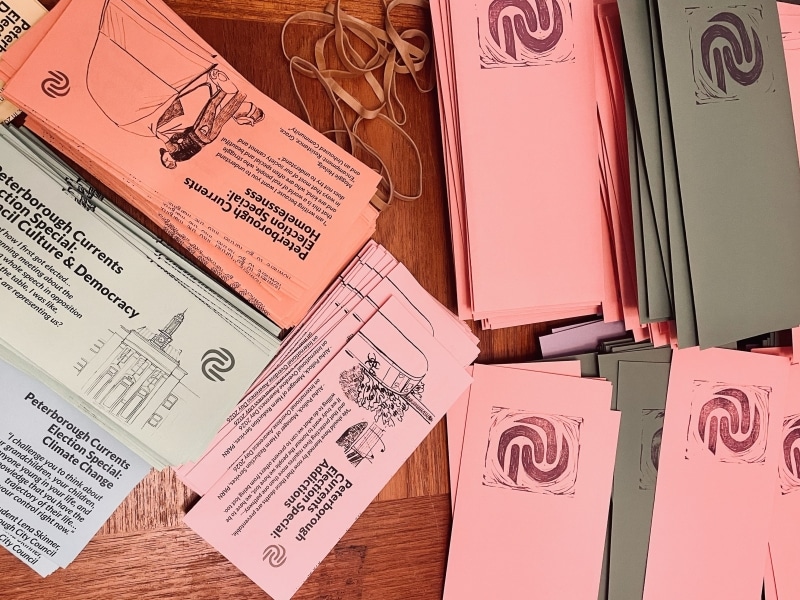
Peterborough Currents Election Special zines
New series of five print zines explore the essential issues this municipal election
Riel commits to investing in buses
Would support Transportation Master Plan as mayor, despite uneven record as councillor

“A very important election”: Peterborough voters say casting a ballot has never been more critical
U.S. threats are top of mind in this election, but other important issues are being overshadowed, local voters say
