
This million-dollar property is taxed as if it’s worth $200K. Is that fair?
After its former factory was razed, the assessed value of 375 Aylmer Street dropped by 80 percent, leading to a drop in its owner’s tax bill

One of the biggest privately owned lots and development opportunities in downtown Peterborough is expected to be listed for sale soon. The owner of 375 Aylmer Street — site of the former Baskin Robbins factory — told Peterborough Currents last week that he intends to put the property up for sale any day now.
Owner Don MacPherson didn’t say what the listing price will be, but the property last sold for $1.15 million in 2012, according to land transfer records obtained by Currents.
Here’s a deal sweetener for any potential purchaser: the property’s assessed value is a mere $188,000, meaning its annual property tax bill is about equal to that of a higher-end single family home elsewhere in the city.
In 2024, the city charged MacPherson’s company $5,882 in property taxes, according to taxation information publicly available at city hall. Meanwhile, the much smaller property right next door — where Jim’s Pizza and Pasta is located — was billed $10,942 in property taxes in 2024. (Currents was unable to reach the owner of Jim’s Pizza for comment.)
Why is the tax bill on a million-dollar property in the downtown core about the same as that of a single family home? It has to do with that $188,000 property assessment.
Property taxes are calculated based on a property’s assessed value. The higher that value, the more tax a property owner pays. In Ontario, assessment values are determined by an independent non-profit agency called the Municipal Property Assessment Corporation, or MPAC. According to provincial legislation, MPAC’s assessment of a property is supposed to be “based on its current value.” But that doesn’t always work out in practice.
MacPherson, a local developer, didn’t appear to be aware of his property’s MPAC assessment when Currents called him last week. He chuckled for a few seconds after hearing it was $188,000. “Are you kidding?” he asked. “It’s worth about a dollar more,” he joked.
MacPherson wouldn’t comment on whether his property’s tax bill is fair or not, saying he doesn’t pay the bills himself. “I don’t pay any attention to it,” he said. “Somebody else handles that all for me.”
Property’s assessed value decreased after factory demolition
The Baskin Robbins property wasn’t always assessed so low. Prior to 2020, its assessed value was $978,000 — much closer to the $1.15 million it cost to purchase in 2012.
But around five years ago, the old Baskin Robbins factory was demolished, and that changed the property’s assessment. “A property’s assessed value can change when a physical change is made to the property,” a spokesperson for MPAC wrote to Currents in an email. When buildings are demolished, MPAC is notified and “updates [its] records to reflect the new state and condition of the property,” the spokesperson wrote.
MPAC reassessed the property in 2020 after the factory was demolished and pegged the new value of 375 Aylmer Street at $188,000. Just like that, MacPherson’s tax bill dropped by more than $10,000 per year.
Peterborough’s own tax policies don’t give preferential treatment to vacant properties — council did away with the city’s vacant property tax discount in 2021. But the city doesn’t control MPAC assessments. “The City isn’t involved in the determination of assessments or tax classes, so the City cannot provide a comment on these for any specific properties,” a spokesperson wrote by email.
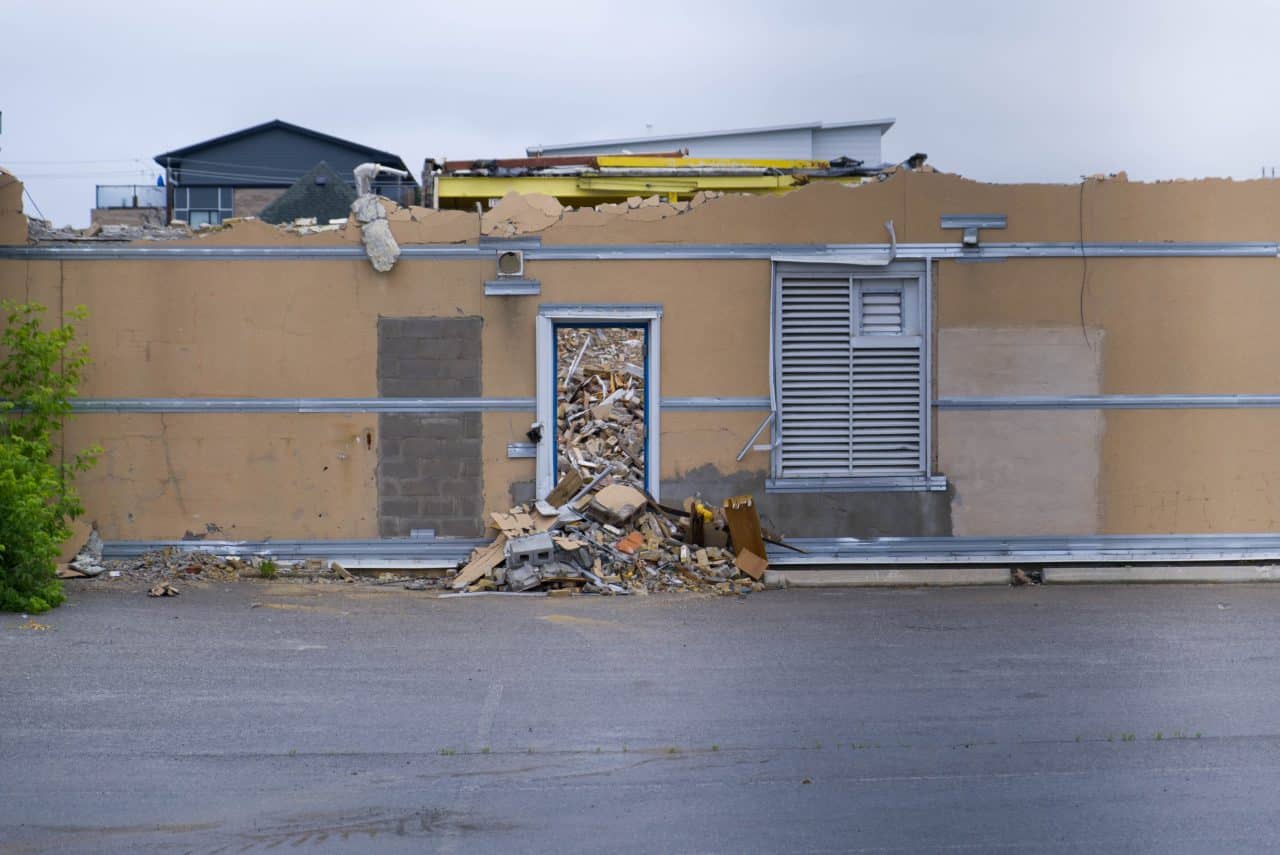
Today, 375 Aylmer Street remains a big empty pit in the middle of downtown. MacPherson told the Peterborough Examiner in 2021 that he would not develop it if a supervised drug consumption and treatment site opened across the street, which happened in 2022. Nonetheless, MacPherson’s company went ahead with efforts to rezone the former industrial land and succeeded in opening it up for future residential and commercial development, as the Examiner first reported.
MacPherson told Currents on March 13, 2025 that the property would be listed for sale the next day. (That doesn’t appear to have happened.)
Harry Kitchen, professor emeritus of economics at Trent University, said the property’s assessment was “surprising” to him. “Assessment is supposed to be about equal to the market value of a property,” he said.
If a property is underassessed, that means it’s also undertaxed, Kitchen pointed out. And that impacts every taxpayer in the city.
“If you’re undertaxing … a certain piece of property, then obviously you have to make money up somewhere else, so you’re going to be overtaxing somebody else,” Kitchen said.
MPAC assessments frozen at 2016 valuations, creating tax “distortions” that experts call “inequitable”
When asked whether his property might be underassessed, MacPherson said that MPAC assessments are low “throughout the city” because they’re based on outdated valuations.
That’s true. MPAC is supposed to update its assessments province-wide on a four-year cycle, but the reassessment on all properties scheduled for 2020 was postponed by the province during the COVID-19 pandemic and has never been rescheduled. That means property owners continue to be taxed according to their 2016 assessments, except in cases where a significant change like a demolition or new construction triggers a reassessment. But even in those cases, MPAC reassesses the property according to 2016 valuations. So MPAC’s assessment of 375 Aylmer Street means the agency believes the property would have been worth $188,000 in 2016, if the factory had been demolished at that time.
Most properties in Peterborough have seen their market values go up dramatically since 2016, so it’s not uncommon for a property’s assessed value to be a lot lower than its market value.
But tax experts say not every property has appreciated at the same rate since 2016, and so the assessment freeze is benefiting the owners of properties that have appreciated more quickly — to the detriment of those whose properties have appreciated more slowly.
Robert Brazzell, managing director of property tax services for Colliers Canada, said the MPAC assessment freeze has created “a variety of distortions” in Ontario property taxation.
“Reassessments are meant to redistribute the tax based on value, and that just hasn’t happened,” Brazzell said. “That’s inherently inequitable.”
Currents asked provincial officials why Ontario was relying on outdated assessments.
“Our government does not support raising taxes or fees on the people of Ontario,” responded Colin Blachar, a spokesperson for Ontario’s Minister of Finance, Peter Bethlenfalvy. “The ministry continues to conduct a review of the property assessment and taxation system, focusing on affordability, and business competitiveness, as well as exploring modernized administration tools to support municipalities with assessment base management.”
Raymond Williams, the chair of tax policy for the Ontario chapter of the Canadian Property Tax Association, said “there’s a bit of a misconception out there” that higher property assessments will necessarily lead to higher taxes.
In fact, MPAC assessments are “revenue-neutral” for municipalities, he said. For every tax increase facing one property owner as a result of a reassessment, there’s a corresponding tax decrease for another property owner, Williams said. That’s because assessment values don’t determine how much tax revenue a municipality generates, they only determine how the tax burden is divided up among property owners.
If and when MPAC performs a province-wide reassessment, properties that have appreciated faster than the city-wide average will see their share of the tax burden go up. Those that have appreciated at the average rate will see their share stay the same. And those that appreciated slower than the average will actually see their share of the tax burden go down, even though their assessments have increased.
Williams called the property reassessment process “a redistribution of that tax burden to a more equitable level.” The end result will be “the shifting of the tax burden to the affluent properties,” he said.
Williams said large industrial sites are an example of a property class that has grown in value faster than other property classes in recent years. As a result, those properties are “not paying a burden relative to their value.” On the flip side, he said single-family homes are an example of a property class that has been overburdened with taxes relative to their value since 2016.
Peterborough-Kawartha MPP Dave Smith did not respond to a request for comment.
“Not fair at all for Jim”

As of publication time, it doesn’t appear that 375 Aylmer Street has been listed for sale as MacPherson said it would be.
Passersby on Monday evening weighed in on the long-vacant property.
Two recently arrived international students walked by and pointed at the litter on the property and said they were surprised at how dirty Peterborough is — they thought the city would be different when they moved here a few months ago. “It’s not looking good,” one of them said. “It should be cleaner.”
A man who gave only the name Brian agreed that the site should be cleaned up. He said he doesn’t care what happens to the property, as long as it’s used for something. “Anything’s better than a pit,” he said. Currents asked Brian to guess whether the owner of 375 Aylmer or the owner of the Jim’s Pizza property paid more in property taxes. “Probably the owner of the pit,” Brian said, “because it’s a bigger lot.”
“It’s definitely an eyesore,” said Taylor Green. “It would be nice if they turned it into green space or something useful for the people of downtown.”
Green also guessed that the owner of the big empty lot would pay more in property taxes than the owner of the Jim’s Pizza property, based on the relative size of the lots. Currents told him it was the other way around. “That’s not fair at all for Jim,” Green said. “That seems backwards.”
Update: This article was updated on March 20, 2025 to clarify that the commercial property with a $188,000 assessment pays about as much property tax as a higher-end single family home in Peterborough, not a typical single-family home.
Author

Related Articles

Alderville First Nation grants legal personhood to Rice Lake
Exploring an alternate solution to climate change, and a growing international movement

Promoting preparedness in East City
A grassroots movement aims to help neighbours out in the next big storm