
Police chief faces criticisms over big budget ask
The Peterborough Police Service needs millions more next year, Chief Stuart Betts told citizens at a town hall on September 19

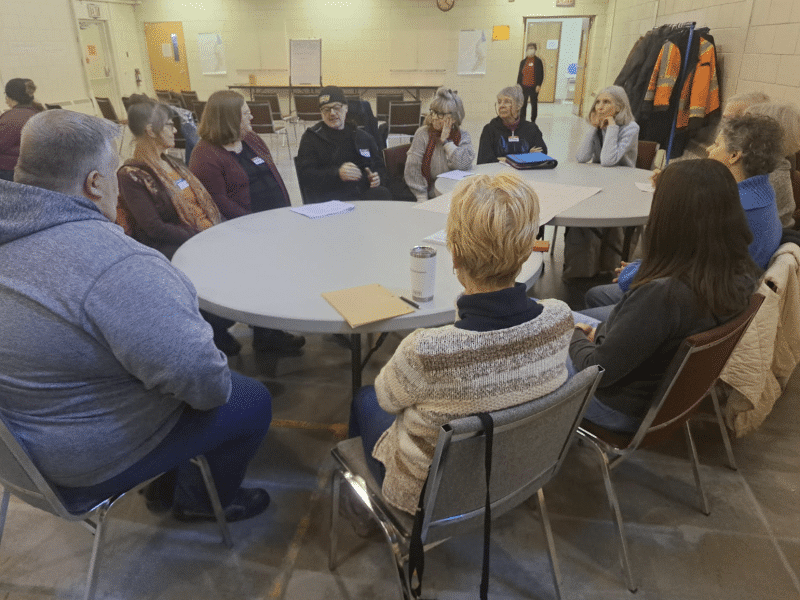
Peterborough’s Chief of Police Stuart Betts was the target of complaints and criticisms at a public meeting on Thursday where he shared that the force will ask taxpayers for another big budget increase in 2025.
“I’m going to ask you for a lot of money, and I think you would want to know what I’m doing with it,” Betts told citizens who had gathered for a town hall meeting about the police budget in advance of municipal budget deliberations this fall. The force needs at least $2.7 million more next year to maintain its status quo operations, according to Betts’ presentation.
Betts held the meeting on September 19 to explain the pressures facing Peterborough’s police officers, who responded to more calls in 2023 compared to 2022, despite reported crime rates falling over the same period. He also explained how the police service will spend its money in 2025.
But attendees appeared to grow weary of Betts’ prepared remarks before he finished. “No one cares about your presentation!” one audience member asserted as citizens started interrupting to express frustrations with the local police force.
Peterborough lawyer and former city councillor Ann Farquharson called last year’s 15.3 percent police budget increase “exorbitant” and “unacceptable” and told Betts that many people in the community won’t be able to afford another increase like that. “You’re going to have to go back to reality,” Farquharson said.
Farquharson said that increased police spending “does not lead to less crime” and that investing in social services would be a more effective way to reduce criminal activity.
“I don’t disagree that we should invest in the social safety net,” Betts responded.
Other community members argued for tougher enforcement against people who use drugs in public, drive recklessly, and commit thefts. These speakers appeared no less upset by the proposed budget increase.
“You want more money?” one attendee asked. The force should first prove that they’ll do what they’re supposed to do, stated the attendee, who expressed a frustration that police weren’t charging people who use drugs in public more often.
“Do your job!” shouted another attendee.
Ashburnham ward Councillor Gary Baldwin told Currents he wasn’t surprised by the confrontational tone of the meeting.
“Since COVID, people seem to be angrier,” said Baldwin, who sits on the police services board. “Their expectations are more than we can deliver.”
Chief sings praises of two new initiaitives
Chief Betts said he was grateful for the budget increase approved by city council last year, and pointed to two new initiatives to show how the force has used the extra money.
First, he spoke about the police service’s “no tolerance” approach to open air drug use, which Betts ushered in last October. Called the Safer Public Spaces initiative, the new policy empowers police officers to stop people who are using illegal drugs in public and order them to move elsewhere.
Officers have responded to 497 open drug use calls under the new initiative, according to Betts’ presentation. Tips from citizens are what initiate most of the calls, and 92 of the calls were to the Trinity Community Centre or an adjacent intersection.
Betts said the intention of the Safer Public Spaces initiative is not to criminalize or arrest drug users, but to give them “the opportunity to move along” somewhere else. However the initiative has led to 19 arrests of people who were wanted for unrelated reasons, Betts said.
One attendee said the Safer Public Spaces initiative just pushes “the problem down somewhere else on the street” and asked Betts to reconsider it out of compassion for drug users. Betts said no, he was “absolutely” continuing the initiative.
Secondly, Betts spoke about the new Community FIRST property crime unit, which investigates what he described as “low-dollar value, high frequency, maximum aggravation types of crimes.”
The unit, which was launched in January, consists of four full-time officers who focus exclusively on these types of property crimes, he said.
In February, Mayor Jeff Leal called the early results of Community FIRST “a very tangible return” on the city’s investment in policing, according to the Peterborough Examiner.
As of August 31, the team had recovered $31,414 worth of stolen property and 112 shopping carts, according to Betts. The most common type of crime the Community FIRST team responds to is shoplifting, he said.
One member of the Community FIRST unit is currently suspended with pay after being criminally charged with two counts of breach of trust and one count of the possession of stolen property, according to the Peterborough Examiner. The charges have not been proven and the officer, Mackenzie Rogers, is expected in court early next month.

Farquharson criticized the Community FIRST initiative at the town hall meeting. She estimated that the four officers on the team each cost about $150,000 annually to employ, which Betts agreed was accurate.
“So we’re spending over $600,000 to recover $31,000 in stolen property?” Farquharson asked. That doesn’t seem to be very cost-effective, she added.
Betts responded that he can appreciate that argument — when it’s coming from people who haven’t experienced those crimes. He said local businesses don’t deserve to be the victims of property crimes.
“When our downtown businesses say, or our other businesses say, ‘I can’t afford this. What are you doing?’ We have to do something,” Betts said.
Baldwin called Farquharson’s criticism of Community FIRST “a little unfair.” He said small, petty crimes “are the things that affect a lot of small business owners and homeowners directly.”
After the meeting, Farquharson told Currents that she has been the victim of a property crime, but still thinks the police need to focus on other priorities. She said she’s concerned about intimate partner violence in Peterborough, and that she’d like to see the Community FIRST money go toward investigating those types of crimes instead.
“I think most citizens of Peterborough would consider [intimate partner violence] to be a much more serious problem than property crimes,” Farquharson said.
Police require 7.7 percent budget increase to maintain status quo: Chief Betts
In his presentation, Betts explained why he thinks the police service needs another big budget increase in 2025.
He presented data that showed Peterborough’s police service receives less funding, per capita, than other comparable cities in Ontario. And he said that the Peterborough Police Service is in a “catch-up” phase after “more than a decade of some fairly austere years of budgeting here in the city with regard to police.”
Prior to 2024, police budget increases “were not keeping up with increased inflation and negotiated salary,” he said. “And if we’re not covering those costs, we’re shrinking your organization.”
Betts presented a chart of “unavoidable” new costs he expects to incur next year, most of which are related to staffing, including raises for officers and the annualization of new positions that were hired for midway through 2024. Eighty-nine percent of the police service’s budget is dedicated to staffing costs, according to Betts’ presentation.
Earlier this year, the Police Services Board agreed to a new collective agreement that committed to raises for non-senior officers that will total 16 percent over the next five years. In addition, officers with five years of service will be eligible for a “front line patrol premium” of one percent starting in 2025. The premium, which was not included in previous collective agreements, is for officers whose night shifts end after midnight and the premium will rise to three percent by 2027, the collective agreement states.
A first class constable’s base salary will rise to $116,015 in 2025 and it takes a little less than four years for a new recruit to reach that level, according to the collective agreement. Sergeants, staff sergeants and other senior officers make more.
Altogether, the force’s “unavoidable” new expenses will total $2.7 million next year, necessitating a 7.7 percent budget increase to cover them and maintain the status quo level of operations, according to Betts’ presentation.
But Betts presented other options that would require even bigger budget increases. For example, if the force received a $3.4 million budget boost, it could hire more staff such as additional mental health workers and an additional investigator, according to his presentation.
Betts called the $3.4 million scenario the “gold” option. If approved by city council, it would raise the municipal share of the police budget from $35 million to $38.4 million — an increase of 9.7 percent.
A 9.7 percent increase to the police budget would equate to a 1.6 percent increase to the property tax rate in 2025, or about $29 per $100,000 of assessed property value, according to Betts’ presentation.
The 2024 police budget increase — which councillors approved during budget deliberations last fall without any debate — added over $100 to the 2024 municipal tax bill for the median-assessed property. Baldwin called last year’s 15.3 percent increase “a course correction.”
In August, city staff advised council that property taxes would have to rise by about 10 percent in 2025 to maintain the city’s service levels — but that calculation assumed the police board would request its own increase of just 3 percent.
However, councillors directed staff to develop a budget that limited the property tax increase to 5 percent.
Peterborough’s Police Services Board has yet to formally make its 2025 budget request to city council. After it does, city councillors will consider the request during municipal budget deliberations in November.
Author

Related Articles

Alderville First Nation grants legal personhood to Rice Lake
Exploring an alternate solution to climate change, and a growing international movement
Promoting preparedness in East City
A grassroots movement aims to help neighbours out in the next big storm