
“Disappointing”: Peterborough moves away from traffic calming, despite data showing pilot projects led to reduced speeds
Councillors vote to study lowering speed limit to 40 km/hr city-wide instead

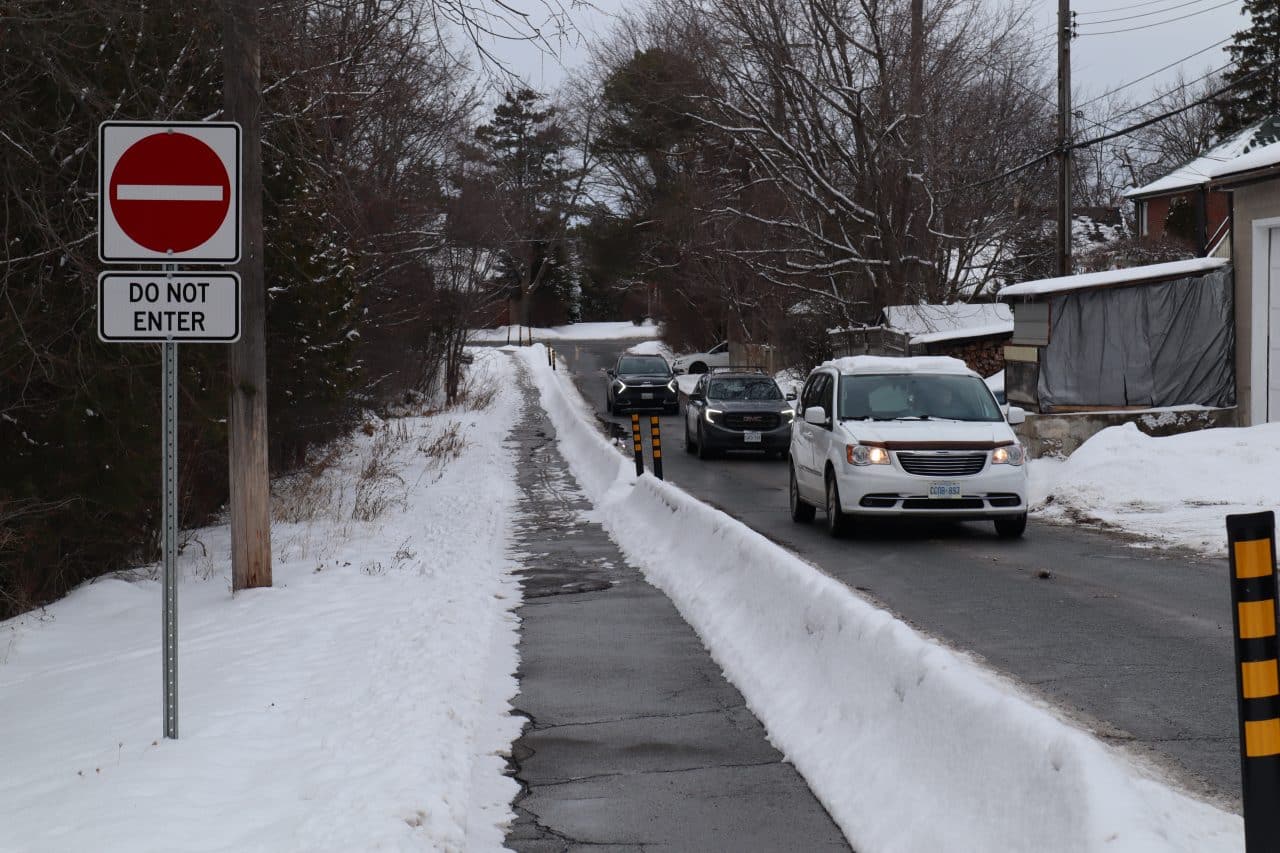
Taking Buddy the dog for a walk on High Street is no longer a nail biting experience for Patti Watson, ever since the city made a section of the busy street one-way in 2023.
The change is part of a “traffic calming” pilot project that also saw a pedestrian pathway installed along a stretch of the street that lacks sidewalks.
“One way is the way to go on that street, and it’s just safer for everyone, traffic included,” said Watson, a volunteer dog walker with Elder Dog Peterborough. She said she likes the new pedestrian pathway and it seems like drivers go “a little bit slower” now.
Many other Peterborough residents want something done about speeding in their neighbourhoods, too. The city has received 130 requests for traffic calming measures from residents since 2021, according to a recent city staff report.
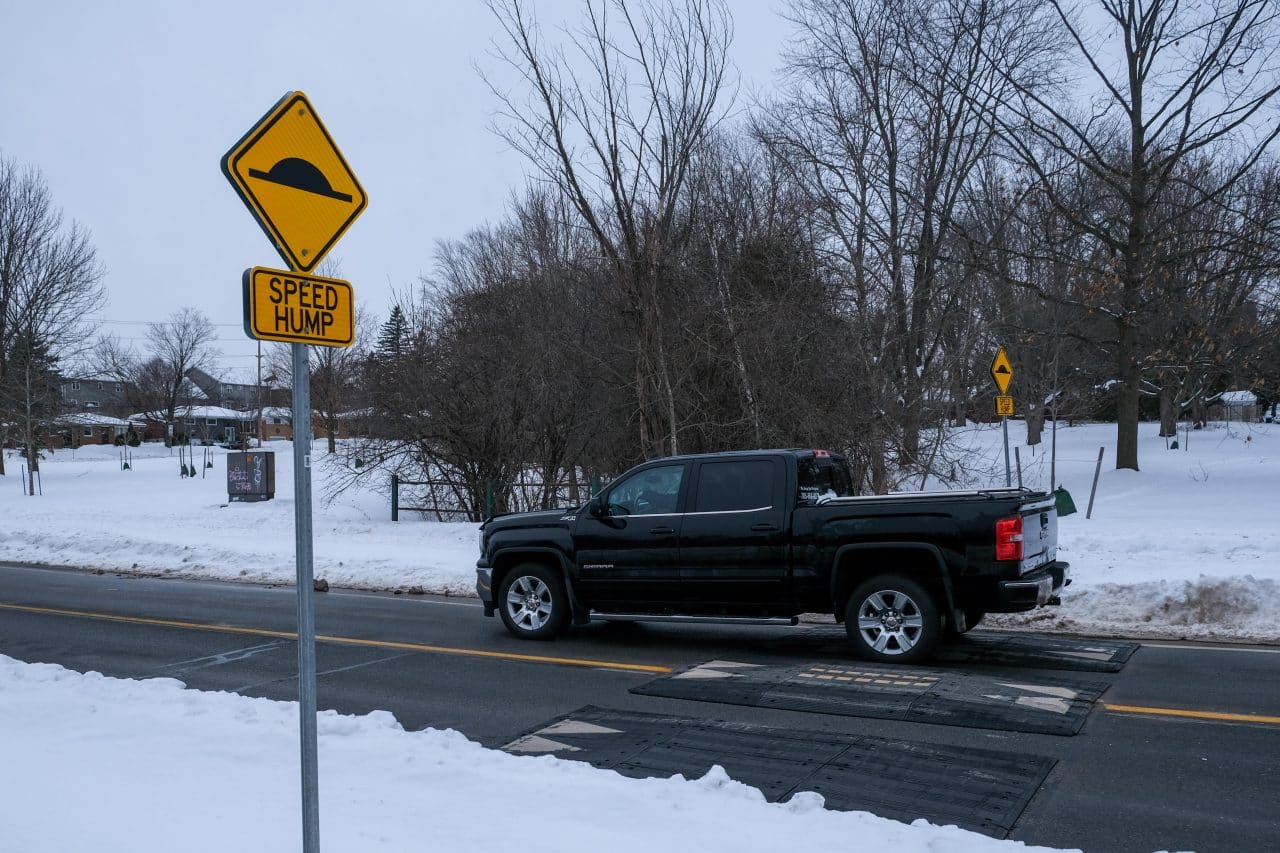
Traffic calming refers to adding things like speed humps, raised pedestrian crossings, curb extensions and other physical measures to streets to slow vehicles. The goal is to improve safety, “especially for more vulnerable road users like pedestrians and cyclists,” according the city’s website.
But after installing eight pilot projects in various neighbourhoods since 2021, the city is now backing away from using traffic calming as a way to make streets safer in residential areas. City council suspended the city’s traffic calming program in 2024 and, during recent 2025 budget deliberations, voted against reviving the program this year.
The cost to continue the traffic calming program in 2025 would have been $500,000, some of which would have been used to hire two new staff, the staff report said.
Staff had also requested $600,000 to make permanent three of the city’s traffic calming pilot projects, which data showed were successful at reducing speeds and stopping drivers from taking short cuts through residential streets. Residents in the neighbourhoods where those three pilot projects were conducted were surveyed about the trial measures and a majority of respondents said they wanted the changes made permanent, according to an earlier city staff report.
Cherryhill Road in the west end, which was part of one of the pilots, saw “vehicle operating speeds” decrease from 54 kilometres per hour to 41 kilometres per hour after traffic calming measures were put in place, according to the staff report. Operating speeds on Westridge Boulevard dropped from 52 km/h to 45 km/h.
On Franklin Drive in the north end, vehicle operating speeds fell from 53 km/h to 47 km/h after speed humps and a pedestrian crossover were installed as part of another pilot project. Shortcutting traffic also went down by 70 percent, according to the staff report.
As part of a pilot in East City, signs were installed to prevent drivers from turning onto Auburn Street from Armour Road to stop drivers from using the residential street as a shortcut. The change led to a 40 percent drop in traffic volumes, according to the report.
Only one of four pilot projects studied was not successful. The addition of speed humps and “Chicane parking” along Morrow Street and Montgomery Street did not significantly reduce vehicle speeds or shortcutting traffic, the staff report said.
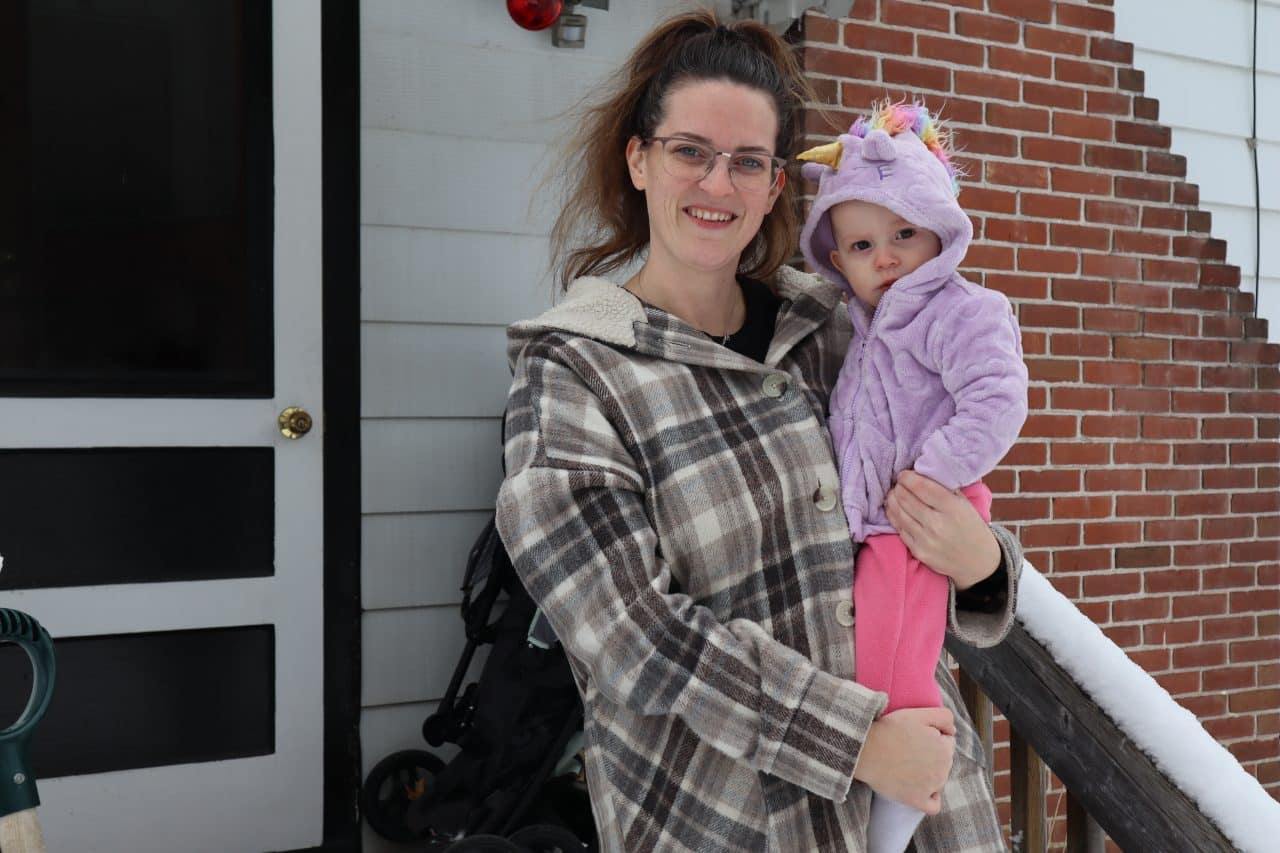
High Street resident Laura Hayes said she can see that the changes to her street have made a positive difference, too, even though the city has yet to release data on that pilot project and several others.
“It’s a lot less busy, a lot less dangerous,” she said.
She said she wants High Street to remain one way, with a curb and sidewalk installed to replace the temporary cement barriers currently in place.
It’s “very disappointing” that city council has suspended the traffic calming program “because it clearly has been working,” she said.
A city spokesperson told Currents that traffic calming measures installed on various city streets on a trial basis “will either be maintained or removed as necessary through 2025 to ensure public safety.”
“If any of these temporary traffic calming measures degrade beyond general maintenance or require substantial replacement, they will be removed,” Sarah Deeth wrote in an email. Measures to slow speeds in school zones won’t be affected.
The decision is bad news for Cathy Shadbolt, who said she pleaded with the city to do something about drivers speeding down the hill on High Street for years, before the one-way trial started. Prior to the switch, it was hard to see vehicles coming over the hill when exiting her driveway, but that’s improved since the temporary pedestrian pathway was added, she said.
“They come flying over that hill – and I do mean flying – and you’re a sitting duck,” she said. “Now we have this walkway, we can pull out far enough to see what’s coming.
“If they take it away, we’re back in the same mess.”
Physician calls decision “a blow to road safety”
Dr. Sara Whitehead, a Peterborough-based public health physician who works on traffic safety internationally, said it’s “deeply disappointing” that council voted down funding to make the three successful pilot projects permanent.
“Public consultation showed the community supported them,” she wrote in an email. “Rejecting funding now is not only a blow to road safety but also makes all that work a waste of money, staff time, and community time.”
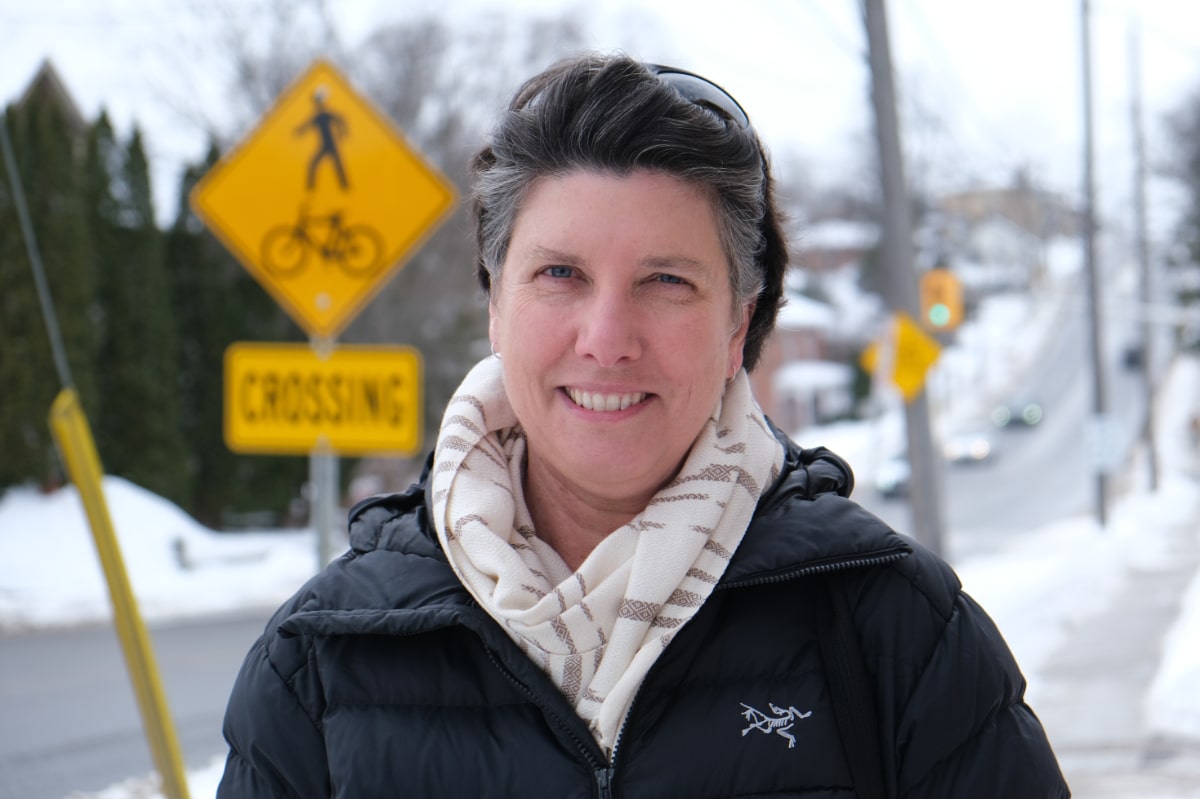
Whitehead said higher speeds increase the risk of death or serious injury when a pedestrian is struck by a vehicle, so the data showing that speeds dropped in two of the pilot neighbourhoods is “significant.”
She said research shows there is a 40 percent chance of fatality or serious injury when a pedestrian is struck by a vehicle going 50 km/hr. As speed decreases, so does the likelihood of death or serious injury, falling to 13 percent if the vehicle is travelling 30 km/hr.
While Whitehead said the successful pilots should remain, she argued the city needs to rethink its approach to road safety going forward, saying the traffic calming program was too “piecemeal.”
“It is essentially a small, request-driven ‘add-on’ project that doesn’t place safety at the heart of transport policy in the city,” said Whitehead, who works on traffic safety as a consultant with New York City-based Vital Strategies.
Instead of putting in traffic calming measures where residents request them, safety improvements should be targeted to areas where collision, speed and traffic-volume data show they are most needed, she said.
She also said safety measures should be added whenever roads are being resurfaced or rebuilt, instead of trying to make streets safer as an “afterthought.”
“That is far more cost-efficient than standalone safety projects done after the fact,” she said.
Councillors ask staff to report on feasibility of 40 km/hr speed limits
Rather than more traffic calming, city council voted during budget talks to have staff report back later this year on other ways to reduce traffic speeds, including the feasibility of implementing a 40 km/h speed limit city wide.
Coun. Lesley Parnell was the one who brought forward the idea of lower speed limits, saying she wanted a solution that would make all city streets safer “as quickly as possible.” The traffic calming program saw safety measures added to only a few streets per year. That approach would take too long to make a difference city wide, Parnell said.
“We need to be able to move faster on making the entire city safer,” she said.
However, data the city has collected from school zones suggests simply lowering the speed limit without putting other measures in place is not likely to reduce speeding, the city’s traffic and parking services manager told councillors.
Peter Malin said in school zones where traffic calming measures were implemented the vehicle “operating speed dropped about eight kilometers per hour.”
In school zones where the speed limit was lowered to 40 km/h or 30 km/h but no traffic calming measures were installed, vehicle operating speeds only went down by two kilometres an hour, he said.
Whitehead said she is in favour of lowering the speed limit to 40 km/h or lower on most streets. But she agreed with Malin that most drivers won’t follow the new speed limit if it doesn’t also come with design changes to streets.
Back on High Street, some residents were also skeptical that simply lowering the speed limit would cut speeding.
“It’s not going to work,” said Shadbolt. The speed limit has already been lowered to 40 km/h on Sherbrooke Street near Prince of Wales School, but she said she doesn’t think it’s reduced speeding.
Watson agreed. “People don’t follow the speed limit — period,” she said. “Unfortunately, people are driving way too fast these days, and something has to be done to try to slow them down.”
City is looking at using speed cameras in some neighbourhoods
During budget talks, many councillors expressed interest in using speed cameras to enforce the speed limit as an alternative to traffic calming. Coun. Keith Riel said the way to stop drivers from speeding is to “hit somebody in the pocketbook with a fine.”
Infrastructure commissioner Blair Nelson told councillors staff are exploring the possibility of introducing “automated speed enforcement” (speed cameras) on some streets, but “we are limited by staff resources in order to look into it.”
Ontario municipalities can install speed cameras in school and community safety zones on roads with a speed limit of less than 80 km/h.
Malin said staff “will be looking at” creating new community safety zones to install speed cameras in, in areas where there are “vulnerable” road users, such as near parks and hospitals.
Shadbolt wants to see cameras go in to catch speeders, saying it “might take a little bit of the burden” of enforcing speed limits off police.
Whitehead said research shows street design is more effective at reducing speed than measures like speed cameras. She said enforcement measures like cameras should go hand-in-hand with safer street design. “Design wins over enforcement, but we should do both.”
Police dedicate four officers to traffic enforcement
City police chief Stu Betts said in an email that if speed limits are lowered to 40 km/h city wide, police “will work with the city to ensure roads are as safe as possible.” When asked, he didn’t say whether such a change would require hiring more officers for traffic enforcement.
There are currently four officers deployed full-time to traffic enforcement within the city, Betts said, adding that those officers also cover Lakefield and Cavan-Monaghan Township. Betts said the police want to increase the number of traffic enforcement officers to five, but that “would require additional funding in the budget.”
However, traffic enforcement was not a top concern the police service board heard from residents when it was preparing its 2024-2027 strategic plan, the police chief said.
“So we prioritize our enforcement and attention to those areas that the community identified as concerns,” he said.
City police use traffic data gathering devices to pinpoint where speeding is prevalent, in order to make “data-driven decisions” about where to deploy officers, Betts said.
Author

Related Articles

Alderville First Nation grants legal personhood to Rice Lake
Exploring an alternate solution to climate change, and a growing international movement
Promoting preparedness in East City
A grassroots movement aims to help neighbours out in the next big storm