
Health-care workers in Peterborough rally against privatization
Local unions say Ford government is creating a “two-tier” health-care system. MPP Dave Smith responds: “It’s about providing people with the care they need, when they need it and where they need it.”
This article originally appeared in the Peterborough Examiner on July 30, 2024 and is reprinted here through a creative commons license.
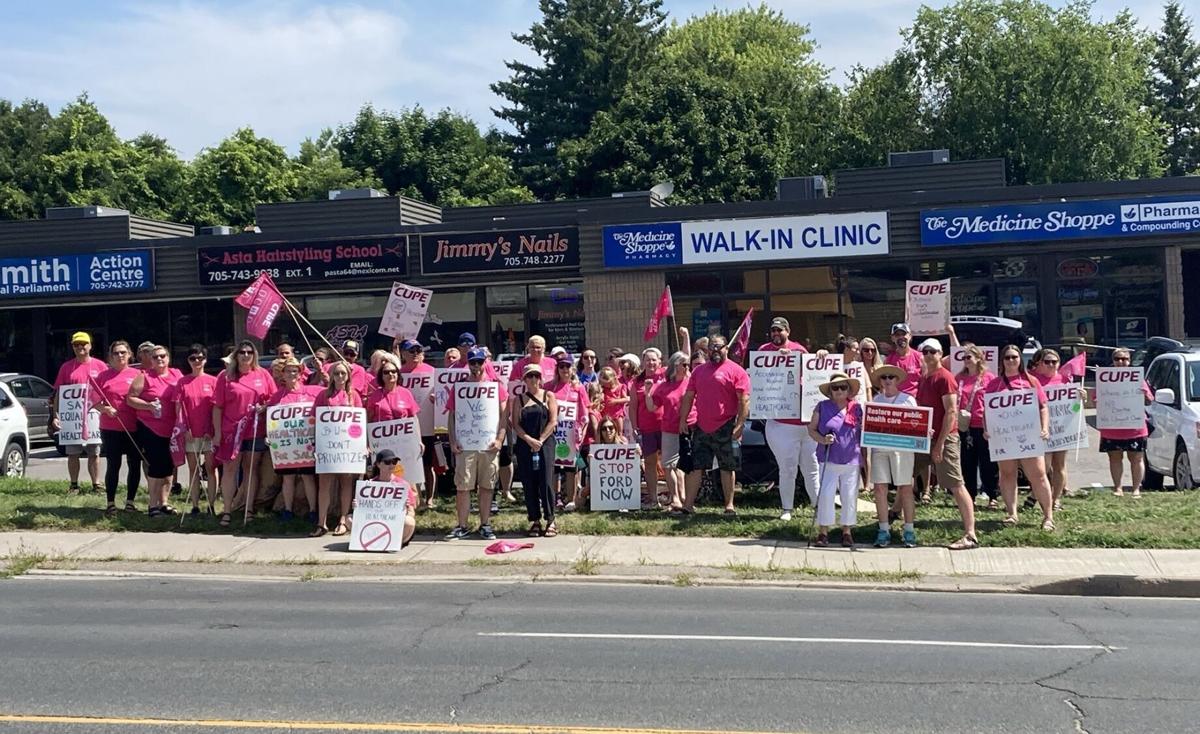
Approximately 60 health-care workers and supporters gathered outside of Peterborough-Kawartha MPP Dave Smith’s office on Chemong Road Tuesday for a rally organized by the Ontario Council of Hospital Unions (OCHU) and the Canadian Union of Public Employees.
The rally marks the end of a month-long campaign which has seen health-care workers and OCHU executives rally outside of MPP offices in 12 communities across Ontario to protest what they describe as the increasing privatization of health care in Ontario under the Doug Ford government and the development of a “two-tier” health-care system.
The workers are also aiming to call attention to an April 2024 Ontario Health Coalition report which found instances of what it alleges are illegal billing practices by private clinics alongside instances of physicians “upselling” expedited services and unnecessary tests and procedures for conditions such as cataracts.
The rally featured a lineup of speeches from CUPE health-care workers, including Charlene Van Dyk of CUPE Local 6364, which represents workers from Lakeridge Health Corporation.
“The Conservatives want to privatize our hospitals,” Van Dyk told the crowd. “The goal of private health care is to maximize profits. Investors don’t put their money in health care because it’s some humanitarian impulse — they do it because they want return on that investment.”

Van Dyk, who also serves as vice chair of the health-care workers co-ordinating committee at CUPE Ontario, continued on, stating that health-care workers in Ontario “have a profound belief in a public health-care system that treats people as human beings and does not discriminate based on their ability to pay together in solidarity with each other.”
Member and acting president of CUPE Local 1943 at Peterborough Regional Health Centre (PRHC), Lisa Barker, used her speech to challenge the Ford government’s claims of having added nurses to the Ontario health-care system.
“They don’t tell us the number of nurses who’ve left the system,” Barker said, noting that according to the most recent data released by the Registered Practical Nurses Association, Ontario added 1,700 nurses last year, but lost 2,100, meaning there was a net loss of 400 nurses in the province.
Barker also challenged the idea touted by the Ford government that privatization under Bill 60, or the Your Health Act, is improving wait times. Citing cataract surgeries as an example, Barker claimed that Ontario lagged behind other provinces with only 59 percent of cataract surgeries being performed in a timely manner in the province compared to the 66 percent national average.
Then, Barker said, there is the cost of privatization as she noted that “the Ontario Health Coalitionhas shown that privatization of cataract surgeries … cost 56 percent more than the same procedure done in our public hospitals.”
MPP Smith was in Toronto on Tuesday attending to matters related to his role as parliamentary assistant to the minister of finance. Reached for comment, Smith said in an email Tuesday morning that he has not read the Ontario Health Coalition report and therefore cannot comment on it directly.
However, Smith noted that if any of his constituents feel they have paid for a service that should have been covered by OHIP he encourages them to file an appeal and reach out to his office for support in doing so.
In response to the allegations of creating a two-tier system in Ontario which allows for those with greater resources to access services faster, Smith stated that the government is “leveraging the existing network of health-care professionals to reduce those wait times.”
“It’s about providing people with the care they need, when they need it and where they need it,” Smith continued, noting that a prime example of this is with cataract surgeries.
Smith explained that the system has been able to provide more than 700,000 surgeries since allowing ophthalmologists to perform the procedure in their own clinics instead of allowing them to use only hospital operating rooms.
“The clinics are more able to work around an individual’s schedule with times available in the evenings and weekends,” he added.
Despite this, Sharon Richer, the secretary-treasurer of OCHU claims there is a pattern of exploitation, especially of senior patients, who are being told that in order to get a quicker date for a cataract surgery they need to pay to avoid losing their driver’s licence or another negative consequence of living with a condition that requires necessary treatment.
The problem for Richer comes down to underfunding of the public system in order to drive people over to the private clinics.
“They’re taking money out of the public system and they’re creating chaos,” Richer said following the rally. “Then they’re saying ‘We have a solution’.”
“(Access) shouldn’t be based on if (you) can afford it, it should be based on need and that’s what Ontarians and Canadians want for our public health system,” she said.
Author

Related Articles

After a year under an Ontario-appointed supervisor, Peterborough’s Children’s Aid Society won’t say if its budget is balanced
The Ford government appointed a supervisor last year to “reinstate good governance and fiscal sustainability” at the society
Two short stories about strong mayor powers in Peterborough
A legal challenge against the City of Peterborough is dropped and “the mayor’s budget” is passed

What happened to the social service workers at the Peterborough Public Library?
Former CEO’s reports suggest the idea was a qualified success
