
This contaminated site is ready to be cleaned up. Will it happen?
Documents obtained by Peterborough Currents offer the fullest account yet to be made public of contamination at the former Outboard Marine property

The boats have been removed from the Canadian Canoe Museum’s former location on Monaghan Road and “portaged” to its new facility in East City, which opened to the public with much fanfare in May.
Now, the next chapter in the history of one of Peterborough’s most notoriously contaminated properties begins.
For decades, the museum’s Monaghan Road and Romaine Street property was known to be contaminated. Not long after the museum opened on the site in 1997, an environmental consultant identified a “pool of degreasing fluid” estimated to contain thousands of litres of a cancer-causing industrial solvent lurking underground. The contamination was left behind by the Outboard Marine Corporation of Canada, a boat motor company that operated on the site for much of the 20th century before shutting the factory down in 1990 and then declaring bankruptcy a decade later.
In 2022, Peterborough’s city council voted to pursue a new future for the site. The city would purchase the property from the museum and apply for federal funding to remediate the site and build a new transit garage on it, councillors decided.
Councillors weren’t unanimous in their decision. They debated whether the location was the right one for a transit garage. They debated whether it would be more appropriate for a private company to remediate the site. And they debated whether the city could afford the clean up. But in the end, the plan passed by a margin of 6-5.
Now, the city and the museum have agreed to a conditional sale, according to Carolyn Hyslop, the museum’s executive director.
“We’re hoping that [the sale] will close in the spring of 2025,” Hyslop said. She added that after more than 26 years of owning the site and supporting remediation efforts on it, the museum is looking forward to moving on and letting that work fall to someone else.
“Making the property better would be our hope, and that’s certainly why a partnership with the city on the sale of this complex property is really important to the Canoe Museum,” Hyslop said.

But how contaminated is this site, really? And what will it take to clean it up?
Having obtained the environmental assessments that guided municipal decision makers in recent years, Peterborough Currents can provide new details concerning the former Outboard Marine property.
Currents first requested the documents in summer 2023 through the freedom-of-information process. The city denied Currents’ request and withheld the documents. Currents then appealed to Ontario’s Information and Privacy Commissioner (IPC). After an IPC-appointed mediator started working on the case, the city wrote to say it had “changed its position” regarding access and released the documents.
The documents include environmental assessments completed by Cambium Consulting in 2019 and 2020 and a peer review of Cambium’s work completed by Blue Frog Environmental Consulting in 2021. Together, these documents offer the fullest account yet to be made public of what’s known about the contaminated land — and what uncertainties remain.
Underground contaminant plume extends beyond site
Outboard Marine operated in Peterborough for almost a century, and the company left a legacy of various industrial impacts when it vacated its site. But the main concerns are the underground deposits of trichloroethylene (TCE), a cancer-causing industrial solvent.
Remediation and monitoring activities have so far focussed on two known sources of TCE contamination at the site. One is under the building at 575 Romaine Street, which until recently was used by the museum to store canoes. The other is under a former Outboard Marine warehouse at 511 Romaine Street.
However, groundwater is not stationary; it flows underground as part of the hydrological cycle. In this case, groundwater contaminated by the TCE sources flows in a southeasterly direction toward the Otonabee River. It flows under the Voyageur Place plaza, under Lansdowne Street, and under the residential neighbourhood beyond.
This means the impacts of contamination are observed well beyond the site itself. A “contaminant plume” extends about one kilometre beyond the site’s boundary and the Ministry of the Environment, Conservation and Parks (MECP) has monitored for the impact of TCE contamination as far south as Hamilton Street, about seven blocks south of the former factory.

The primary health risk identified in the environmental assessments stems from the potential for TCE to vapourize and migrate into buildings as a gas, where it can be inhaled. This process is referred to as “vapour intrusion.”
The provincial government has previously conducted air quality testing at homes along Romaine Street and Brioux Avenue, where the contaminant plume is known to extend. “Based on previous monitoring, concentrations of trichloroethylene vapour in indoor air samples are below levels that would warrant the need for active mitigation measures,” a spokesperson for the MECP stated to Currents by email.
The MECP also continues to measure TCE concentrations in the neighbourhood’s groundwater. “Most recent groundwater sampling in the down-gradient area, undertaken by the ministry in 2023, indicates down-gradient concentrations are currently stable,” according to the spokesperson.
The groundwater monitoring wells south of Lansdowne Street “are perennial reminders that we need to do better,” then-city councillor Kim Zippel told her colleagues in 2022 before she voted in favour of the city’s remediation plan.
Province will require “containment” of groundwater plume
According to the environmental assessments, MECP officials indicated that a ministry-approved containment strategy will need to be implemented upon the sale of the site.
Ministry officials communicated in 2019 that “containment” would be defined as “stable or decreasing” TCE concentrations in groundwater leaving the site, “in comparison to recent groundwater monitoring data,” Cambium reported.
“The new owner would be required to complete some off-site groundwater monitoring to confirm containment of the … groundwater plume,” Cambium stated.
Presently, containment of the groundwater plume is achieved by the operation of a “pump and treat” system. This system pumps out contaminated groundwater as it leaves the site, treats it, and then releases it into the municipal sewer.
The system obtains water from five pumping wells, four of which are located immediately south of the site at 898 Monaghan Road — the Voyageur Place plaza. In 2017, the system pumped 44 million litres of groundwater and removed an estimated 14 kg of contaminants before discharging the water into the sewer system, according to the environmental assessments.
Hyslop said that the MECP paid for the operation of the pump and treat system up until 2020, using funds obtained through the Outboard Marine bankruptcy proceedings. Those funds ran out in 2020, Hsylop explained, and the museum has been covering the cost of running the system since then.
Cambium recommended the continued operation of the pump and treat system as one potential strategy to contain the groundwater plume that extends beyond the site.
Another option: installing an underground permeable barrier along the southern boundary of the site to filter groundwater as it leaves the property.
One final option: With municipal approval, an owner of the site could pump out groundwater as it leaves the site and then discharge it into the municipal sewer system untreated.
Removal of contaminants won’t be mandatory
Any combination of the three containment strategies suggested by Cambium could stabilize or decrease TCE concentrations in the groundwater beyond the site. But none of them would address the source of contamination at the site itself.
That might not be an impediment to redevelopment, however. According to Cambium, MECP officials in 2019 “indicated that source removal would not be a mandatory component” of the containment strategy.
Writing to Currents more recently, the MECP spokesperson stated: “If a new owner chooses to keep the land use as is, such as commercial/industrial, an RSC [Record of Site Condition] is not required, however the owner must ensure contaminants are controlled to prevent off-site environmental impacts.”
What’s an RSC? It’s a document that confirms a previously contaminated site has been remediated and meets the provincial standards for toxin concentrations.
“A Record of Site Condition is a document that discloses the soil, groundwater, and sediment quality on the site,” explained Meggen Janes, the executive director of the Canadian Brownfields Network. “You can’t file a Record of Site Condition unless your site meets the standards for soil, groundwater and sediment.”
The environmental assessments show that the Outboard Marine site does not meet those standards. TCE concentrations exceeded the applicable standards in four of Cambium’s soil samples and six of its groundwater samples. Of the six groundwater samples that exceeded the standards, most were between 6 and 25 times higher than the standards. One outlying sample (taken at the southeast corner of the 575 Romaine Street building) had TCE concentrations that were more than 300 times higher than the standard.
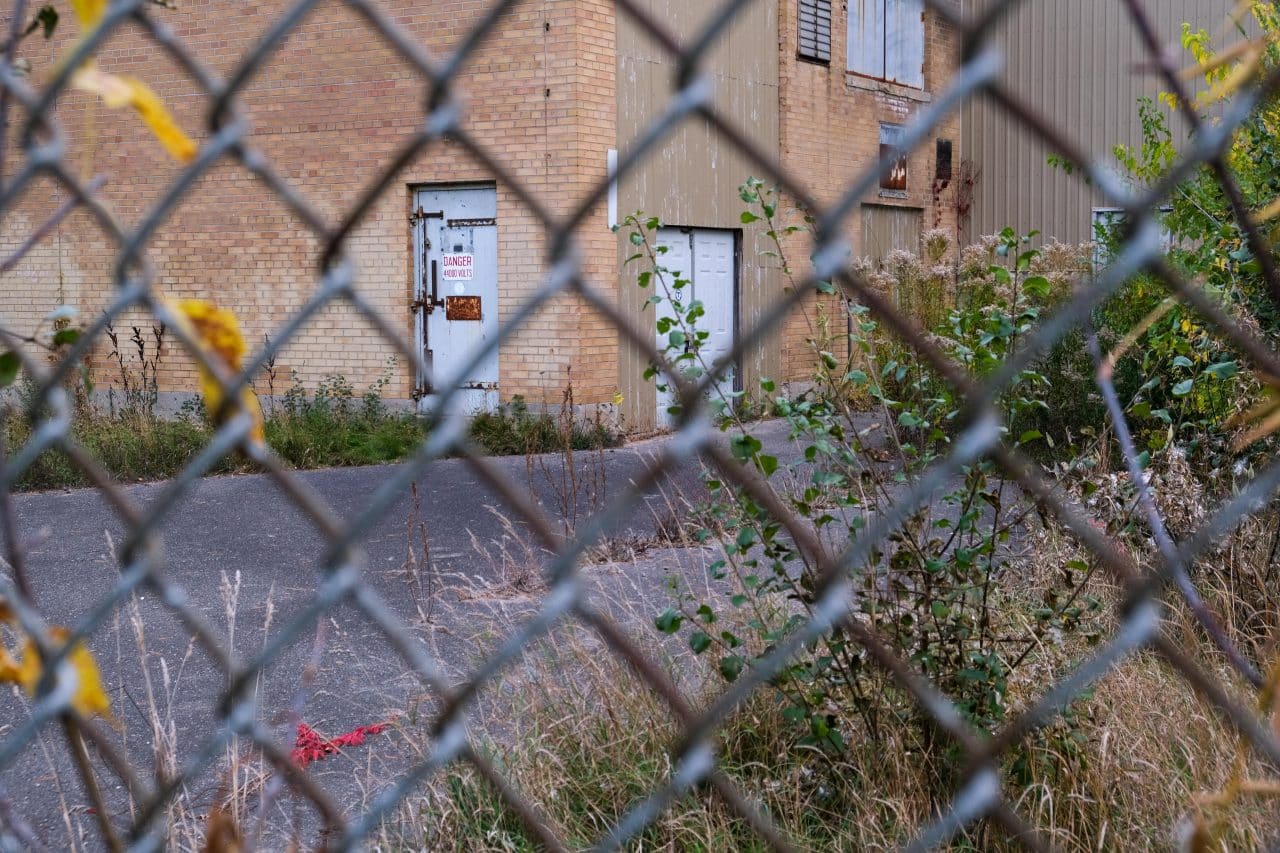
Janes explained that Ontario’s Environmental Protection Act does allow for property owners to develop site-specific standards that are less stringent than the province’s generic standards, as long as a risk assessment is completed and mitigation measures are put in place to protect users of the site. In the case of an underground TCE plume such as the one at the Outboard Marine site, mitigation could involve the installation of a vapour-blocking barrier underneath any proposed buildings to ensure the indoor air concentrations of TCE are safe, Janes said.
Regardless, a Record of Site Condition will only be required if the site transitions to a more sensitive use, such as to a residential use, the MECP spokesperson wrote.
“The ministry is not aware of any intentions to change the property use for the property located at 910 Monaghan Road,” the MECP spokesperson wrote.
But Cory MacLeod believes that even if the site is used for a transit garage, it still ought to be brought up to the same standards that would be required for a residential use. MacLeod represents Peterborough’s transit workers as the president of ATU Local 1320.
“Our union members spend an enormous amount of time” at the current bus garage, MacLeod stated to Currents by email. “Our members work, eat, bathe, and spend their breaks at this location.”
The union “expects that any future replacement facility shall be built with employee safety in mind,” MacLeod stated. “If a residential home cannot be constructed on the chosen property, the union argues that our members cannot be expected to work there 40 hours a week.”
When asked by Currents whether the city is committed to a full remediation of the site, spokesperson Brendan Wedley replied by email: “The City has no comment.”
TCE “rebounds” observed after pump and treat system shut down in 2014
There has been some work done already to remediate the site. When Outboard Marine declared bankruptcy, the Ontario Superior Court of Justice appointed Dillon Consulting Ltd. as the company’s environmental remediation receiver.
Dillon held that role until 2013, and over those years the Court awarded Dillon millions of dollars sourced from Outboard Marine’s assets to fund clean up efforts, according to the publication Canadian Consulting Engineer.
From 2001 to 2008, Dillon oversaw the removal of an estimated 4,500 litres of contaminants from the site using a variety of methods, according to Cambium.
Dillon did further remediation work in the early 2010s, targeting an estimated 10,000 litres of contaminated groundwater underneath the Canoe Museum’s storage warehouse, Cambium wrote.
Dillon stated that it achieved 99.8 percent of its remediation target and the firm received a Canadian Consulting Engineering Award (CCEA) for its work. But it soon became clear that the site wasn’t fully cleaned up.
The pump and treat system was turned off in 2014, according to the environmental assessments. The system was no longer needed because Dillon’s work had eliminated the risk of vapour intrusion, according to Dillon’s CCEA submission.
But within years, TCE concentrations rebounded — both on-site and off-site in the residential neighbourhoods south of Lansdowne Street, according to the environmental assessments. That led the MECP to turn the pump and treat system back on in 2017.
According to the environmental assessments, the MECP noted that there was “some uncertainty” around the degree to which the temporary shutdown of the pump and treat system was responsible for the “concentration rebounds” that were observed. But the ministry recommended the system’s continued operation “to mitigate any further groundwater concentrations spikes that may occur in the source area,” Cambium reported.
Fund more in-depth community journalism
It takes a lot of resources to produce in-depth local journalism. We can’t do it without your donations. Help fund our next investigation by becoming a monthly supporter.
“Substantial additional investigation” required to determine remaining contamination levels
If Dillon achieved its remediation targets, why does the site remain a concern?
One reason is that Dillon’s work was confined to a limited area of the site, even though the company had identified contamination outside that area. Dillon identified TCE soil impacts to the northeast, northwest, and southwest of the area it treated, according to one of the environmental assessments. But “no action was taken to remediate contaminant impacts outside the Treatment Area,” the document states.
Soil and groundwater testing conducted by Cambium in 2019 found TCE concentrations in excess of the applicable provincial standards both inside and outside of the area Dillon had treated. Cambium’s samples were taken through boreholes and monitoring wells dug in various locations throughout the site.
Cambium identified six “hot spots” where it recommended further remediation efforts.
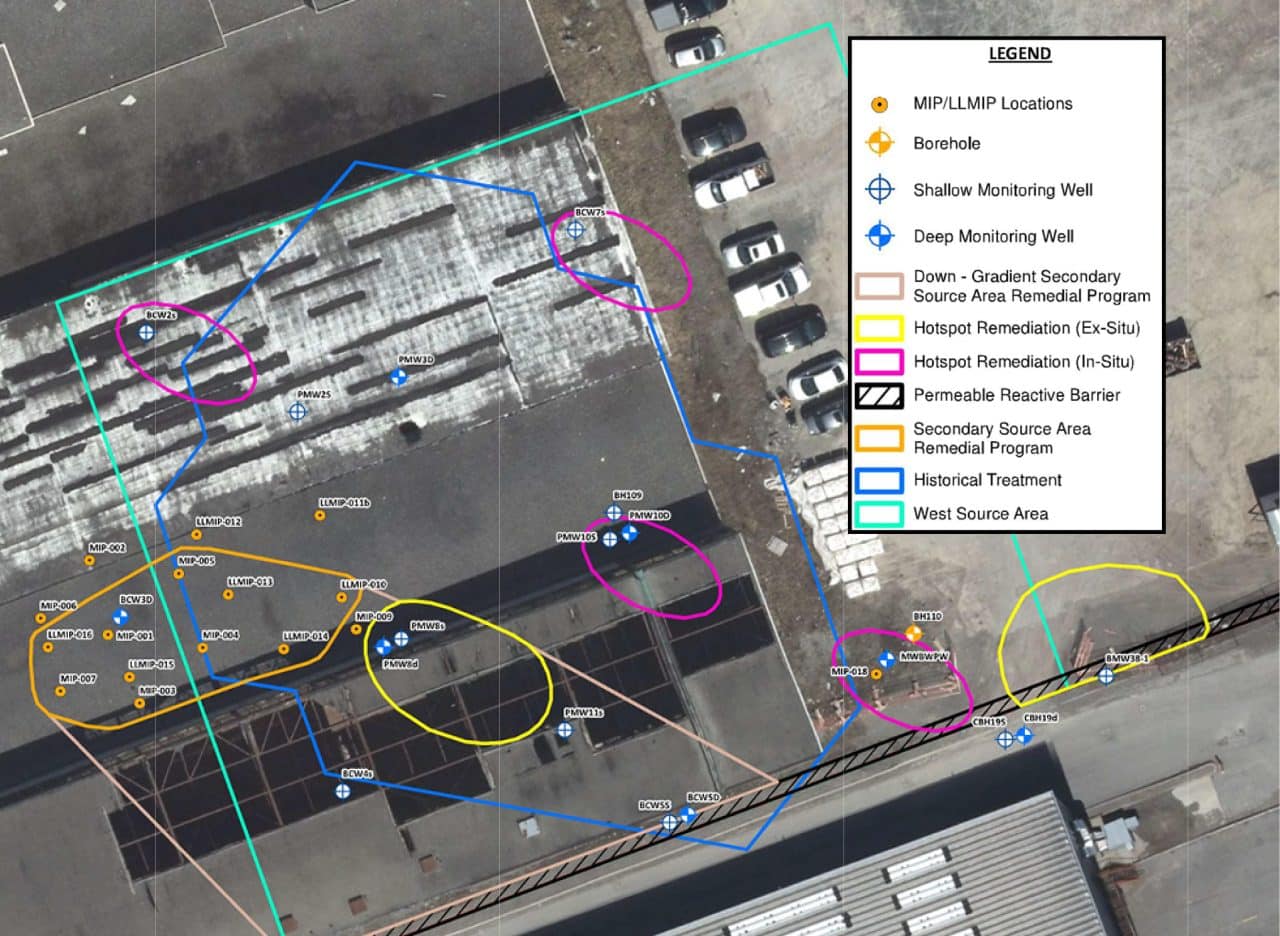
But according to Blue Frog Environmental Consulting, the firm the city contracted to review Cambium’s work, Cambium’s tests don’t reveal the full extent of those hot spots. “The lateral and vertical extents of contaminant impacts in each of these six areas have not been determined,” according to Blue Frog’s assessment, leading the firm to conclude that “substantial additional investigation is required to delineate soil/groundwater impacts” at the site.
Councillors were made aware of uncertainties concerning the site in 2022, when city staff warned in a report that there was a “risk that additional contamination could be found during construction” of the transit garage.
When asked by Currents if additional testing was underway or being arranged, city spokesperson Brendan Wedley responded by email: “The City has no comment.”
511 Romaine Street purchased by numbered company in 2023
The property owned by the Canoe Museum and set to be purchased by the city comprises two municipal addresses: 910 Monaghan Road and 575 Romaine Street.
But some of the contamination documented in the environmental assessments is on a separate adjacent property to the east that Outboard Marine also occupied, 511 Romaine Street. That property was purchased by a numbered company in 2023.
The company, named 1000609546 Ontario Inc., purchased 511 Romaine Street for $1.7 million in a tax sale, which is when a municipality seizes and sells a property because the owner hasn’t paid its property taxes.
McWilliams Moving and Storage, the company owned by former city councillor Dan McWilliams, is renting the property to use as a warehouse, McWilliams said. He said the property was “totally remediated” about ten years ago. “It’s not pristine, but it’s certifiable and clean,” he said.

Cambium’s groundwater sampling identified TCE concentrations in excess of the provincial standards at 511 Romaine Street in 2019. However, MECP officials indicated to Cambium that a containment strategy for the contamination at 511 Romaine Street would not be required should that property also be acquired by the city, according to the environmental assessments.
“It is unlikely the Ministry will require further work and/or plume management related to [511 Romaine Street],” Cambium stated.
However, Blue Frog expressed skepticism at that idea, calling it “incongruous” and suggesting that the rationale for why the MECP would exempt 511 Romaine Street from requiring a containment strategy was “not clear.”
City budgeted almost $10 million for remediation efforts
The city’s spokesperson declined to answer whether the city had been successful in obtaining federal funding for the transit garage project. A spokesperson for Infrastructure Canada would only say that a decision on the application had been made.
But the conditional purchase of the property, set to close next year, suggests the city is moving forward with the project. So, what’s the plan? While the city’s spokesperson wouldn’t say, the approved budget does provide clues.
In a memo prepared for the city in 2020, Cambium estimated that installing an underground barrier at the site’s southern boundary to filter groundwater as it leaves the site would be the most cost-effective way of meeting the MECP’s requirement to contain the off-site TCE plume. Cambium estimated that this strategy would cost about $1.9 million in total, according to the Blue Frog peer review.
But Cambium also provided a cost estimate for going beyond what the MECP would require of a new owner and remediating the entire site to the applicable provincial standards. Cambium noted that if the entire site were remediated in this way, the MECP would likely waive the requirement for an underground barrier to contain the off-site plume. Cambium’s estimate for the cost of a full cleanup: about $10 million.
When councillors approved the transit garage plan in 2022, they voted in favour of applying to the federal government for partial funding for the project, including funding for environmental remediation. Councillors heard from staff at the time that environmental remediation would cost about $10 million, which suggests that staff were envisioning a more full-scale remediation of the site.
But as construction costs increase and the city faces a budget crunch, it’s unclear if that is still the plan.
Some dissenting councillors stated in 2022 that they thought $10 million would be insufficient to clean up the site.
“I don’t think you’re going to be able to even touch it with the $10 million,” said then-councillor Dean Pappas, who voted against the plan. Councillor Keith Riel, who also voted against the plan, said he thought the estimate was a “lowball” number and that “there could be no end to the money that’s spent on trying to remediate this site.”
In its peer review of Cambium’s work, Blue Frog recommended going beyond the MECP requirements.
Simply meeting the MECP’s requirement to contain the off-site plume “would be less costly than a more robust due diligence remediation,” Blue Frog stated. “However, the larger program would provide the better level of comfort that on-site and off-site liabilities would be reduced to a great degree.”
CORRECTION: A previous version of this article incorrectly quoted the city as saying it had “changed its mind” regarding the release of the FOI documents. The correct phrasing was “changed its position.” This article was updated with that correction on September 6, 2024.
Author

Related Articles
Tension, uncertainty ahead of potential public housing redevelopment
Planned $47.2 million redevelopment on Hilliard Street leaves current residents with questions about what happens to them

Alderville First Nation grants legal personhood to Rice Lake
Exploring an alternate solution to climate change, and a growing international movement

After a year under an Ontario-appointed supervisor, Peterborough’s Children’s Aid Society won’t say if its budget is balanced
The Ford government appointed a supervisor last year to “reinstate good governance and fiscal sustainability” at the society
