
Tensions boil over into a strike at Community Living (and across the province)
Chronic underfunding and a wage cap lead to coordinated labour actions across the province

Tom Newton has worked multiple jobs at Community Living Trent Highlands. The non-profit organization helps children and adults with developmental delays in Peterborough, Haliburton, and Kawartha Lakes. Newton has been midnight assistant coordinator at a group home, he’s been involved in operations and planning, he’s helped to train staff, and he also worked at LifeShare, a program that connects adults with developmental disabilities with families who are willing to host them, in a semi-independent living situation, with regular home visit check-ins and other support.
“The key in our work is relationships,” says Newton. “That’s where you get that level of trust and understanding. When someone’s having a good day, you celebrate those wins, like when they learn a new skill. Or if they’re having a bad day, whether that’s police involvement or just someone to talk to. It just depends on the individual.”
Teresa Jordan is executive director at Community Living. (Note: This article will use “Community Living” to refer specifically to the local Community Living Trent Highlands, not the wider association of nonprofits.) Jordan talks about what a complex job her staff do. “There’s some support needs and physical care needs, but then there’s this entire suite of competencies: what does it mean to be a citizen, and how does a citizen contribute and have their gifts accepted. That’s very intricate to understand.”
“And yet,” says Jessica Bushey, another worker at Community Living and the president of her local union, Ontario Public Service Employees Union (OPSEU) 358, “we’re struggling. We’re struggling while taking care of the most vulnerable people. We have workers taking two jobs, workers going to food banks.”
Newton has been at Community Living for 13 years and now. “I’m blessed and very thankful to be living with my parents,” he says, “helping them, taking care of them, because they’re starting to age a bit, and they help me too. I think a lot of families are doing multi-generational homes, because… y’know, the cost of living.” Newton is now on the OPSEU 358 negotiating team.
The development services sector has been chronically underfunded by the provincial government – that’s an assessment shared by the union and their employer Community Living, and backed up by the government’s own Financial Accountability Office. Adding onto that, these workers, as well as public sector employees across Ontario, came under specific pressure in 2019, with Premier Doug Ford’s introduction of Bill 124, which limited wage increases to below inflation – a move that was deemed unconstitutional by multiple courts, and was eventually struck down.
All of this is now boiling over, as OPSEU 358 enters its fourth week on strike, but it’s not just Peterborough. OSPEU’s “Worth Fighting For” campaign is province-wide and represents employees across the entire public sector. The campaign has been ramping up for over a year, and the local strike is part of the first wave of strike actions. Across Ontario, there are currently 27 OPSEU locals and over 4,000 employees on strike, and the union promises “larger provincial coordinated actions” in the weeks to come.
It’s also an unusual type of strike, with local strikers splitting their time between protests at Community Living’s office and at the constituency office of area MPPs, like Peterborough—Kawartha’s Dave Smith. This is because, while the workers are considered public sector employees, their actual employer is Community Living, a separate agency that’s funded almost entirely by the government.
As the province tells the employees they need to go back to their employer to negotiate, and the employers say their ability to negotiate is tied by provincial funding, OPSEU is looking to set up a central bargaining table, to negotiate directly with the provincial government.
It’s a complex strike, revealing long-term cracks in the way our province delivers social services as well as deep wounds in some of our most essential workers, and as the strike drags into weeks with no apparent end in sight, some of the most vulnerable people in our community are most affected.
A brief history of Bill 124
For the union, the strike originated all the way back in 2019, with the Ontario government’s introduction of Bill 124. Presented as a way to reign in government spending and address the deficit, Bill 124 capped salary increases for almost all public sector employees at 1% for three years.
This included developmental service workers, like those at Community Living, and many other sectors, including school teachers, college faculty, corrections workers, public servants, LCBO employees, social workers, and more. (Some essential workers, like police and firefighters, were excluded from the legislation, though nurses – also essential workers – did get capped.)
This legislation was immediately met with pushback from employees and unions, who said capping wages below inflation levels was essentially a progressive pay cut. The situation was only made worse with the arrival of the COVID-19 pandemic the next year, which put added pressure on the sector and its employees. “They called us heroes,” says Bushey, “and then they capped our bargaining rights at 1%.”
Eventually, the courts deemed Bill 124 unconstitutional, for violating the employees’ right to bargain collectively for their wages. After a failed appeal, Ford agreed to repeal the law in 2024, but by that time, years in, the damage was already done.
Some sectors were offered compensation for the years of lost wages, but many are still looking for backpay and retroactive pay increases to this day. OPSEU’s Worth Fighting For Campaign asks for a 6.5% wage increase across the province, which they say would cover the wage increases they missed out on over those years.
A rock and a hard place
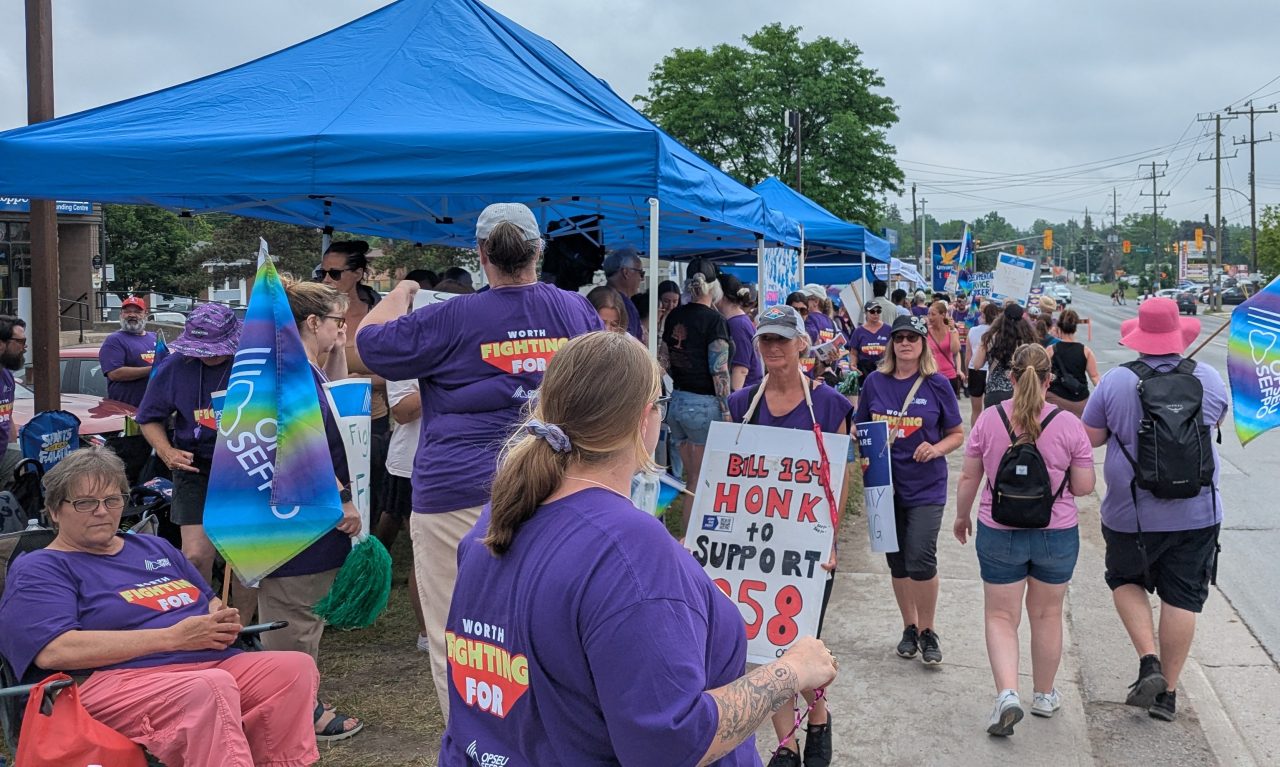
Bill 124 compensation has been spotty so far, but there appears to be a distinction between the public sector workers who are directly employed by the provincial government, like teachers and nurses (who generally did get compensation), and those who work for third-party agencies that are funded by the provincial government, like Community Living (who generally haven’t).
Community Living Trent Highlands is an independent non-profit agency that makes its own hiring decisions and bargains directly with the local OPSEU union to set terms for their employees. However, they are what’s known as a ‘transfer payment agency,’ meaning that they’ve entered into an agreement with the Ontario government to provide certain public services, and in exchange they receive regular funding. A look at Community Living’s financial records shows that the vast majority of their revenue (81% over the last five years) has come from the province.
This creates an odd ‘double employer’ for the OPSEU workers, who were considered public employees and so fell under Bill 124 restrictions, despite not working directly for the government.
Says Bushey, “Dave Smith said to some of my members, ‘This is a bargaining issue between you and your employer,’ but it’s not, because they’re the funder of our employer. [The Ontario government] actually holds the purse strings, not my employer.”
Chronic underfunding
“I… you know, always have to be careful,” says Teresa Jordan, executive director of Community Living, “because I’m funded by the ministry which I’m speaking about.”
However, like the union, she also speaks about a provincial government “that has not kept up with inflation, not kept up with rising costs, and that goes equally for wages.” She says that the Worth Fighting For campaign is “aimed at shining a light on this really complicated role that is chronically undervalued, both in public opinion and in funding.”
She is quick to point out, “That’s about all [the union and I] align on, but certainly, at the heart of the campaign, we are aligned.”
As OPSEU leadership said in a letter to the provincial government earlier this year, “We are seeing the consequences of underfunding first-hand: long waitlists, soaring caseloads, growing demands, and critical staffing shortages. Workers are stretched thin, and services are at a breaking point.”
And this appears to be backed up by the government’s own findings, as presented in a 2024 report by the Financial Accountability Office (FAO) that looked at funding for the Ministry of Children, Community and Social Services, the agency responsible for Community Living and most social services across the province. The report found that government spending increases weren’t keeping up. According to the FAO’s calculations, the government had allocated $3.7 billion less than was required to fund existing social services over the next several years, leading to budget shortfalls that would grow each year.
A follow-up report the next year noted that, with updated 2025 budget numbers, government spending on social services was now actually expected to go down every year, for the next several years.
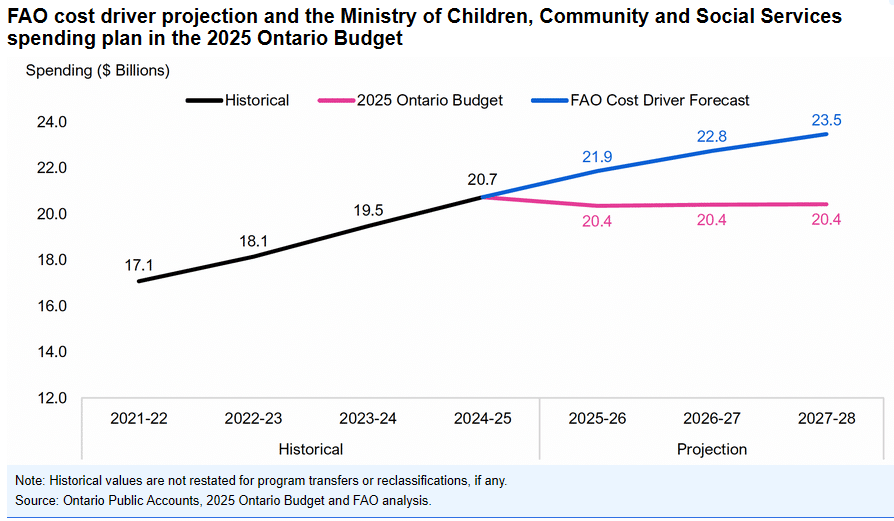
The reports also note that their calculations assume that the government will only provide services to those currently receiving aid and no one more – but waitlists are growing. In a five-year period examined by the report, the number of people with developmental disabilities waiting for supportive housing grew by almost 50%, while the number of people with housing remained flat.
Jordan notes that “that is what I think holds the board back from completely aligning with Worth Fighting For.” The campaign is focused on employee wages, but Jordan would like to see a more “general statement about increased funding and increased investment that would add spaces.”
Tense negotiations
These rising pressures on the sector have led to tense negotiations between Community Living and the OPSEU local.
Jordan notes that, following Bill 124’s repeal, Community Living did provide a one-time payment to make up for lost wages. “I really did feel, before the [Worth Fighting For] campaign started, we had negotiated a compensation for the hardship of it,” she says.
But OPSEU’s Bushey notes that a one-time payment doesn’t provide nearly the same assistance as an ongoing wage increase, and says the union also wants “a general increase in benefits and language changes to strengthen our collective agreement.”
The union is also concerned that, without an increase to the agency’s funding, growing employee wages could come at the cost of layoffs. Says Bushey, “The bargaining team asked the employer multiple times to put in writing that the offer would not come with layoffs… and they refused to respond.”
Jordan says their offer “doesn’t contemplate layoffs. However, being asked to absolutely guarantee no layoffs is impossible for me, because our funding could change at times.”
Negotiations started to break down, as the province-wide OSPEU campaign ramped up, and finally, last month, Community Living made a ‘forced offer,’ a final offer presented directly to the employees, which they must vote on. The 309 members voted, and 87% refused the deal, leading to the strike.
‘The gap will grow’
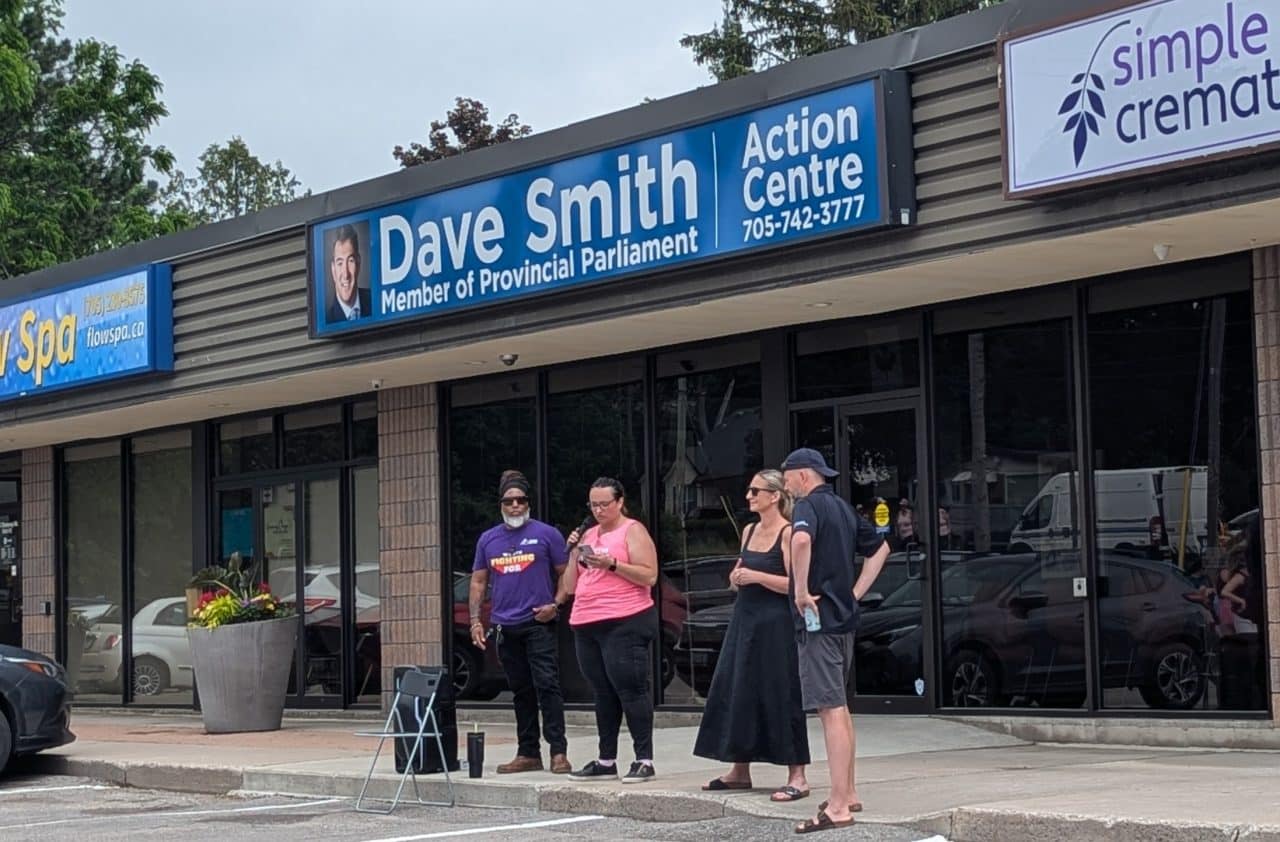
On the picket line, in front of a darkened window and a locked front door leading to Dave Smith’s constituency office, Newton tells the story of an OPSEU strike that occurred last year, over similar issues as the current strike.
That one involved frontline staff at Central West Specialized Developmental Services (CWSDS), a similar nonprofit agency that provides support to adults with developmental disabilities in the Greater Toronto Area. During the strike, CWSDS temporarily moved residents out of group homes and into a centralized facility in Oakville, and ultimately, one of the residents died at the facility during the strike.
“I haven’t heard anything about that from Ford’s government,” says Newton. “And that executive director, who decided to move everyone there and block all their staffing. That death was on their… it’s just horrible.” He sighs.
Community Living has brought in temporary workers to cover essential services during the strike (“Scabs,” interjects Bushey) and the organization still has management and non-union staff working, but both Jordan and the workers speak sadly about all the services that are simply closed down during the strike, and the impacts it will have.
Group homes, which need employees on site 24 hours a day, still have staff, but community engagement programs, family supports, day programs, and check-ins for programs like LifeShare have stopped entirely.
“We’re supporting people and keeping them safe,” says Jordan, “but there are families and people that just aren’t getting the service that they’re used to, from our qualified staff. The longer this goes, the gap of what we’re not able to provide will grow.”
Newton notes that people with developmental disabilities and neurodivergences such as autism often struggle with change. They can take a long time to establish relationships of trust, making this kind of disruption even more difficult. He has clients he’s seen for 13 years, who he’s not able to visit right now. “I can only imagine the individuals that are caught up in all this, the fear that they have.”
“It’s extremely hard,” he says. “There are people out here [on the picket line] that are in tears every day, that they’re not able to work with the people that they want to, because a government fails to use the money. [Ford] could do that any time, but he’s trying to starve us out, and that’s not happening.”
The ways forward
“I think that our way forward is to come to some kind of agreement as a single agency, at our own bargaining table,” says Jordan. “I can’t negotiate on behalf of the government.”
Bushey says that her union is currently working to set up dates for the bargaining team to return to the table with Community Living. Without compensation for Bill 124, “I’m not sure what they can offer us that will get us off the line, but we’re willing to hear what they have to say.”
What OPSEU really wants, province-wide, is “a central bargaining table,” says Bushey, where they can negotiate directly with the provincial government, even for transfer payment agencies like Community Living. This has never happened before in the province, but she says OPSEU has had some “minimal conversations, not negotiations, almost pre-negotiations,” with the government.
Meanwhile, OPSEU will continue to “escalate” actions. The Community Living strike was part of the first wave of OPSEU actions, which now includes 27 locals and over 4,000 employees, and Bushey predicts “larger provincial coordinated actions” in the weeks to come.
She says this kind of coordinated campaign “has never happened before. Public service workers have never gone on strike like this before in a province-wide setting. This is actually Ontario labour history, happening right now.”
Peterborough Currents reached out to Dave Smith’s office for an interview for this story, but he declined to comment.
This article was updated on June 15, 2026 with corrected information about which public sector employees were excluded from Bill 124 wage caps.
Author

Related Articles

How Peterborough and other municipalities are adapting to extreme heat
As Peterborough plans for the impacts of climate change, an innovative strategy in BC tries to protect vulnerable renters

Queer refugees find community in Peterborough, as Canada tightens rules that helped them arrive
“My family, my government, my religion, and the whole country is against me for being gay.”

An uncertain path forward for Peterborough’s new arena project
What did council actually approve? Who will pay for it? And what happens next?
