
“We look after the whole person”: Non-profit offers housing – and much more – to women and their children fleeing abuse
Volunteers converted old houses in downtown Peterborough into apartments for women and their children escaping intimate-partner violence starting in the 1980s.
In 1985, Sister Joyce Murray was looking for a way to give back to the community, so she reached out to some people she knew in Peterborough.
It didn’t take long for Murray, a Catholic nun with the Congregation of the Sisters of St. Joseph, to bring together a group of people who wanted to do some good. They just needed a project to tackle. So they sat down with the head of the city’s social services department, who pointed them to a “very big need” in Peterborough: housing for single mothers, Murray recounted.
“We were concerned about the well being of the women and the children,” she said. “Even in those days, Trent students were taking most of the low income, affordable housing.”
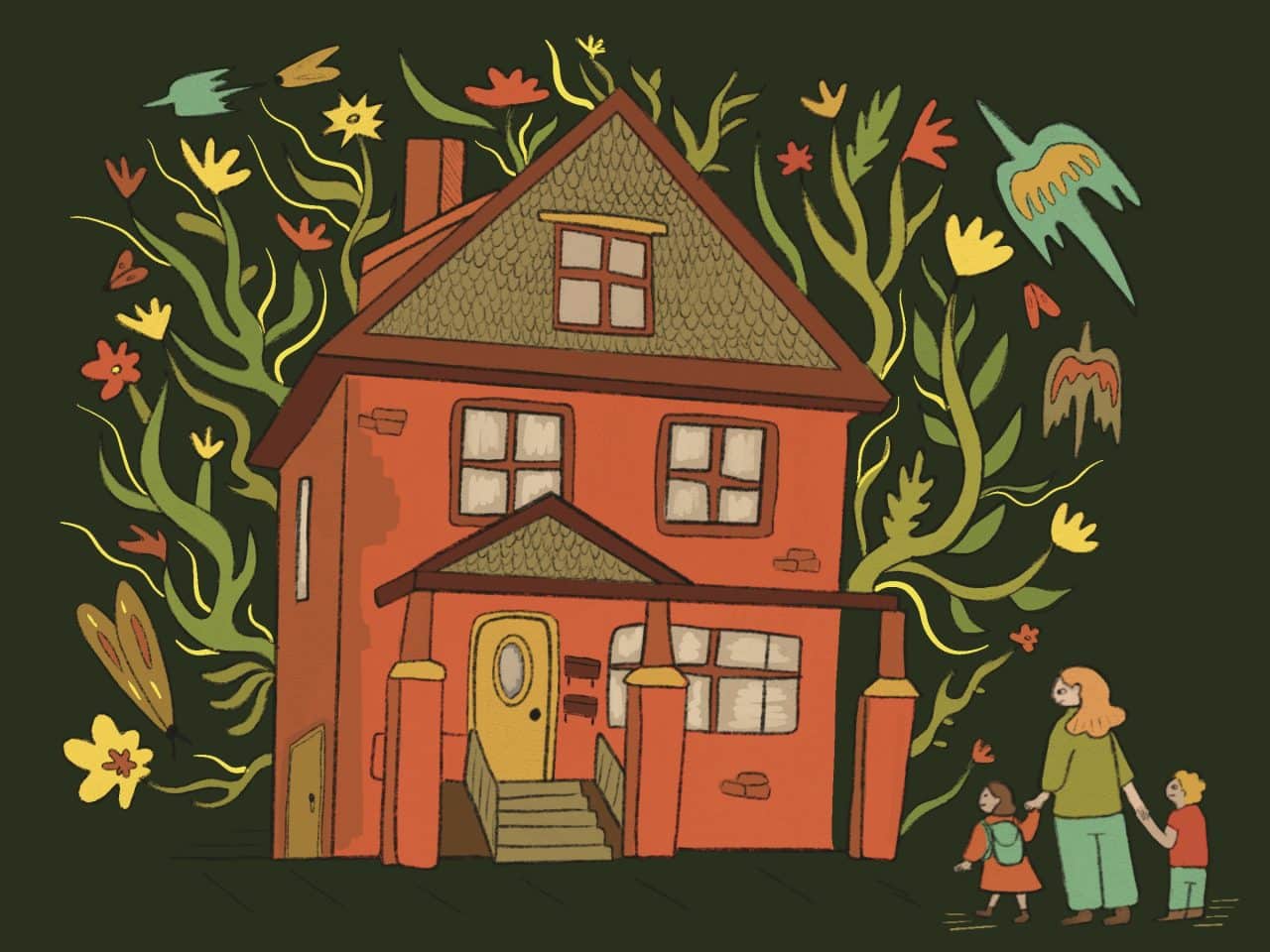
Murray and the others turned that concern into a plan: they would buy some old houses and convert them into apartments where single mothers could “raise their kids in a respectful, dignified, comfortable” way, she said.
The group took the name Kairos Non-Profit Housing, and over the next several years acquired six homes in downtown Peterborough neighbourhoods, according to the organization’s website. (Kairos is an ancient Greek word that can be translated as “a place of new beginnings,” Murray said.)
Murray helped select the first families to move into the homes, in consultation with the YWCA’s Crossroads Shelter for women and children, she said. Shelter staff suggested the homes go to mothers fleeing intimate-partner violence, according to Murray. That has been Kairos’ focus ever since.
Today, the non-profit still owns the duplexes that volunteers bought and renovated in the 80s and 90s. And Kairos still offers them as deeply-affordable housing to single mothers and their children, with rents capped at 30 percent of tenants’ incomes thanks to provincial subsidies.

Volunteers remortgaged their own homes to start Kairos
Murray was also a teacher at St. Peter Catholic Secondary School in the 1980s, where she taught Carm Connelly’s daughter French. The two women met and became friends, and Murray enlisted Connelly to become one of the founders of Kairos in 1985.
“It was kind of scary,” Connelly said. “We didn’t have a blueprint or a plan to follow.”
Some volunteers remortgaged their own homes as a loan guarantee to buy the first three Kairos homes in the 1980s, including Connelly and her husband Dan, she said. Donations also helped with the purchases, according to the Kairos website.
The next three homes were acquired in 1991, with the help of provincial and federal funding, the website states.
Mortgages for the homes were provided by the Canada Mortgage and Housing Corporation, according to Murray.
Each of the homes was divided into a duplex, creating a total of 12 apartments, with much of the renovations done by volunteers, according to John Martyn, another Kairos founder. “We were blessed with a lot of people who wanted to help,” he said. (Martyn and his wife were another couple who took out a second mortgage to buy two of the Kairos homes, he said).
From the start, the goal was to do more than give women and children a building to live in, Martyn said. They also wanted to make the families feel safe and supported. “A building may be a good starting point,” Martyn said. “But unless you’re prepared to support that building and the people living in it, you’re not going to solve the issues of poverty.”
He recalled how volunteers stepped in when one woman, who had come from Central America to marry a man in Canada, was facing the threat of violence from her ex-partner.
“The guy brought her and at least one of her children to Canada, and then abandoned them,” Martyn said. She was under “constant threat of attack,” so Kairos members installed security cameras and “fortified” the house to ensure the family’s safety.
Martyn remembered another woman who had left her abusive partner with the help of the YWCA, only to then be diagnosed with cancer. Martyn said he got to know the woman and her three children and visited her in the hospital before she died.

Connelly said Kairos used to host a Valentine’s Day dinner every year where they would give out flowers and chocolates to the women. “We just wanted to make sure they felt special on that day,” she said.
Fundraising helps women cover expenses, return to school
The same ethos of care persists at Kairos today.
Donna Ball, a Kairos board of directors member, said there are regular fundraisers to help the families pay for expenses they can’t afford. “We look after the whole person,” she said. “If they don’t have glasses, then we try to find a way to help them get glasses. If they don’t have diapers, we find a way to get diapers for them – anything they need.”
Volunteers also fundraise to send children in Kairos homes to camp in the summer and drop off gifts on holidays like Christmas and Mother’s Day, said Su Musclow, another board member.
Many of the women have gone back to school with the help of educational bursaries Kairos offers, Musclow added.
Martyn said it was an “enormous reward” to see the women continue their education and move into new careers, and to see their children’s faces light up when they got to go to camp.
“That’s the rewarding part of the work: To see a family housed and then to watch their progress,” he said.
Connelly said she still runs into former Kairos tenants around Peterborough today, and seeing their success is a reminder that people can make a positive difference in the community.
“A lot of people just need… that one little break in life sometimes,” she said. “And then when they get it, they can excel.”
“It kind of gives you that incentive to keep on doing positive things.”
Murray recently rejoined Kairos’ board of directors for the third time, after moving in and out of Peterborough over the years, she said.
“It is gratifying that we’re still going strong,” she said. But today, with the whole country gripped by a housing crisis, building affordable housing is “so so much more complex,” she said. “Affordable housing has suffered because developers, in looking for the profit, have built all these big homes.” She said all three levels of government need to work together to solve the problem.
Need for housing for women and children fleeing violence even greater today
In the late 1980s, Kim Dolan worked at the YWCA’s Crossroads Shelter for women and children facing abuse.
She said there was a sense of excitement after Kairos opened because it gave some women and children the chance to move out of the shelter and into safe, permanent homes.
“It was visionary,” she said. “It really grabbed me that there were people in the community who really cared about our women and kids who had experienced some really awful things and were looking to rebuild their lives.”
Today the need for housing for women leaving abusive partners is even greater, according to Dolan, now executive director of YWCA Peterborough-Haliburton.
She had hoped to see a drop in cases of intimate-partner violence after a sharp spike during the COVID-19 pandemic, she said. But that hasn’t happened. “More women are experiencing more violence that is more severe than we were seeing in the past,” she said.
With the current housing crisis and high cost of living, some women have come to the Crossroads Shelter only to end up returning to abusive relationships because they can’t afford anywhere else to live, Dolan said.
In addition to Kairos, the YWCA’s own Centennial Crescent Housing Community provides another 40 housing units specifically for women and their children fleeing gender-based violence. And people facing intimate-partner violence, abuse or trafficking also get priority access to other social housing units across the city, as per Ontario law, Dolan noted. But nonetheless there isn’t enough housing to meet the demand. “The housing stock is pretty non-existent,” she said.
Kairos expansion halted by provincial funding cuts in 1990s
By 1995, Martyn and the other volunteers could see that Kairos was meeting a deep need in the community, and they made plans to expand, he said.
They were making arrangements to buy enough additional homes to accommodate 18 more families, Martyn said. The funding was to come from an affordable housing program created by Bob Rae’s NDP government.
But then one day in June 1995, Martyn came home to find a message on his answering machine. It was a Friday afternoon and he was set to go sign a purchase of sale for one of the houses the next morning. The message was from a consultant Kairos had hired to help with the expansion, telling Martyn to “stop everything.” The NDP had lost power in that month’s provincial election, and the new PC government of Mike Harris had put a “kibosh” on the NDP housing program that Kairos was counting on to expand, according to Martyn. “It was a terrible, terrible situation,” he said.

Other housing programs were also slashed amid major provincial and federal spending cuts of the 1990s. Martyn draws a “direct line” between those funding cuts and the housing crisis Canada faces today. “It’s not even arguable,” he said.
Martyn left Kairos sometime after the failed expansion attempt, but has continued to work on affordable housing projects in Peterborough ever since. In 2013, he helped found the Mount Community Centre, which provides dozens of affordable apartments in the sprawling former convent of the Sisters of St. Joseph, on Monaghan Road. He continues to sit on the Mount’s board of directors today, almost four decades after his first foray into housing issues as a founder of Kairos.
One of the biggest drivers of the housing crisis, according to Martyn, is a “general lack of caring” about those who have less.
“Unless a community collectively is prepared to put some effort into its lowest income citizens, the problem is not going to go away,” he said. “For me, you compensate for a lack of caring by actually doing something, not writing letters to the editor or complaining. You get your hands dirty, and you do something.”
If you are experiencing domestic abuse, there are resources available to help:
YWCA
ywcapeterborough.org
24 Hour Support and Crisis Line: 1-800-461-7656
Text: 705-991-0110
Kawartha Sexual Assault Centre
Kawarthasexualassaultcentre.com
24 Hour Crisis Support Line: 1-866-298-7778
Text: 705-710-5234
Author

Related Articles
In line for a shelter bed on a cold night
The Trinity Community Centre’s overnight shelter has reached capacity nearly every night this winter and had to turn people away

Can PATH’s sleeping cabins be used at the Wolfe Street modular housing community?
Mayor Leal wants to explore the idea. But a PATH representative said the nonprofit still wants to build its cabins on Lansdowne Street and is “disgusted” city councillors rejected the group’s proposal.
Peterborough cohousing community moves closer to construction, despite delays and rising costs
Kawartha Commons has purchased a 1.4 acre property in the west end, and plans to build a 40-unit cohousing community there
