
The rowdy Halloweens of Peterborough’s early days
In the late 19th and early 20th centuries, young people waged a “dark onslaught” of pranks and mischief every Halloween. It led to a crackdown by Peterborough’s early police force.

A version of this article first appeared in the Heritage Gazette of the Trent Valley in 2003. An adapted version is published here with permission of author Diane Robnik.
By the 1890s, Halloween had lost most of its religious significance as the eve of All Saints Day. To young people in Peterborough at the time, the night had taken on a new meaning. It was an opportunity for mischief.
The Peterborough Examiner, in 1895, lamented the passing of traditional forms of observing Halloween, and chastised how boys of that day celebrated the night.
“This night is surrounded with a great amount of superstition which has degenerated into horseplay and often more malicious than mischievous pranks,” stated the Examiner. “The modern boys link no religious association with his observance of the night. Instead of invoking spirits and performing spells … they are making a dark onslaught on cabbage gardens and committing raids on removable gates.”
Reading the Examiner’s coverage of Halloween in the late 19th and early 20th centuries, one can trace several key shifts in how the holiday was celebrated and how local citizens responded to the night’s mischief.
Newspapers drew attention to the destructive pranks and vandalism committed on Halloween, nearly always the work of boys. At times, however, the newspapers regretted that girls had been causing mayhem as well.
In response to the mischief, the Peterborough police force became more active over the years, possibly to prevent potential property damage, or to prevent criticism from notable citizens.
In addition to policing, there were two major efforts to counter the bad effects of Halloween. Young girls were encouraged to stay off the streets and instead attend parties and masquerades. In 1925, the Peterborough Examiner sponsored a Halloween parade designed to reduce destructive acts by young boys and to bring all Peterborough’s citizens together on Halloween night. This event, indeed, changed how Halloween was celebrated in Peterborough.
A festival of misrule
Halloween was one night when all seemed possible. Time stood still, the weather was not too cold and mischief was unpunished in this festival of misrule. Halloween was also a social ritual. Boys generally between the ages of eight to sixteen took to the streets of Peterborough, usually at night, and in small groups caused damage and mayhem. Older boys initiated younger boys in the joys of mischief, as the pranks of one generation passed to the next, perhaps improved by new opportunities and new inventions.
According to the 1894 Examiner, “Last night was a celebration of an antique custom. The outbreak this year of the spirit of mischief last night in town was particularly active, and a complete chronicle of the pranks of the night would make a lengthy chapter.”
Peterborough pranks were recurring and caused a mixture of fear, laughter and annoyance. Young boys usually removed store signs and placed them strategically or inconveniently on top of other buildings or in roadways. They tore down sheds, stole gates and fences, and broke shutters and occasionally windows. They used peashooters against pedestrians. Vegetables decorated stores and other public places downtown.
In 1892, a group of boys braved the rain to scatter cabbages, beets and other vegetables indiscriminately around town. In 1894, a courthouse bench was run up the top of the Union School flagstaff. In 1904, signs and windows of stores all along George Street were hit when some boys literally “painted the town red.” In 1911, two boys thought it humorous to alter a “Help Wanted” sign to “Wife Wanted” and then place it on a Chinese laundry.
The vandalism occasionally led to serious injuries. In 1898 some boys throwing stones bruised the face of William Close who was protecting his home. The Examiner noted the tragic case of an eighteen-year-old Meaford prankster who was killed by rifle shots from a retired bachelor farmer who was annoyed with boys assembling on his property.
The earliest mention of boys dressing up for Halloween occurred in 1911 when reporters noted young men wearing grotesque masks. It is not clear whether this was intended to hide a culprit’s face from the police.
The social class of boy vandals and their victims is also difficult to determine. Newspapers did not routinely mention the names of the pranksters. Most pranks occurred downtown on George and Water Streets. Vandalism downtown included broken store windows, stolen signs, damage at the town hall or courthouse, or tampering with street lights and telegraph poles. A few rocks removed any chance for the bright lights of downtown to be a deterrent.
It is possible that lower class boys wished to embarrass middle-class storeowners and town officials. In 1889, boys traveling down Water Street poured a shower of mud over a carriage of young ladies and gentlemen on their way to a party. In this instance, the police caught working/lower class boys who had upset a carriage of high class party-goers.
In the residential areas, the targets were often the town’s wealthiest citizens. The natural darkness made it easy to ring doorbells and steal porch furniture. Peashooters were handy for hitting windows. In 1894, two boys moved Mr. Braund’s cutter from his Albert Street barn to the roof of a vacant Chamberlain Street house a block and a half away.
Fence posts and gates were frequently removed. In 1894, the lot in the rear of the Grand Trunk storehouses was filled with gates, and annoyed and inconvenienced homeowners were seen at an early hour looking for their particular gate. Gate-snatching was the ideal Halloween trick: easily executed, not physically harmful, but certain to draw strong reactions the following morning, no matter how often repeated. The boys evidently thought gate owners should be storing their gate on Halloween.
Special police force patrolled the city on Halloween nights
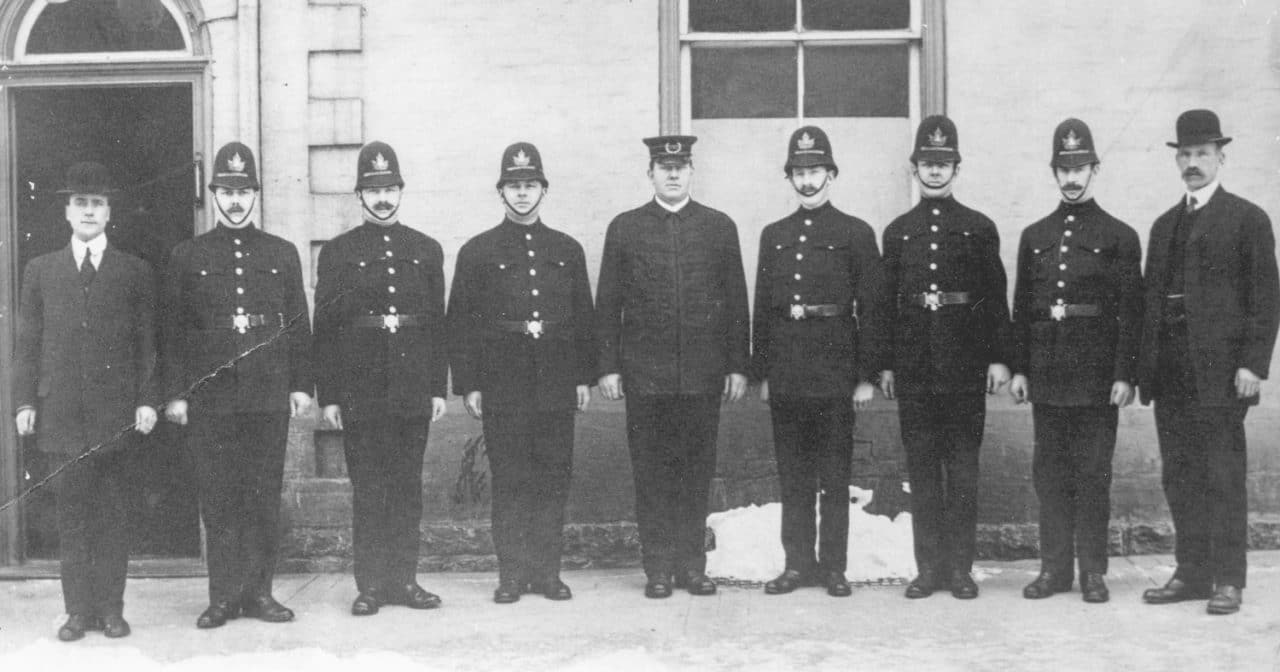
By the turn of the century the residents of Peterborough had had enough of Halloween and wanted the holiday to be canceled, or at least the destruction of property stopped. Year after year, they woke to discover missing gates and fences or front steps. In 1895, the Peterborough police even urged citizens to take in their gates in order to spoil the fun of the youngsters, and many did, which was noted in the newspaper.
Due to the overwhelming concern of town citizens, the police created a special force in the late 1890s which was on duty only for Halloween night. They patrolled the streets and arrested anyone seen destroying private property. Fun and harmless acts were to be tolerated and even appreciated, but more damaging aggression was prohibited and could result in a young boy spending his Halloween night in the police station.
Other acts such as masquerading in women’s clothing were also not tolerated as was noted in 1894 when two men who masqueraded down George Street were quickly brought into the police station. Interestingly enough, in 1906 police noted that two women who were dressed as men had paraded down George Street — apparently no action was taken against them.
In 1901 the Examiner read: “Tonight is Halloween and the small boy will no doubt be up to his usual tricks. The police do not mind the young people enjoying themselves, but any attempt at disorderly conduct will be firmly dealt with. The chief intends to keep a sharp look out for any boys or young men who may carry their pranks too far.”
The next day, a message from the Chief of Police was also placed in the newspaper declaring the holiday officially over, in the hopes that the destruction would cease as well. One example was found in 1902. “The chief wishes to tell the boys now that Halloween is over, they had better put their peashooters away for the present otherwise they may get into trouble.”
In 1903, the police put forth a stronger message. The police chief strongly distinguished between harmless fun and the destruction of property. “They must differentiate innocent mischief from malicious injury to property. Hanging a butcher’s cart in a church steeple is fun, but there is no fun in destroying the hinges of a widow’s gate and putting her to an expense.”
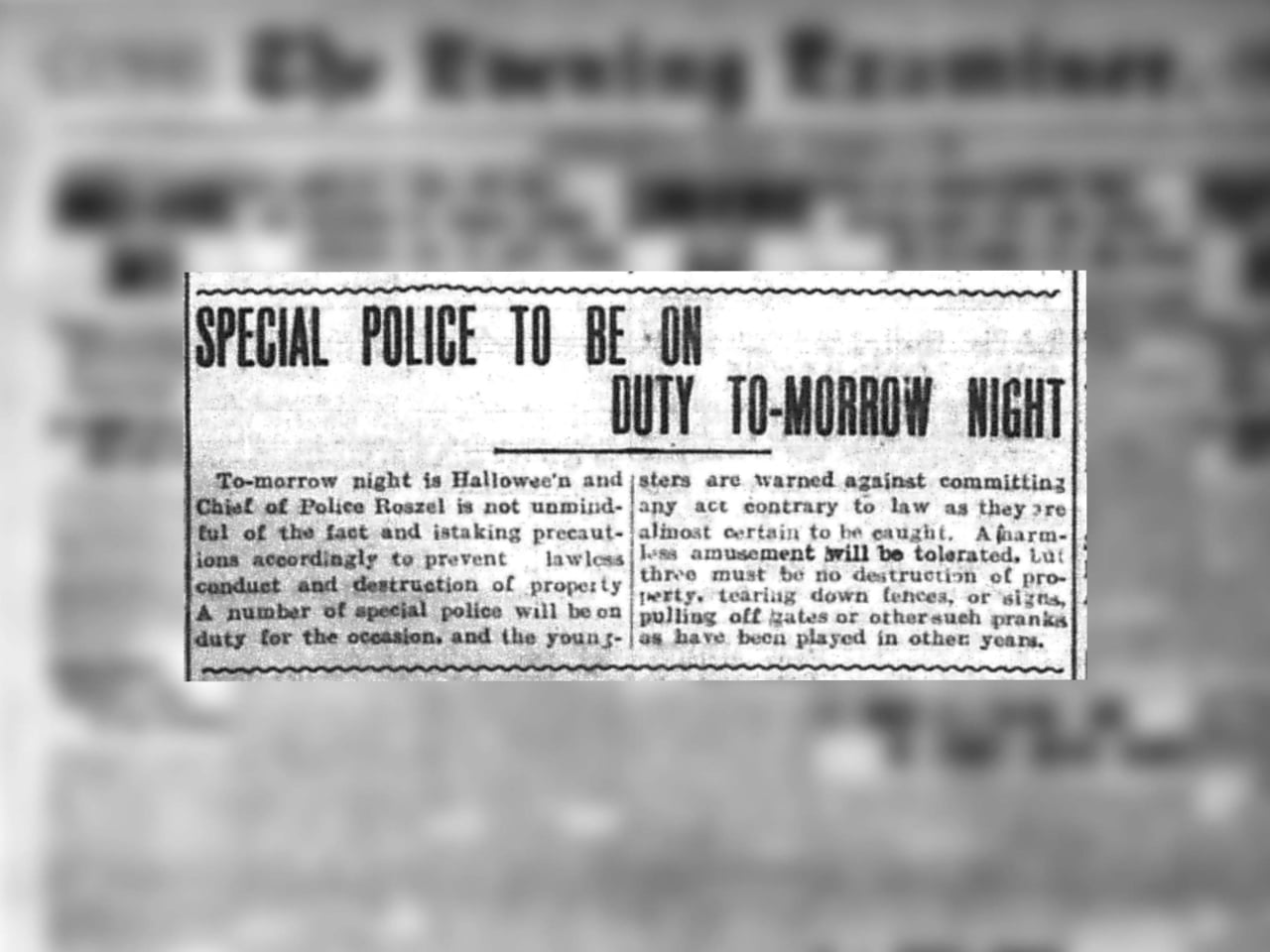
Halloween pranks may be acceptable for rural communities, but Peterborough had “outgrown” such primitive ways of “observing the vigil of Halloween.” Uprooting cabbages, unhinging gates, and similar “rustic horseplay” might have been fine a half century earlier while Peterborough was still in its village stage. Boys should let the holiday pass. But they seemed to want to have their fun, regardless of good taste and civic dignity.
Some citizens took matters into their hands and played tricks upon the tricksters. In 1906, one man placed a thick coat of tar at the front of his house to prevent his front steps from being carried off once again; indeed, the culprits were quickly caught. A man in 1924 rigged his chicken coop so that a trip wire would cause buckets of water to fall on Halloween pranksters.
In the late nineteenth century there were the usual five or so police officers which were regularly on duty Halloween night. This was increased in 1904, to thirteen officers on the “special force.” By 1906, the Peterborough police were threatening a force of fifty special officers.
“Chief Roszel wishes to say that harmless fun will be overlooked, but that there are fifty special policemen for those who carry off gates and other acts of vandalism,” an editorial in the Examiner stated in 1906. “In years gone by, Halloween was accompanied by the wanton destruction of property, but the law has asserted itself and this custom is being generally overcome. Disorderly conduct will be sufficient to cause an arrest. Thus, youth are given a last warning not to act as ruffians unless they wish lodgings in the police cells.”
Clearly, the police were taking a harsher view than even a few years earlier. In 1907, five boys who removed the gate and tore down the fence of D.H. Burritt were arrested and eventually fined two dollars. The Examiner noted, “Halloween had been taken back by the police.”
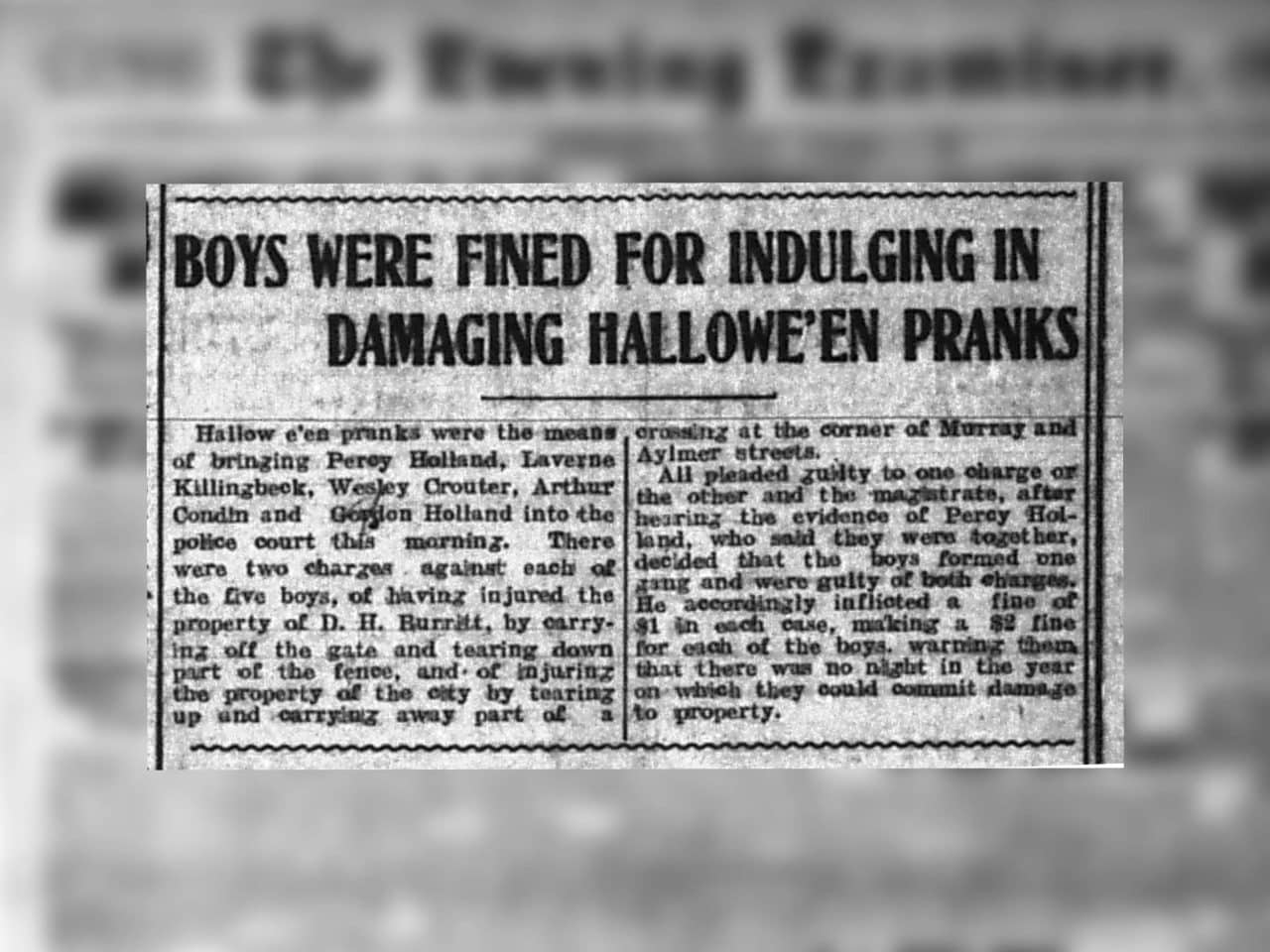
By the 1920s, there were fewer Halloween pranks, and those mostly in residential areas. The police had cars which permitted quicker response to incidents.
Perhaps more important, the Halloween parade became a popular downtown fixture by 1925. People found the parades entertaining, noisy and fun. Both boys and girls paraded in costumes and carnival bands played.
In 1929, the Examiner reported that in four years of parades, there had been less destruction in most areas; in the downtown, vandalism virtually disappeared. Apparently the boys were kept busy either participating or watching. Also, the parading police officers were highly visible, and so many people downtown “en masse” deterred vandals.
The crowds gathered early and stayed late. Most stood on the pavement but many sat in parked cars. The parade was a “sane and happy” way to celebrate Halloween. The popular costume contest was a source of amusement and entertainment, and many watching the parade were also in costume; watching was as important as parading.
The parade route which wove through downtown began at the Armoury around eight o’clock, and ended there with an organized masquerade party lasting until eleven in the evening. The Examiner noted that “Everyone hurried over to the armouries there to trip the light fantastic to the music as dispensed in a right blightsome style by the band of the Peterborough Rangers.”
It was also noted that, “En route vagrant troubadours serenaded girls who were boys, and girls openly flirted with boys who were girls. It was a jolly mix-up. Nobody knew who was who, and neither did they care. All were partners in fun and the whole affair passed off without a single marring note.”
Attitudes had changed dramatically. In earlier years, Peterborough residents would have frowned on males who dressed as females and vice versa. However, in the 1920s, crossdressing for Halloween seemed humourous and acceptable. Halloween was less “scary” and “mysterious” now that everyone got together and had a good time. As the parade changed Halloween, the young boys had lost their holiday of misrule.
The girls of Halloween
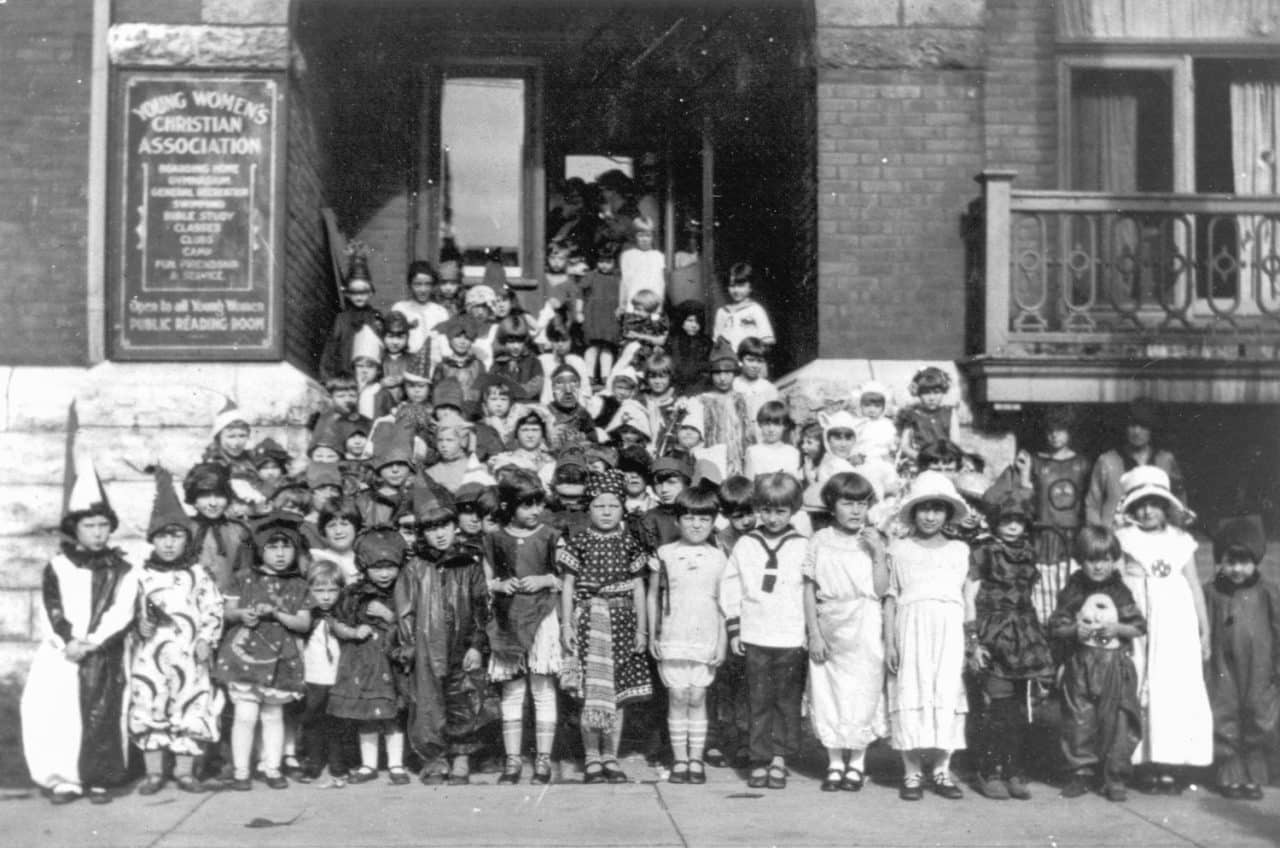
Where were the girls while the boys ruled the streets at Halloween? Even as Halloween was a “prankish boy’s delight,” it offered much for the “fun-loving girl.” Until the twentieth century, females, rarely seen in the streets on Halloween, generally attended indoor social events such as community dances held in the halls of city lodges and churches, or at the YWCA — The Young Women’s Christian Association.
These well-advertised events attracted some boys, and were sometimes held the night before Halloween; on Halloween night, girls would be at home rather than consorting with boys. However, these events were primarily for girls. In 1903, a Halloween social at the YWCA featured story telling and games. Some of the stories were told by young boys telling of pranks played in previous years.
At most Halloween events preceding the turn of the century there would be up to 150 girls in attendance, and close to 300 in the two decades following. Such large numbers could account for the scarcity of girls in the streets.
Interestingly, only one article was found which described females taking part in an act of vandalism. However, this does not necessarily mean that they were not participating in them. In 1888, three girls stole a sign from a confectioner’s store on George Street and were witnessed by police who hid and watched, finding the whole event extremely amusing. This was a very different reaction from the serious and stem attitude the police took with young boys.
As years went by, girls seemed to be congregating more with young boys on the streets, although not taking part in damaging property. In 1911, the newspaper reported that between Dalhousie and Chamberlain Street, small groups of girls and boys were ringing doorbells and hitting townspeople with peas. The girls were dressed in male clothing. In speculation, it is possible that girls had been disguising themselves in such a manner in previous years in order to participate in boys’ activities.
The masquerade parties that females attended seemed to hold the traditional values of Halloween. Most of these parties had dancing, singing, taffy-pulls, bobbing-for-apples, poetry-reading, indoor games and the telling of ghost stories. Here, girls of all ages — most accompanied by their mothers — would dress up in costume. For these costumed girls, Halloween was viewed more as a social event in which one could visit with their neighbours and partake in innocent merry-making than being either a night of mystery or of mischief.
The costumes were the cause of much of the evening’s talk and contests judging the skill of construction and the originality of design were held. These contests generated much competition between the participants who annually attempted to out do each other. Refreshments were served, especially the traditional favourites: apples, nuts, and candy. Although candy was handed out to young girls during these socials, trick-or-treating was not mentioned in the Examiner until the 1920s.
Some girls held private Halloween parties which were advertised in the newspaper and became very popular after 1900. Dimmed lights and occasional drafts were used to suggest the invocation of spooks and spirits. For the guests these conjurings were the occult and scary side of Halloween. Vivid orange and smiling pumpkins with gaping teeth, scarlet apples and nuts all symbolized the prankish goblins who sallied back and forth on All Saints Eve for their annual frolic.
In an article dated 1905 there is an example of a typical Halloween party. It stated, ”Last evening the home of Mrs. Symons of 291 Reid Street was the scene of a Halloween party. At the witching hour of 8pm the boarders assembled in the drawing room which was decorated with pumpkins and candles etc.” In most cases, all the guests who were invited were listed in the article, and only rarely did boys attend.
Traditional divination games which involved apples were a traditional choice. The sight of apple parings in the streets in 1894 suggested that divination games were still in existence. The custom of the holiday was to pare an apple being careful not to break the peeling. Then one threw it across one’s left shoulder while chanting, “I pare this p’ppin round and round again, my lover’s name to flourish on the plain! I fling unbroken parings o’er my head! Upon the floor my lovers name to read.” The parings on the ground would form the initials of the child ‘s future partner.
Parties would have apple-paring bees in which children competed to have the longest paring, and Halloween sports such as burning nuts before a fire. One of these games in 1898 involved a bowl of applesauce inside of which were an almond, peanut, chestnut, and walnut. Everyone had to eat the mixture with spoons until each nut was found; each symbolized a different fortune: the almond symbolized wealth, the walnut symbolized happy marriage, the chestnut meant that the child would travel far, and the peanut was a symbol of bad luck.
Bobbing for apples involved filling a tub half full with water and placing apples with boys names on the stems inside. Girls would lean over and remove an apple with their teeth, the name they chose indicated which boy they were going to marry. This game was occasionally played with forks so that girls would not mess their hair. Carving pumpkins and even turnips was also popular.
Another game involved young girls jumping over candlesticks in their long skirts. Whichever candle did not go out with the breeze of her long skirts would be the man she would marry.
These examples illustrate how the Examiner helped shape Halloween through their articles. Because many women read the paper, changes in the practices of the holiday were accomplished through its suggestions. Articles defining the proper Halloween protocol were published and to a great degree created the standardized and popular Halloween celebration. The paper included everything from proper attire, decor, and food to what activities were appropriate. As these celebrations were very traditional, much of the paper’s advice was recycled annually.
By the 1920s parades and informal parties on Halloween seemed to be the newest form of entertainment in which all could take part. Costuming made up a large portion of the entertainment as well, and numerous stores on George Street sold costumes or sold patterns for costumes that mothers made for their children. Dressing up was evident in all classes and all ages. Children would dress up in order to seek candy from houses or parade, while adults would masquerade for parties and dances. Boys dressing as girls and vice versa was extremely popular during this time.
What the Examiner’s coverage of Halloween tells us about early Peterborough
The Examiner’s coverage of how Halloween was celebrated in the town of Peterborough provides a sense of what life was like between the years 1890 and 1929. First, it tells us that the town of Peterborough was a church-oriented society. There were four main churches downtown, each holding Halloween socials annually attracting large numbers of people. The largest parties were held by the Y.W.C.A, another religious institution. Second, examining the newspaper shows that Halloween in Peterborough was still practiced very traditionally, especially by girls. Through their dances, songs, recitals and divination games, young women were able to pass these traditional aspects of Halloween down to their children. Third, the Examiner illustrated that the boys of Peterborough held their own annual Halloween “tradition” of misrule as well. Peterborough boys were no less typical than other boys from neighbouring towns who participated in destructive pranks on Halloween night. Fourthly, the Examiner’s coverage of Halloween demonstrates the growing fear of the Peterborough police force. Expanding from thirteen officers to fifty in three years had a significant impact on those who lived in the town and those who wanted to vandalize on Halloween night. Undoubtedly, as Peterborough was still small in population, fifty policemen would be evident in the streets. This change illustrated the growing fears and frustrations of citizens as well, as they longed for the Halloween pranks to cease and be replaced with “safer” indoor games and trick-or-treating.
Finally, we see the shift in the celebration of Halloween once the Examiner established the Halloween Parade in 1925. The parade, which was created in an effort to reduce the vandalism occurring in the downtown district, changed the holiday significantly. Halloween was no longer the young boys holiday — the mischievous, scary, and mysterious holiday that it had been for decades previously. Instead, it had changed into a “fun time for all!” A community event. The number of Halloween parties seemed to decline. Vandalism was almost non-existent. And whatever “rules” were in place before the parade, such as the one against crossdressing, were relaxed.
I firmly believe that the creation of this parade was to change Halloween to be an “acceptable” holiday for children, and more importantly, for adults. The most important aspect though was that the holiday persevered, and that while certain practices were lost or altered, the festival of Halloween remains with us still today to be enjoyed by adult and child alike.
Author

Related Articles

Uncovering the history of the Curve Lake Day School
New book reveals a pattern of abuse, cultural erasure, and systemic neglect by the Canadian government

A century on, descendants of early Chinese restaurant owners still run businesses in Peterborough
Local restaurateur and bar owner Shannon Mak’s great grandfather ran a downtown Chinese restaurant starting in the 1910s
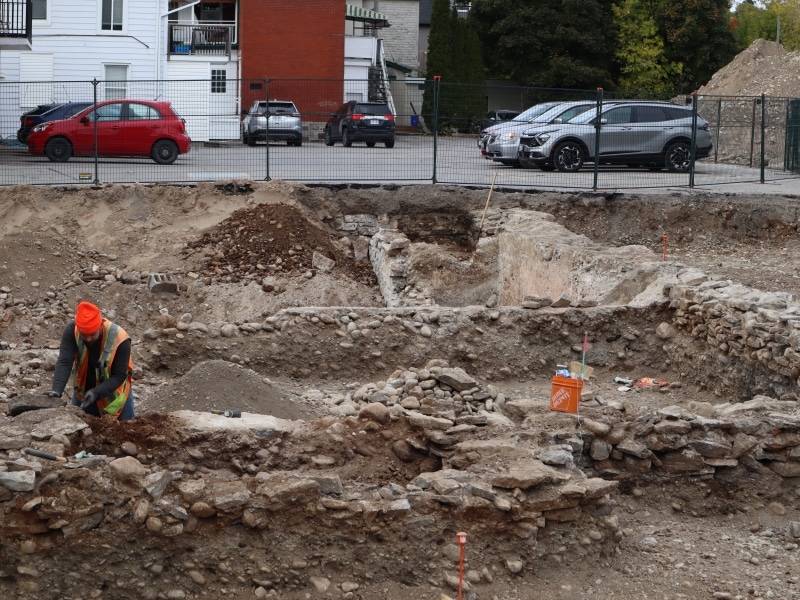
Archaeologists unearth foundation of 19th century church on George Street
The foundation was buried under a parking lot, but the frame structure of the church that once stood there was preserved in the 1990s
