
Advocates raise concerns over police crackdown on public drug use
“What we’re seeing here is the stigma winning,” said Mkwa Giizis.

Mkwa Giizis felt “very nervous” as they set up the Tweak Easy on the evening of October 6, 2023.
The 2022 YMCA Peace Medal recipient cofounded the Tweak Easy, an unsanctioned and volunteer-run overdose prevention site primarily serving inhalation drug users, two years ago. Volunteers at the site share space with drug users, watching to make sure no one overdoses and handing out donated supplies such as socks, snacks, and winter gear.
Peterborough’s Consumption and Treatment Services site offers government-sanctioned safe use services for people who inject drugs. But inhalation is not allowed there. That means there is no location in the city where it is safe and legal for people to smoke drugs. That’s the gap Tweak Easy tries to fill, if only for one or two evenings a week.
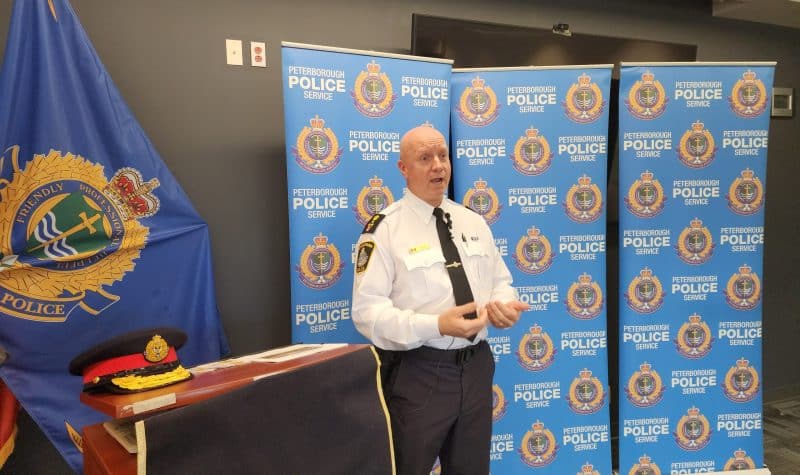
But a new policy from the Peterborough Police Service puts the initiative on shaky ground. On Thursday October 5, Chief Stuart Betts unveiled a new “no-tolerance” approach to the use of illicit drugs in public.
“We have seen a proliferation of open-air drug use in our community,” said Betts at a media conference. “It’s creating an environment where community members have expressed concern and fear.”
Effective immediately, officers can now stop people who are using illicit drugs in public and order them to move to a different location, Betts announced. If drug users don’t comply, they will be arrested and their drugs will be seized, he said.
The goal of the new approach is to “send a clear message that all public spaces should be considered safe for all residents.”
Betts said that he doesn’t intend to charge people with possession of drugs under the Controlled Drugs and Substances Act and that he intends for people to be released unconditionally after their drugs are seized. But he said that “there may be other things that spring from that investigation” which could lead to charges.
Many local politicians were pleased with the move.
“Thank you for your leadership. Public safety needs to be a priority,” wrote MP Michelle Ferreri on social media.
“I commend the police service for what they’re doing,” said Coun. Kevin Duguay during a general committee meeting. “I commend the chief for his announcement.”
“Chief Betts has articulated that police clearly understand that people with addictions who are using illegal drugs in parks and public spaces need to be directed to supports,” Mayor Jeff Leal stated, in part. Leal did not respond when asked whether his statement amounted to an expression of support for the new approach.
Giizis didn’t know what to do on Friday night. Would visitors to the tent be at risk of arrest?
“When the announcement came out, the first thing we thought about was like, ‘How are we going to be able to help people?’” they said.
Canceling on Friday would have been difficult, Giizis said, because many who use the Tweak Easy don’t have phones. “And, I didn’t want to feel like I was letting [the police] win by canceling,” they said. “So we just went forward with it.”
In the end, Giizis said it was a typical night, with community members dropping by throughout the evening to use drugs, chat, get supplies, and discuss the potential impacts of the police chief’s announcement.
Despite the relatively calm night at the Tweak Easy, the ground has shifted for drug users in Peterborough, and Giizis said they feel disheartened. To Giizis, concerns about public safety regarding people who use drugs are overblown.
“Many of these people are my friends,” Giizis said. “And in reality, I know at the end of the day 99 percent of these people are more likely to hurt themselves than they are anyone else.”
Giizis believes the Chief’s announcement is more about hiding from view the poverty in our community. “The privileged people of Peterborough have spoken,” they said. “They don’t want to see homelessness. They don’t want to see poverty. They don’t want to see mental illness or drug use in the streets.”
“What we’re seeing here is the stigma winning.”
Health unit opposes new crackdown on public drug use
Hours after Chief Betts made his announcement, Peterborough Public Health expressed opposition to the new policy. A statement from the health unit said the new approach “differs significantly from an evidence-based, public health approach to substance use.”
“Sick people are not criminals,” medical officer of health Thomas Piggott said in the health unit’s release. “The Chief’s approach, in the absence of changes to enhance access to treatment and prevention services, criminalizes people who are vulnerable and ill, and pushes them further from help and support.”
Star Fiorotto, a local harm reduction outreach worker, echoed that concern. “The bad effect would be that [people who use drugs] go into hiding to use,” she told Trent Radio. That could make it harder for her to do her job and connect people to resources, she said. “When we can’t find them, we can’t help them and we can’t treat them.”
“What we need are more supports, not more policing,” Fiorotto said.
Chief Betts acknowledged that there is a shortage of services to support drug users in Peterborough. “There is a lack of other resources that are out there,” he said in an interview with Currents. “That isn’t the responsibility of the police to create those resources.”
Still, Betts said directing people toward help is the goal of the new policy. “We’re doing our best to try and connect them to local resources,” he said. “It’s about connecting them and providing them with information on where they can get help.”
At his press conference last week, Betts unveiled a pamphlet that officers can provide to drug users. The pamphlet lists some resources in Peterborough, along with phone numbers people can call if they want help to address their substance use.
Attendees at the Tweak Easy poked fun of the pamphlet on Friday night, noting, for example, that the phone number listed for the Elizabeth Fry Society’s peer support program wasn’t correct. (When Currents dialed the number, a recorded message said the line wasn’t available. “Goodbye,” the recording said, before the line was disconnected.) Chelsey McGowan, who runs the program, said it is “coming to an end as of March 31 due to funding.” Police have since released a new pamphlet without that particular service included.
Carolyn King, who manages the safer supply program at the 360 Degree Nurse Practitioner-Led Clinic, said clinic staff were surprised to see their agency listed on the pamphlet. The clinic “is not a drop-in/walk-in service for the community,” she wrote to Currents by text message. “It only provides services for rostered patients.”
Giizis said drug users already know about the services that exist in town. “A lot of these people are already connected to resources and support,” they said. “Unfortunately, without housing, there’s nothing any agency in the city is going to be able to do.”
Donna Rogers, the executive director of addictions treatment provider Fourcast, agreed that housing is the big missing piece. “Any solution around open air drug use has to include conversations about housing,” she said. “Housing is the foundational solution for recovery.”
Rogers said the services listed on the pamphlet will not alleviate the issues around housing, health care, and poverty that are driving drug use. “We’re not offering a safe space to use. We’re not offering housing. We’re not offering any kind of health care,” she said.
Without those additional supports, the Chief’s approach alone won’t solve the problem, she said. “It needs such a more fulsome set of solutions.”
Peterborough’s no-tolerance approach could be a vanguard in Canada
Betts said his idea for the new approach to public drug use crystallized after he had dinner with Edmonton’s police chief in August. Edmonton was planning its own no-tolerance crackdown on public drug use, and Betts agreed that it was the right approach to take.
Betts waited a few weeks to see how Edmonton’s rollout worked before instituting the approach in Peterborough, he said.
All the while, the province of British Columbia was preparing its own ban of illicit drug use in many public spaces, unbeknownst to Betts. And B.C. Premier David Eby’s NDP government happened to table its legislation on the same day Betts announced Peterborough’s new approach.
Betts said British Columbia is “walking back the decriminalization and the permissiveness for open air illicit drug use in their entire province.”
These new policies may signal a nation-wide shift. In 2020, the Canadian Association of Chiefs of Police voted to endorse the decriminalization of the possession of drugs, stating that “merely arresting individuals for simple possession of illicit drugs has proven to be ineffective.”
But Betts said that in places like British Columbia, where a decriminalization pilot is underway, the policy “has created an unstable environment in terms of public safety.”
Betts took issue with Peterborough Public Health’s statement, which said the Chief’s new approach departs from “the shared approach of this community for the past 14 years,” a reference to the history of the Peterborough Drug Strategy.
“Here we are, 14 years in, and nothing has gotten better,” Betts said. “If anything, things are getting worse.”
Author

Related Articles

Province to support Peterborough Street Medicine team with over $1 million a year for three years
Program aims to increase access to primary care for people experiencing homelessness and divert traffic from emergency rooms
Architecture firm denies blame for PRHC’s leaky roof
Hospital, architecture firm and general contractor all point fingers at one another in court filings over PRHC’s faulty roof, which may take years to fix.

Moms call out stigma at event honouring victims of the local drug crisis
Participants said their loved ones faced stigma when seeking help — including at Peterborough’s hospital. “We have a lot of growth to do,” a hospital representative responded. “But we’re trying very hard to get better.”
