
As the Rotary Trail turns 30, it’s still a work in progress and still “one of the best things about Peterborough”
Paving of the first leg of the well-used trail began in September 1994.

In the summer of 1974, Kerry Banks and two friends cycled all over Peterborough imagining where a network of “bikeways” could one day be built.
“People thought we were a little crazy,” said Banks, who now lives in Vancouver, over the phone. Back then the idea of building bike lanes and trails was only starting to get a hearing in some Canadian cities and was considered “very radical,” according to Banks.
“Cyclists weren’t really welcome on the roads,” he said. “Drivers resented our presence.”
Banks and his friends wanted to change that mindset by giving everyone in Peterborough the chance to experience “the joy of journeying upon a bicycle,” as they wrote in a report laying out their vision for a bike-friendly city.
The Peterborough Bikeway Report, which the friends published in 1975, proposed an extensive network of bike lanes and paths throughout the city.

Banks, a new Trent University graduate at the time, said he and his friends got a polite but lukewarm reception when they pitched their ideas to city officials and community groups.
“We could see the potential there, but it’s a little disheartening because there wasn’t a lot of enthusiasm coming back about it at the time,” he said.
In the subsequent decades, however, some of the routes the friends proposed did become part of the city’s multi-use trail network, such as the Jackson Creek Trail and the Parkway Trail.
And their dream of a corridor along the east bank of the Otonabee River eventually became a reality when the first leg of the Rotary Greenway Trail in East City was built in September 1994.
It’s now been 30 years since construction began on that 15-kilometre trail, which today has become an indispensable part of the city for the many locals and visitors who flock to it year-round.
“It’s one of the best things about Peterborough,” said Annie, who didn’t give her last name, as she stood on the trail on a muggy July morning. “I just feel it’s essential to Peterborough and it would be foolish to lose any part of it.”
She especially loves that the route is flanked by greenspaces like Rotary Park and other undeveloped land along the river, which she said should stay untouched. “The river side should always stay for the people to enjoy, and birds and things.”
North-end resident Steve Smith said he felt like he was “living in paradise” as he cycled along the trail near Trent University on a recent morning, something he’s been doing since the mid-1990s.
“This saves me from taking the car,” Smith said, who was on his way to a workout at the YMCA on Aylmer Street. “I love it. It’s a tremendous asset.”
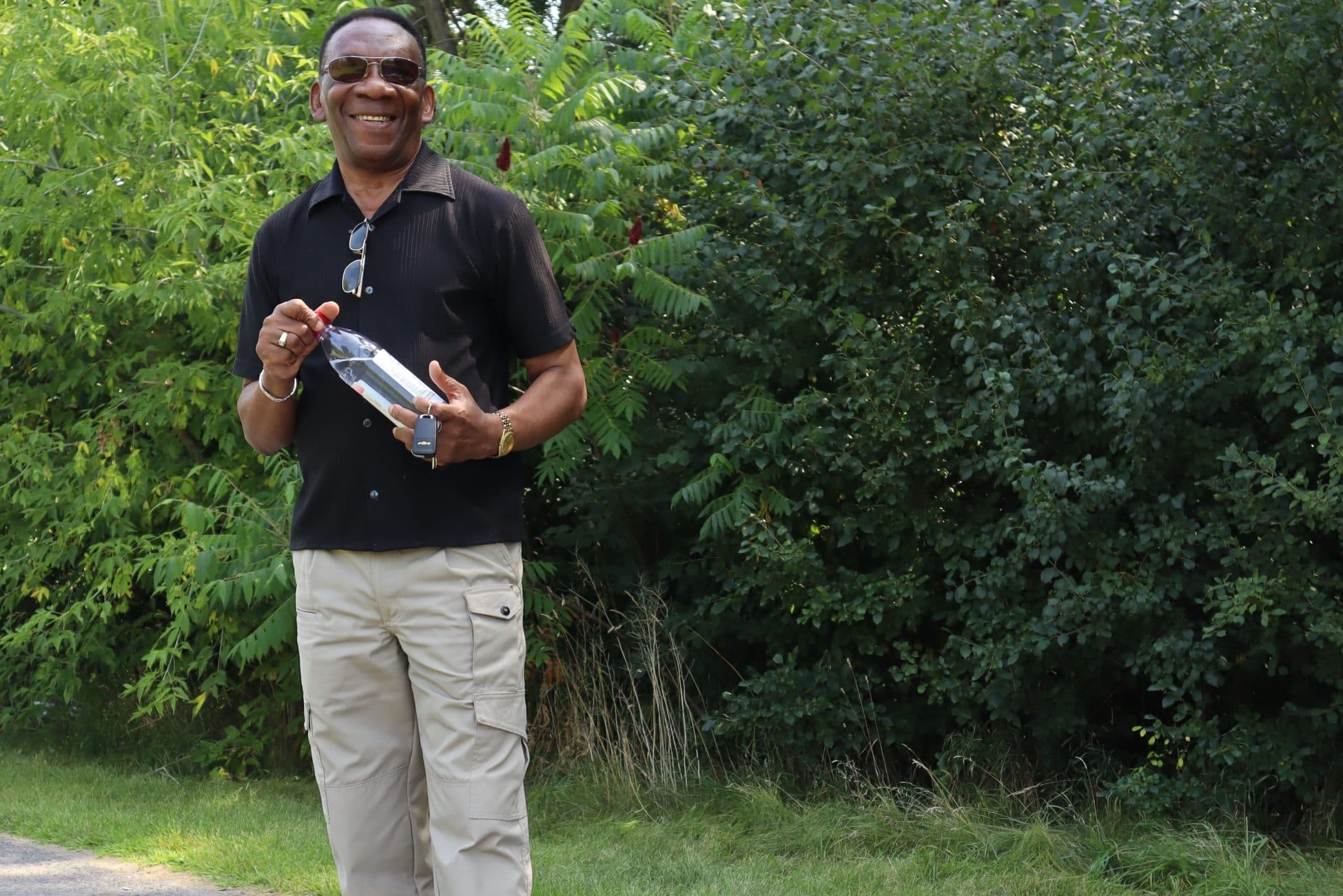
Max Rochester loves taking long walks along the Rotary Greenway Trail after spending his week in the noise and chaos of downtown Toronto.
“It’s quieter here and it’s more enjoyable to walk,” said the Toronto resident who visits a friend in Peterborough every weekend.
Rochester said people usually say hello as they pass him on the trail, which reminds him of growing up in Barbados.
“You have to say hello to adults on the street,” he recalled of his childhood on the Caribbean island nation. “If my grandmother knows that I didn’t say it, I have to explain why.”
In Toronto his greetings fall on deaf ears, but not so on the trail in Peterborough. “Some people even stop and talk,” he said.
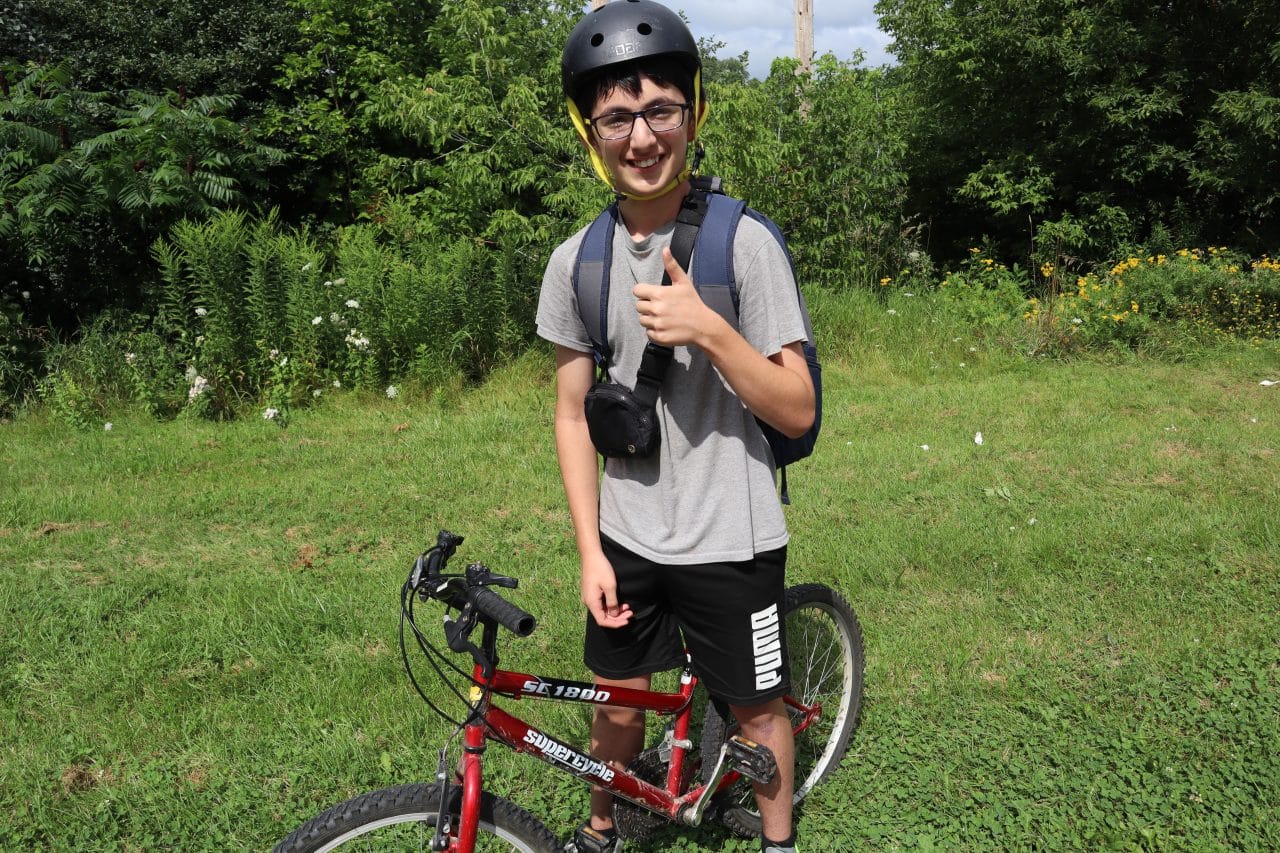
Trail took more than 20 years to pave – and it’s still not complete
The Peterborough Examiner reported in November 1993 that city council approved a plan by the Rotary Club of Peterborough to build a “public hike and bike trail” along the east side of the Otonabee River.
It was hoped it would become a “major bike route” for Trent University students, diverting them off Water Street where bicycle traffic to the university was “becoming hazardous,” according to one city council member.
The city had recently purchased several kilometres of railway lines abandoned by Canadian National Railway when the company pulled out of Peterborough in 1989.
The Rotary Club, the city and the province all pitched in funds to pave the trail along the old railway bed from Hunter Street East to Parkhill Road in 1994 and then further north to Armour Road in 1995, the Examiner reported at the time. The cost, which also included paving a section of path between Beavermead Park and the Trent Severn Waterway, was just over $110,000.
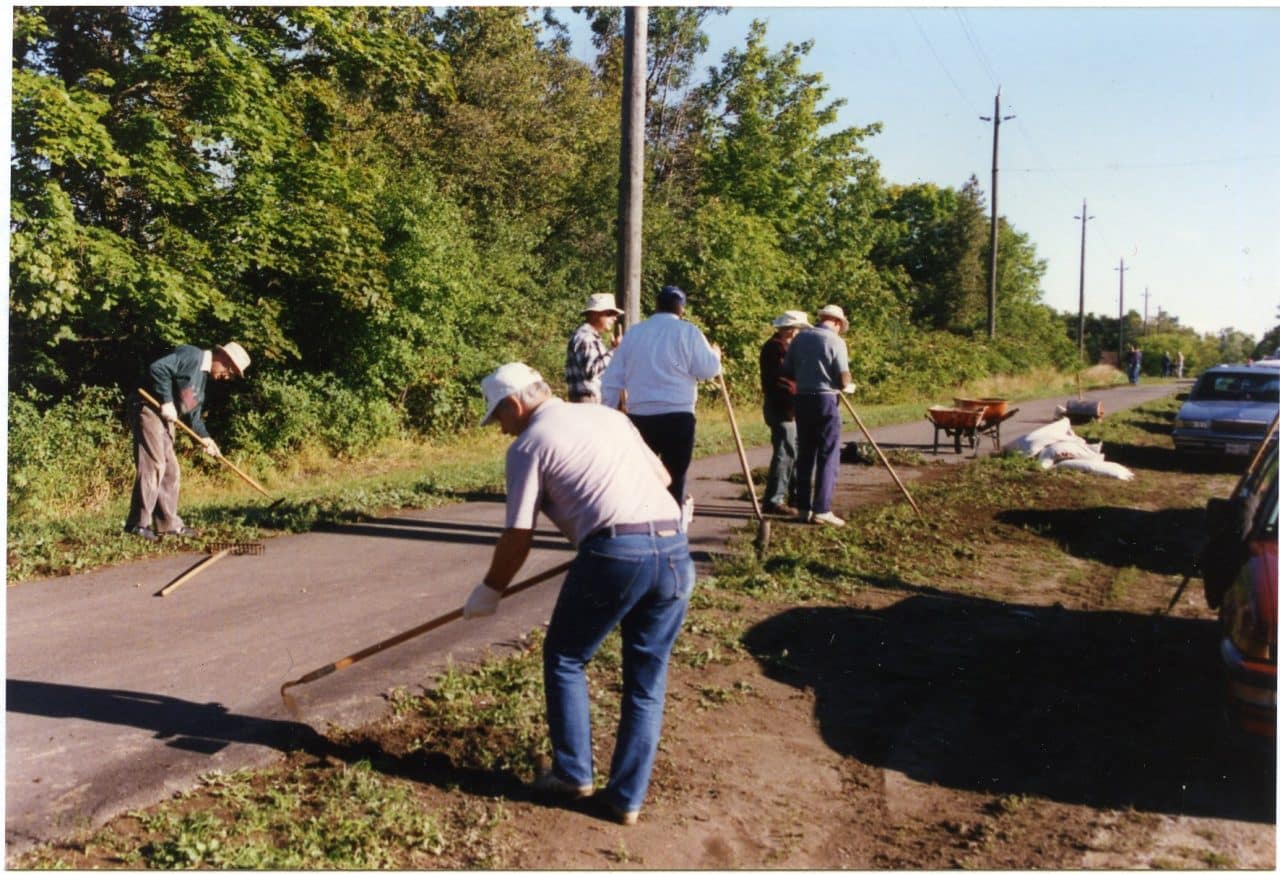
The trail grew over the years and decades, with new sections and offshoots paved as money was raised. “It’s a pay-as-you-go project,” long-time Rotary trail committee chair Charlie Burge told the Examiner while fundraising to build the section from Hunter Street East to Sophia Street in June 1998.
“We have to make sure we have the money before we can do any extensions,” he said. “We eventually want to make it like a promenade around the river and through the town.”
The most recent addition, along Nassau Mills Road to Trent University’s Faryon Bridge, was paved in 2015. But the city stopped short of extending it all the way to East Bank Drive, where a gravel section of the trail leading to Lakefield begins. The gap was supposed to be filled in a few years ago, using $750,000 Peterborough received from the Ontario Community Infrastructure Fund. City council approved the project in March 2021, but it was stalled after the city determined that the road allowance under the bridge was too narrow to allow the trail to pass under it, according to city spokesperson Sharron Hatton.
Part of trail was slated to become a “downtown bypass” road in the 1990s
“Our trails are really a gem,” said Lindsay Stroud, the city’s transportation demand management planner, after hopping off her bike near where the Rotary Trail crosses the intersection of George and Hilliard streets. This section, officially known as the Rotary Greenway Trail Link, is a feeder line to the main branch on the east bank of the river.
“I like to think of our trails as pretty strong commuter corridors,” said Stroud, addressing a group of about a dozen people who were on a tour of the Rotary Trail as part of the Peterborough Bicycle Advisory Committee’s cycling summit last April. “This is one of those commuter corridors that I think gets used very well every day.”
But this car-free commuter corridor almost became something else in the 1990s — a downtown bypass road.
The city’s 1991 master plan called for a new street to run diagonally from Aylmer Street north along an abandoned railway bed to the junction of George and Water streets. Called the “Aylmer Street extension,” the plan had been on the books for many years, according to an Examiner article from the time.
But by 1999, the city’s priorities had shifted and the Examiner reported in June of that year that the Rotary Club was working on the leg of the trail near the junction of George and Water streets. Now that section is set to get an upgrade. The city is planning a redesign of the intersection of George and Hilliard streets, including the addition of traffic lights, to make the crossing safer for trail users. Lighting will also be installed along the trail from Hilliard Street to Bethune Street, with construction slated to start in spring 2025.
Improvements are also coming to the Rotary Trail crossing at Hunter Street in East City, where work to install a new set of traffic lights is set to begin this month.

City plans to realign Armour Road along Rotary corridor
But the city is still eyeing another section of the former railway bed where the Rotary Trail now runs to eventually turn into a road.
Peterborough’s transportation master plan calls for the stretch of Armour Road from Cunningham Boulevard to Nassau Mills Road to be realigned to follow the current trail corridor.
The old railway bed runs in a straight line, whereas Armour Road north of Cunningham Boulevard winds along the Otonabee River. So the idea is to build a new section of road along the former rail corridor to give drivers a more direct route. If construction goes ahead “the existing trail would either remain as is or would be replaced, depending on the design for the Armour Road realignment,” according to city spokesperson Sharron Hayton. Construction isn’t set to happen anytime soon. First the city needs to complete a study of the realignment proposal, but that study is “not active” right now because “other projects are prioritized,” Hatton said.
The plan doesn’t sit well with Anna Rodenburg, who uses the Rotary Trail to get to her job at the Camp Kawartha Environment Centre, on Pioneer Road, everyday in the summer.
Her commute to work is “peaceful” and she doesn’t want it to change. “You get nothing like it anywhere else, I would say,” she said.
Resident Steve Smith said he is “suspicious” of the proposal to realign Armour Road. He said whatever changes the city makes should not “detract from the quality of what we have now.”
Trail user Eugene More said he is open to the city’s proposal, but in the meantime he said the trail in that area is full of large cracks and “needs new pavement.”
“But so do all the streets in Peterborough,” he said.
More is getting his wish this week: starting Monday August 26, crews will be smoothing out the trail from Armour Road to Nassau Mills Road, by sealing cracks and repaving some sections, according to the city. Work is expected to wrap up on Sept 2.

Planned trail expansions stalled over cost concerns
West end resident Pat Asselin said he finds it “pretty difficult to get across the city” because “there’s not really a good trail system east-west.” He hopes that one day the Rotary Trail will link seamlessly with other routes around the city to create a true cycling network, he said.
“It’d be nice if there could be a bike trail system all the way around the city that was strictly trails so you didn’t have to ride roads,” said Asselin, who first discovered the Rotary Trail while working at Quaker Oats in the 1990s and has been riding it ever since.
A more connected trail system would also be a big tourist draw, according to Asselin. He came across a pair of tourists from France on the Crawford Trail in the south end earlier this summer who wanted to bike to Lakefield. But he said he couldn’t help them because that trail doesn’t connect to the Rotary Trail.

Plans to complete the Crawford Trail from the south end to downtown, where people could connect with other routes like the Rotary Trail, have been continually delayed in recent years due to lack of funding.
That’s not the only trail project to be stalled over cost concerns in recent years. A plan to build a trail bridge over the Otonabee River, just upstream from Lansdowne Street, is also on hold. The city put out a request for proposals for a consultant to conduct an environmental assessment for the project last year, but all of the bids came back “significantly over budget,” former acting infrastructure commissioner Michael Papadacos told council last fall. As a result, staff had to “take a pause” and “re-evaluate” how to move forward, he said. The bridge is crucial to the city’s plan to eventually have a path all the way around Little Lake.
Kerry Banks, who co-authored the Peterborough Bikeway Report, moved away from the city in the 1970s, when CN trains still plied the routes that today carry cyclists and pedestrians. (There used to be train tracks right down the middle of Bethune Street, where he lived, and trains going by “shook the house all the time,” he said).
While he felt disappointed at the time that there wasn’t more enthusiasm for his proposals, he said he’s “glad to see that people have taken the torch and proceeded to push the agenda of having the bike routes.”
“It just confirms our original premise that there’s a lot of potential there,” he said. “But it took a while to just take effect.”
This article was updated to reflect comments the city provided after initial publication, regarding the stalled plan to extend the Rotary Trail under Trent University’s Faryon Bridge and the proposed realignment of the Armour Road near Trent.
Author

Related Articles
Promoting preparedness in East City
A grassroots movement aims to help neighbours out in the next big storm

A century on, descendants of early Chinese restaurant owners still run businesses in Peterborough
Local restaurateur and bar owner Shannon Mak’s great grandfather ran a downtown Chinese restaurant starting in the 1910s

Self-esteem coach. TV camera operator. Blacksmith. Volunteer fair showcases some unexpected ways to give back.
With volunteering on the decline in Canada, Volunteer Peterborough is trying to make it easier to contribute
