
Local astronomy group keeps looking up
Members of the Peterborough Astronomical Association gathered to watch last Thursday’s total lunar eclipse. The group meets monthly and welcomes newcomers.

The night was crisp and still on Thursday, March 13, for the “Blood Worm Moon” total lunar eclipse. The stars shone brighter as the moon’s glow dimmed. Over the course of several hours, Earth cast a dark shadow over the moon’s face, turning it a dusky red by around 3 a.m.
A small group of local astronomers gathered at Harold Town Conservation Area to watch the big celestial event. Bundled up in winter coats, thick mitts and thermal socks, they adjusted their scopes to get a closer look at the lunar eclipse as it progressed.
“This is the best you could possibly hope for this time of year,” said Rick Stankiewicz, publicity director for the Peterborough Astronomical Association (PAA). “No wind, no bugs of course, and clear skies as it turns out… It’s unbelievable, because all week it was threatening to be cloudy.”
PAA members often come together at the nature park to view the stars and planets. In the summer months it’s common for more than 20 people to join in, but the cold winter weeknight saw only the “die hards” show up, according to PAA past president David Mills.
“Right now, we’re looking at what they call the penumbra or the outer shadow, where the moon might just start turning a little bit yellow,” explained Mills, looking through his telescope at the moon as it slowly saturated into a yellow hue. “Once it gets to the umbra, or inner shadow of the Earth, that’s when the blackness and darkness starts scrolling across the moon.”
He added that this lunar eclipse “is actually one of the longest lunar eclipses we’ve had in about ten years,” visible for six hours, with totality lasting for over an hour.

Mills used a four-inch Vixen telescope to track the moon’s transformation. Meanwhile, Stankiewicz had an elaborate setup to view the moon at different magnification levels, including an eight-inch tracking scope, a huge twelve-inch manual scope, two digital cameras on tripods, and a smart scope set to automatically capture photos of the moon every minute throughout the night.
However, beginners don’t need to purchase their own gear to go stargazing with the Peterborough Astronomical Association. Members can use loaner telescopes and have access to other shared tools and resources through the club.
“That’s what the club is all about,” Stankiewicz said. “Everything that we bring people can have a look through, a look at, ask questions about… we can help you decide on kind of where your interest in the hobby goes from here.”

At the group’s regular monthly meetings, educator Brett Hardy leads a lesson for folks gathered virtually on Zoom and in-person inside the Rotary Education Centre at Riverview Park and Zoo. During the March session, he handed out sheets of card stock and showed everyone how to make their own planisphere.
“When you go orienteering, you have a map. You have a compass,” he said. Plansipheres function in a similar way, but they help viewers to locate points of interest in the night sky. The card stock sheets came printed with a ring of times and dates, and a large round map featuring stars and constellations. The pieces are affixed so that the ring can rotate, creating a window to the part of the night sky that is visible based on the date and time.
Hardy demonstrated how to use the planisphere to find out which stars and constellations would be visible in the night sky on any given date and time. He held the analogue stargazing tool over his head and a handful of children at the gathering followed suit, studying the collection of stars that would be visible outside that night.
Andrea Fredrickson praised Hardy for his monthly presentations. “Even the kids get it,” she said. “I just am so impressed with his ability to communicate complex information to newbies.”
Fredrickson said that she joined the group a year ago to expand her understanding of space while she writes a science fiction screenplay, and now she continues to attend the meetings because being part of PAA brings her “celestial joy.”
She said she’s “finally starting to get a grip on the universe.”
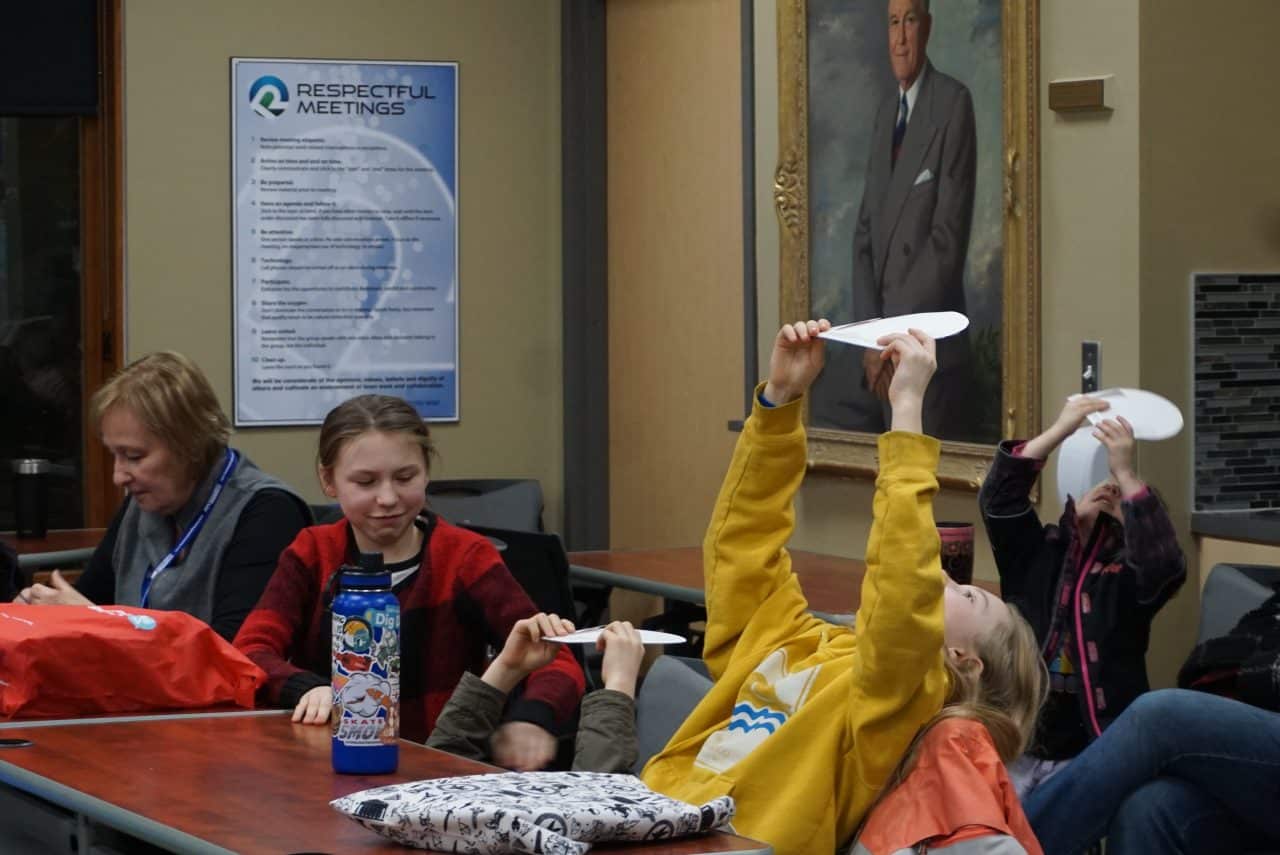
Jessica Malouin has been bringing her kids to the group for the past year after her thirteen-year-old daughter expressed a budding interest in astronomy. She said PAA members have “embraced the kids wholeheartedly. They love working with them, and they love teaching them and guiding them in their knowledge.”
Some of veteran astronomer David Mills’ favourite moments with the club have included working with the kids. “There’s nothing more energizing,” he said. “Their eyes just light up, and they’ve never seen anything like the stars or the planets or the galaxies… you get that wow factor.”
He remembers his own first encounter with the stars back in 1966. “I started in astronomy when I was five years old. My dad got me into it,” Mills shared. He later went on to join the Royal Astronomical Society of Toronto and participate in thirteen science expeditions over almost 40 years. He still remembers one of his first challenges as a budding astronomer.
“Believe it or not, when I was five years old, my dad gave me a survival test,” he said. “Our nearest neighbour’s a quarter mile away. There’s no lights, no nothing. He takes me in the bush and says ‘come on home.’”
As a small child, Mills traversed the half-mile stretch of forest and country road to get back to his family’s cottage, using only the stars as his map. Now, through the Peterborough Astronomical Association, he gets to pass his love of the stars on to the next generation.
The next PAA event open to the public will be a gathering at Harold Town Conservation Area to view the annual Perseid Meteor Shower this August. To learn more about the astronomy club, visit www.peterboroughastronomy.com or check out the Facebook group.
Author

Related Articles
Promoting preparedness in East City
A grassroots movement aims to help neighbours out in the next big storm
A century on, descendants of early Chinese restaurant owners still run businesses in Peterborough
Local restaurateur and bar owner Shannon Mak’s great grandfather ran a downtown Chinese restaurant starting in the 1910s

Self-esteem coach. TV camera operator. Blacksmith. Volunteer fair showcases some unexpected ways to give back.
With volunteering on the decline in Canada, Volunteer Peterborough is trying to make it easier to contribute
