
Peterborough cohousing community moves closer to construction, despite delays and rising costs
Kawartha Commons has purchased a 1.4 acre property in the west end, and plans to build a 40-unit cohousing community there

When Aukje Byker imagines her dream home, she focuses less on how it will look and more on who she will share it with.
“What I’m looking forward to most is really living in community,” said Byker, standing on the site of her future home in Peterborough’s west end. That home will be a condo unit in what’s being billed as the city’s first cohousing community, called Kawartha Commons Cohousing.
In a cohousing community, residents live in private, fully-equipped suites and share extensive common spaces, such as recreation areas, kitchens, gardens and guest rooms. There are at least 24 cohousing communities already established across the country, with more in the process of forming in six provinces, according to the Canadian Cohousing Network.
Kawartha Commons Cohousing (KCC) plans to build a 6-storey, 40-unit condo building on a large vacant lot on Maryland Avenue, near the intersection of Sherbrooke Street and Clonsilla Avenue. The energy-efficient building will feature 4,000 square feet of communal space, including a workshop and craft area, as well as a shared kitchen and dining room.
“[I’ll] have my own private space, which is great. But I can step out my door and have community,” said Byker, a retired college professor who lives alone.
Due to rising costs, private suites to start at $600,000
If the group is able to begin construction next year, as hoped, it will be the culmination of years of effort.
The group formed in 2018 and spent five years searching for a site to build on that was centrally located and large enough to accommodate 40 households and greenspace, according to KCC member Tom Calwell. “The group wants to be able to walk and bike and so it needed to be somewhere close to downtown,” he said.
They also want to be surrounded by nature. That’s why the building, to be designed by Toronto’s Coolearth Architecture, will only occupy a portion of the 1.4 acre property, allowing many of the pine, walnut and birch trees that cover the site to remain standing.
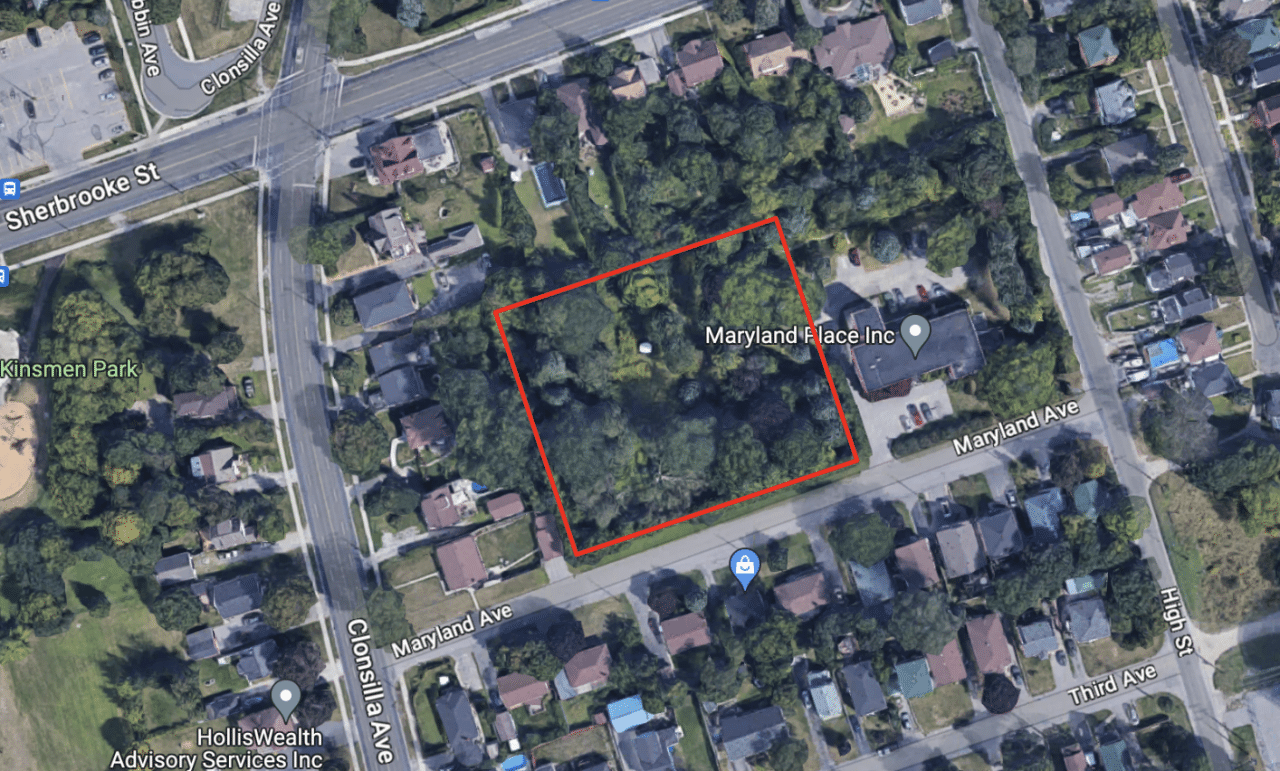
Soaring land prices during the pandemic dashed members’ hopes that the project would be more affordable than a regular private market condo, according to Calwell. The cost of the Maryland Avenue property more than doubled between the time they started looking and when they finally made the purchase in 2023, he said.
The property’s size and proximity to downtown made it a perfect fit, but it was not initially on the market. It took some convincing to get the previous owner to sell, according to Calwell. “We maybe annoyed him for like six months or so before [he said], ‘Yes, I’ll sell,’” he said.
Construction materials have also shot up in price since the pandemic, further straining the group’s budget. “We’re finding it really difficult to have it affordable for any of us right now,” said Calwell. Their desire to design the building to be as energy efficient as possible will result in even more upfront costs, although it will bring down their utility bills in the long run, he added.
The end result is that prices for a private suite will start at around $600,000, according to the group’s website.
So far, 10 households have put down tens of thousands of dollars each to secure their place in the community. Many of the current members are retired, but the group hopes to attract younger families, as well. “We really would like this to be an intergenerational community, because I think it really is a great place to raise kids,” Byker said. However, planning a community from scratch is a lot to take on for busy families with young children, according to Calwell. “It’s almost a full time job,” he said. Younger families tend to join cohousing communities once they are closer to being move-in ready, he said.
Cost is another barrier for many people, Calwell said. To make the project more affordable, the group is looking into whether they can qualify for funding from a $1.5 billion federal program to support the construction of co-op housing that was launched in June. It would mean that members wouldn’t need to contribute equity to develop the building and purchase their own units, as is currently the case. Instead, the federal government would provide forgivable and low-interest loans to finance the construction and then households would pay monthly rent to live in their units. “It would make it much easier to get members [to join the community],” said Calwell.
The project’s next hurdle is getting permission from the city to build a multi-unit residential building on the site, which is not currently designated for residential use. It’s zoned as a “public use district,” as it was once the grounds of a former Catholic convent belonging to the Sisters of the Precious Blood.
“There’s a lot of hoops to jump through,” Calwell said. The group has had to hire consultants to complete 17 different studies before it can apply for a zoning amendment from the city, he said. The studies look at things like the amount of traffic the development will generate, what the load on the sewer system will be, and whether there are any endangered species on the property.
Calwell said he understands why most of the studies are needed, even though they are costly and time consuming. “We’ve been now a year and a half working on getting… ready for rezoning,” he said. According to him, part of the reason it’s taking so long is because the city has had to adjust its processes to align with multiple changes to provincial planning rules in recent years.
Relationship building comes first, before construction
Even though Kawartha Commons Cohousing has not broken ground on the building yet, the group has already started forming a community, according to Byker.
“Building community first – that’s our motto. And we’re definitely doing that,” she said. Members regularly get together for meals and virtual “coffee chats” and there’s a “support circle” to help people cope with challenges they’re facing. “Most of us didn’t know each other when we started this, but now we’re really good friends,” said Byker.
“The main part of it isn’t the building, the main part of it is the social community,” added Calwell.
Byker has also trained all the members in non violent communication, a technique which teaches people to listen empathetically and express their feelings so as to diffuse conflict and find common ground.
“To think you can go into a community and there’s never going to be any conflict is naive,” Byker said. She would know. She raised her children on a 57-acre farm outside of Hamilton that she and her former partner shared with a friend and another family. “There was some conflict and we hadn’t figured out a good way to deal with it, which is why for me, it’s always been really important that we have a system to deal with conflict.”
For Calwell part of the appeal of living in a cohousing community is having a supportive and accessible place to grow older. He is retired and spends a lot of time working on hobbies like pottery, broom making and woodworking. “It can get lonely,” he said. One of the things he’s looking forward to most about his future home is the shared workspace where he’ll get to practice his crafts in the company of others.
After six years in the planning stage, other projects may have fizzled out by this point. But the group has managed to keep forging ahead thanks to the strong bonds members have formed between each other over the years, according to Byker.
“The connection between people is what really keeps us going,” she said.
Author

Related Articles

A century on, descendants of early Chinese restaurant owners still run businesses in Peterborough
Local restaurateur and bar owner Shannon Mak’s great grandfather ran a downtown Chinese restaurant starting in the 1910s

Self-esteem coach. TV camera operator. Blacksmith. Volunteer fair showcases some unexpected ways to give back.
With volunteering on the decline in Canada, Volunteer Peterborough is trying to make it easier to contribute

Meet Marjorie, the giant Newfoundland dog spreading joy at a Peterborough retirement home
“I think dogs are nicer than most people,” said a Royal Gardens Retirement Residence resident who looks forward to the therapy dog’s weekly visits.
