
Moms call out stigma at event honouring victims of the local drug crisis
Participants said their loved ones faced stigma when seeking help — including at Peterborough’s hospital. “We have a lot of growth to do,” a hospital representative responded. “But we’re trying very hard to get better.”

Families gathered at Millennium Park on Friday, August 30 to remember and honour the loved ones they have lost to the local drug poisoning crisis.
Friends, parents, and other relatives of those who have died talked together under the hot summer sun. Some decorated white crosses symbolizing the lives lost this year, while others shared tearful moments beside a banner displaying the faces of more than 100 local drug poisoning victims. Local harm reduction and addiction treatment agencies, including the Elizabeth Fry Society of Peterborough, PARN, One City Peterborough, and Right to Heal, joined the event as well.
This was the fifth year in a row that Gail Parry and the local chapter of Moms Stop the Harm have organized an outdoor event to recognize International Overdose Awareness Day (IOAD), which falls on August 31 each year.
“Toxic drugs are taking so many more lives every year,” said Parry, who lost her daughter Jodi in 2018. “It’s more and more people that we’re losing.”
This year’s event came just after the Ford government announced that it would be forcing the closure of 10 supervised consumption sites across the province and opening new addiction treatment centres in their place — a decision that was criticized by speakers at the event.
“I think politicians need to stay out of dealing with life or death matters,” Parry said. “Treatment alone is not going to work. Detox alone is not going to work. We need safe supply, and we need sober housing.”
Parry said she worries that without safe consumption sites, people won’t have access to clean needles or life-saving emergency care. “Diseases are going to spread so much faster,” she said. “We need people alive to get them to treatment. Dead people don’t recover.”
Peterborough’s safe consumption site remains open — it wasn’t impacted by the Ford government’s recent policy changes.
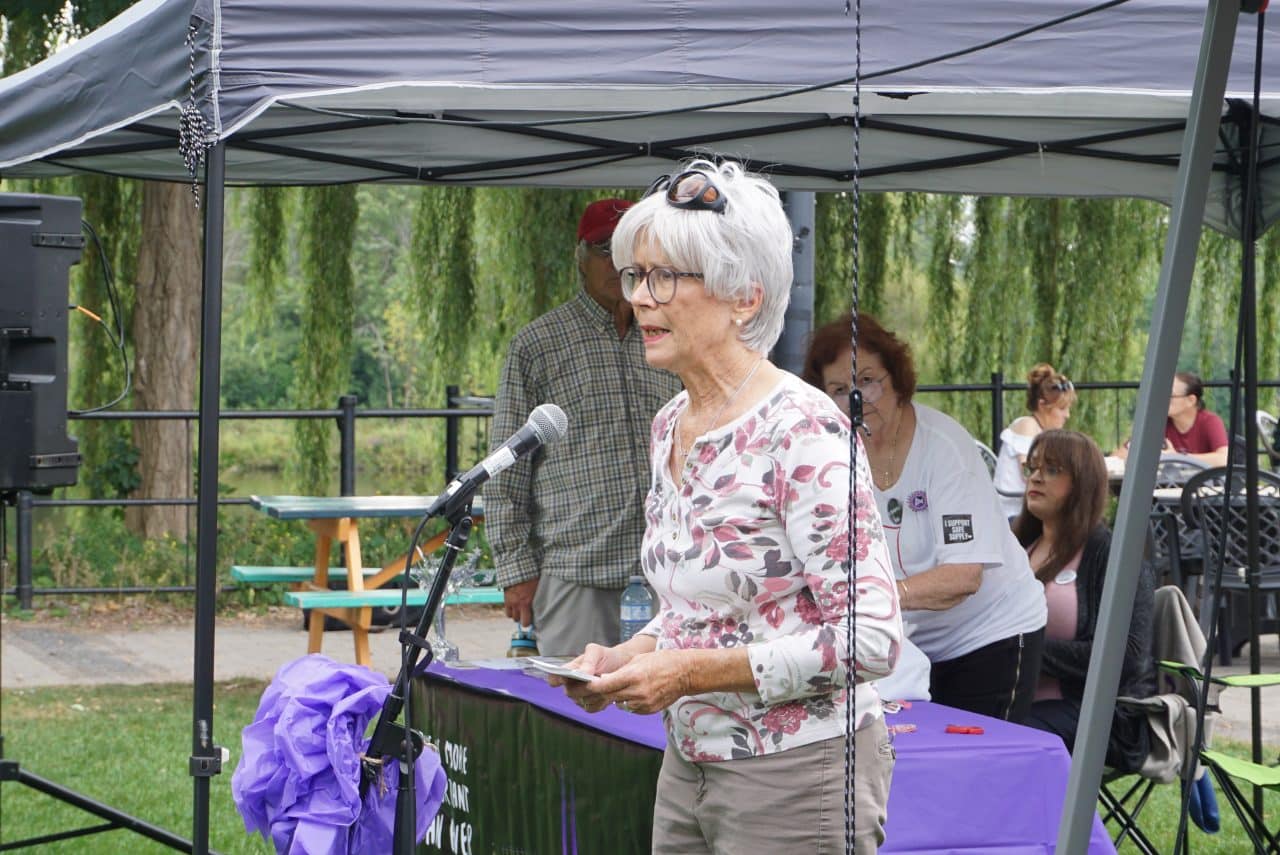
Jane Davidson took the mic to speak about her own daughter, Katie, who died in 2019. “Katie was a lot more than just a drug addict,” she said. “She was popular, zany, brilliant; she swam for the Trent swim club… She was even an angel in the iconic Christmas story at Holy Trinity Church in Toronto. I loved being her mom.”
Davidson recounted the story of her daughter’s introduction to heroin, and described the following 18 years as a “roller coaster of grief, terror, and hope. Grief, terror and hope. Over and over again.”
“She tried to hold jobs,” Davidson said. “She had dropped out of school and lost a lot of friends, mostly because she moved away from them because she was so ashamed when she was in full addiction,” Davidson said. “She lost a great deal of her self esteem.”
“We’re talking about people’s lives here. It’s a health issue,” said Rhonda Gordon, who lost her step-daughter to an overdose in 2020. “We’re fighting for safe supply, and trying to save as many lives as possible. The last thing you want is for someone in active addiction to give up hope.”
The trouble, Parry explained, is that many people in active addiction are made to feel like hopeless causes when they do reach out for help, including at Peterborough’s hospital.
“They don’t want to go to the hospital because of the way they get treated there,” Parry said. “My daughter never wanted to go to a hospital because she knew how she’d be treated. The stigma is horrendous up there.”
The Peterborough Regional Health Centre (PRHC) participated in the IOAD event for the first time this year. “We should have been here before, but we are now,” said Jane Mark, patient relations consultant at PRHC.
As Mark approached the microphone to speak, she was met with critical murmurs from the loved ones gathered in the park.
“We know that our hospital — we have a lot of growth to do,” Mark said. “But we’re trying very hard to get better… We have a great group of individuals that really care.”
Mark added that the hospital is prioritizing education for staff around trauma-informed care. She urged people struggling with addiction to reach out and get assistance from patient relations if they are worried about how they will be treated at PRHC.
Chelsea McGowan, who previously worked with the Elizabeth Fry Society of Peterborough and now serves as a social worker at PRHC, shared her own lived experience with addiction and recovery.
“Recovery looks different for a lot of people,” she said. “Abstinence isn’t necessarily the answer for everyone… It’s important to have options and resources available for people. We need people to be able to access those things without the barriers that prevent them from being able to get there.”
Author

Related Articles
A century on, descendants of early Chinese restaurant owners still run businesses in Peterborough
Local restaurateur and bar owner Shannon Mak’s great grandfather ran a downtown Chinese restaurant starting in the 1910s

Self-esteem coach. TV camera operator. Blacksmith. Volunteer fair showcases some unexpected ways to give back.
With volunteering on the decline in Canada, Volunteer Peterborough is trying to make it easier to contribute

Meet Marjorie, the giant Newfoundland dog spreading joy at a Peterborough retirement home
“I think dogs are nicer than most people,” said a Royal Gardens Retirement Residence resident who looks forward to the therapy dog’s weekly visits.
