
An election wrap-up … plus more local news
Plus more local news in this week’s issue of the Peterborough Currents newsletter

You’re reading the March 4, 2025, edition of the Peterborough Currents email newsletter. To receive our email newsletters straight to your inbox, sign up here.
Good afternoon, and welcome to the Peterborough Currents newsletter.
Peterborough-Kawartha stayed PC blue in last week’s snap provincial election, despite a close challenge by first-time Liberal candidate Adam Hopkins, who lost by just over 2,000 votes. Meanwhile, the NDP’s vote share locally and province-wide continued to shrink. So what’s the future of the two opposition parties in this riding? Keep reading for more on that.
Also in this week’s newsletter:
- Fleming College freezes hiring amid “unprecedented financial challenges”
- Public school board cuts back on bussing, forcing more kindergarteners to walk to school
- PATH and One City Peterborough announce a new tiny home for someone experiencing homelessness
Let’s get to it!
Third straight PC victory has local Liberals and New Democrats reflecting on what’s next
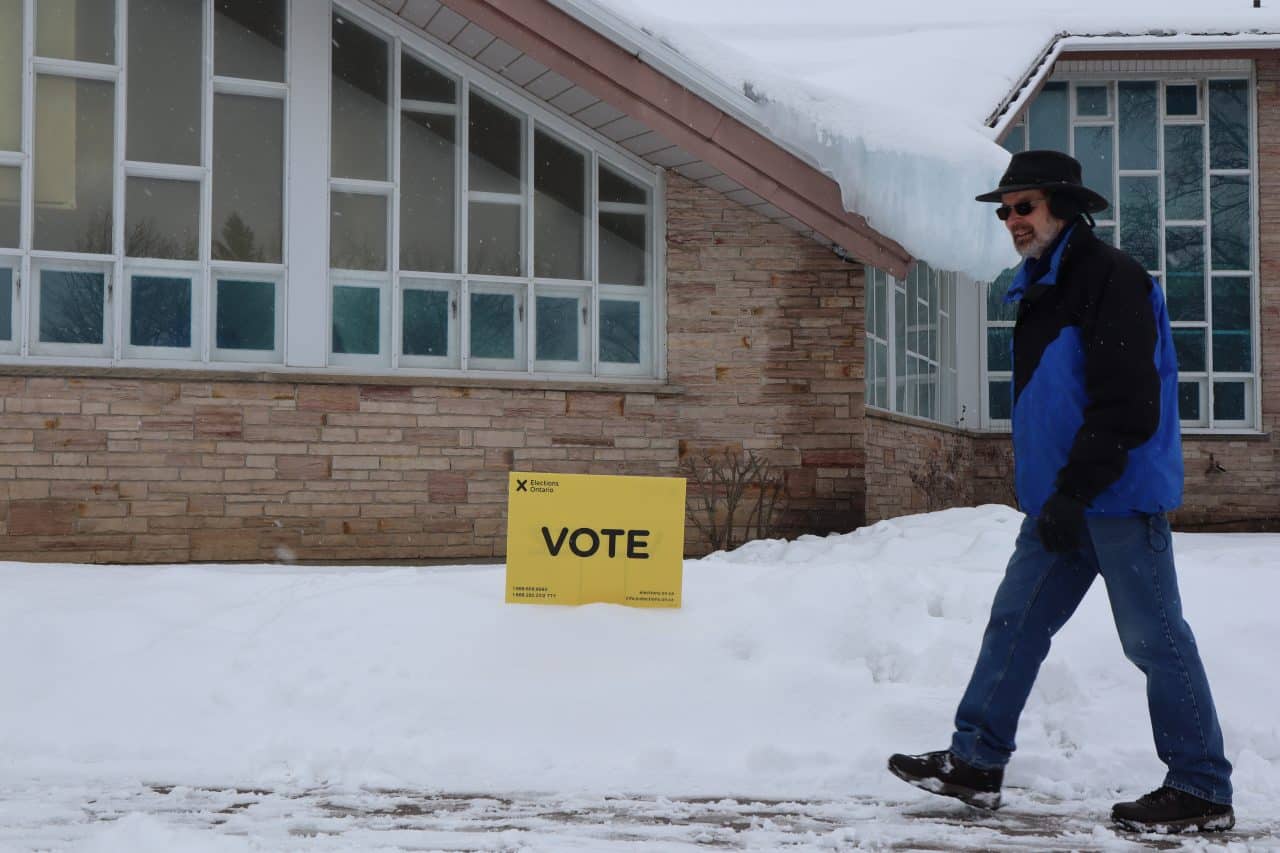
After Progressive Conservative Dave Smith was re-elected to a third term in Peterborough-Kawartha last week, local Liberals and New Democrats are reflecting on where their campaigns fell short.
Smith won 40.5 percent of votes, with Liberal Adam Hopkins trailing close behind in second place with 36.4 percent, according to unofficial results from Elections Ontario.
It was the Liberals’ best showing locally since Smith defeated former MPP and current Peterborough Mayor Jeff Leal in 2018.
“I think there’s a lot to be proud of and a lot to build off of there,” said Zach Hatton, communications director for Hopkins’ campaign.
Peterborough-Kawartha election results
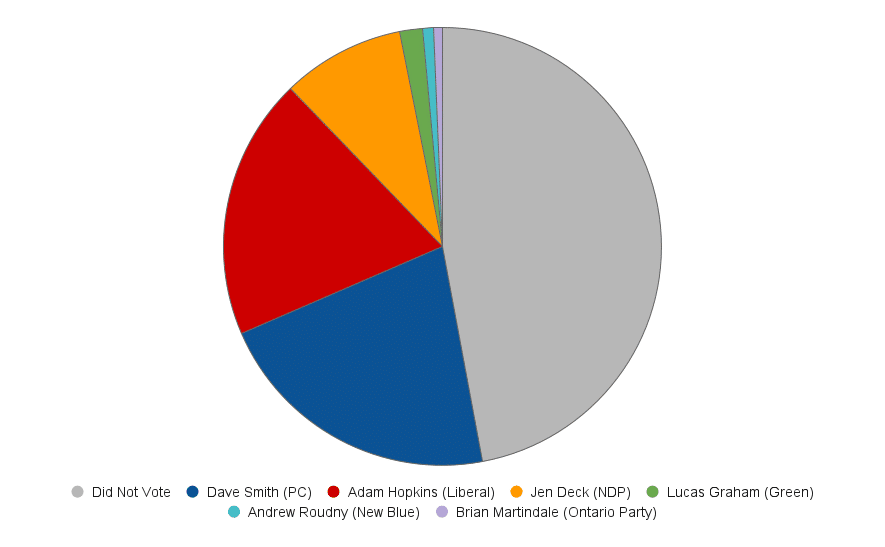
Hopkins picked up 4,137 more votes than the Liberal candidate in the 2022 provincial election received. (Smith increased his vote count, too, by 2,178).
The Liberal boost came partly from New Democrat supporters, according to Hatton, who said the NDP’s vote “collapsed locally.”
Two-time NDP candidate Jen Deck received 17.2 percent of votes, down by just over four percent from 2022. Deck hasn’t been able to regain the level of support the NDP received in 2018, when the party came in second in this riding with 33.8 percent. (Province-wide the NDP has lost almost a million votes since 2018.)
Last week Deck received 1,716 fewer votes than in 2022.
Where did those votes go? NDP volunteer Benjamin Hickey said while door knocking some NDP supporters said they planned to vote PC this time because they were afraid of changing governments with a Canada-U.S. trade war looming.
He also heard from people who planned to vote strategically for the Liberals because “they were afraid of a Conservative victory.” Hickey said the NDP should resist calls to cooperate with the Liberals in the next election to defeat the PCs, something one newly re-elected New Democrat MPP said she wants to explore.
Waterloo MPP Catherine Fife told the Waterloo Region Record she isn’t “interested in running in another election against other progressives,” saying it “only benefits” the PCs.
Any kind of cooperation with their Liberal rivals would probably be a hard sell to NDP members. Deck dismissed the idea in an interview with Currents during the campaign, saying “the Liberals don’t have a super track record.”
The NDP needs to stay independent and “be extremely active in the community” until the next scheduled election in 2029, Hickey said.
One New Democrat who is open to the possibility of working with the Liberals: former MPP Jenny Carter. Carter, now 93, represented Peterborough at Queen’s Park from 1990 to 1995 — the last New Democrat to do so.
“I think that’s something to be looked into,” she said. “It would certainly be a way of winning, because I think the two votes together would win in most places.”
But she said she wouldn’t support an NDP-Liberal merger because there are “crucial differences” between the parties.
Hatton said the parties “should work together to defeat the Conservatives.” But he said he’s not sure what that could look like. He wouldn’t support standing down Liberal candidates in ridings where the NDP is better poised to beat the PCs, and vice versa, he said.
Meanwhile, Ontario saw voter turnout tick up slightly last week, to 45.4 percent, from a record low of 44 percent in 2022. But as is usually the case, turnout was higher than the provincial average in Peterborough-Kawartha, where 53 percent of eligible voters cast their ballots.
Fleming College freezes hiring amid “unprecedented financial challenges”

Fleming College has implemented a hiring freeze on administrative and support staff positions in response to “unprecedented financial challenges” facing the college, according to a letter the college’s acting co-presidents sent to staff on March 3.
The college will prioritize hiring “for only the most critical roles” and will make buyout offers to incentivize early retirements in the coming days, the letter states.
The letter blamed the college’s struggles on “a provincial tuition freeze, chronic underfunding, and recent federal immigration policy changes.”
A recent pre-budget submission Colleges Ontario submitted to the provincial government noted that Ontario has the lowest per-student funding of all provinces and called on the Ontario government to “expand” and “modernize” its funding for colleges.
Speaking during last month’s candidates debate on YourTV, Progressive Conservative MPP Dave Smith cast blame for Ontario’s postsecondary challenges on the federal government, which has capped international student enrolments across the country. Smith said his government approved $1.2 billion of new funding over three years to help post-secondary institutions adapt to the changes. Colleges Ontario called that funding “a welcome first step” in its pre-budget submission.
Trustees approve longer walking distances for kindergarten students
Kindergarten students in Peterborough will be denied bussing unless they live within 1.6 kilometres of their school next year and some students will face longer bus commutes.
That’s because KPRDSB trustees approved new maximum walking distances for kindergarteners and new maximum bus trip lengths for students up to grade six at a meeting last week, according to the Peterborough Examiner.
Previously, kindergarteners living within one kilometre of their school were expected to get there by foot and were not eligible for bussing. Under the new policy, that distance will increase to 1.6 kilometres. Also, the maximum acceptable bus commute will rise from 60 minutes to 75 minutes for students up to grade six, according to the approved policy changes.
Trustees voted by a margin of 5-4 to approve the policy changes as a cost-cutting measure. By reducing the number of buses needed across the school board, the new policies will save the board an estimated $500,000.
Even trustees that voted in favour expressed disappointment with the decision. “This is not great. Nobody likes it,” said one trustee. “But we are looking at a big deficit … and we have to make some tough decisions around this.”
PATH and One City announce completion of new tiny home
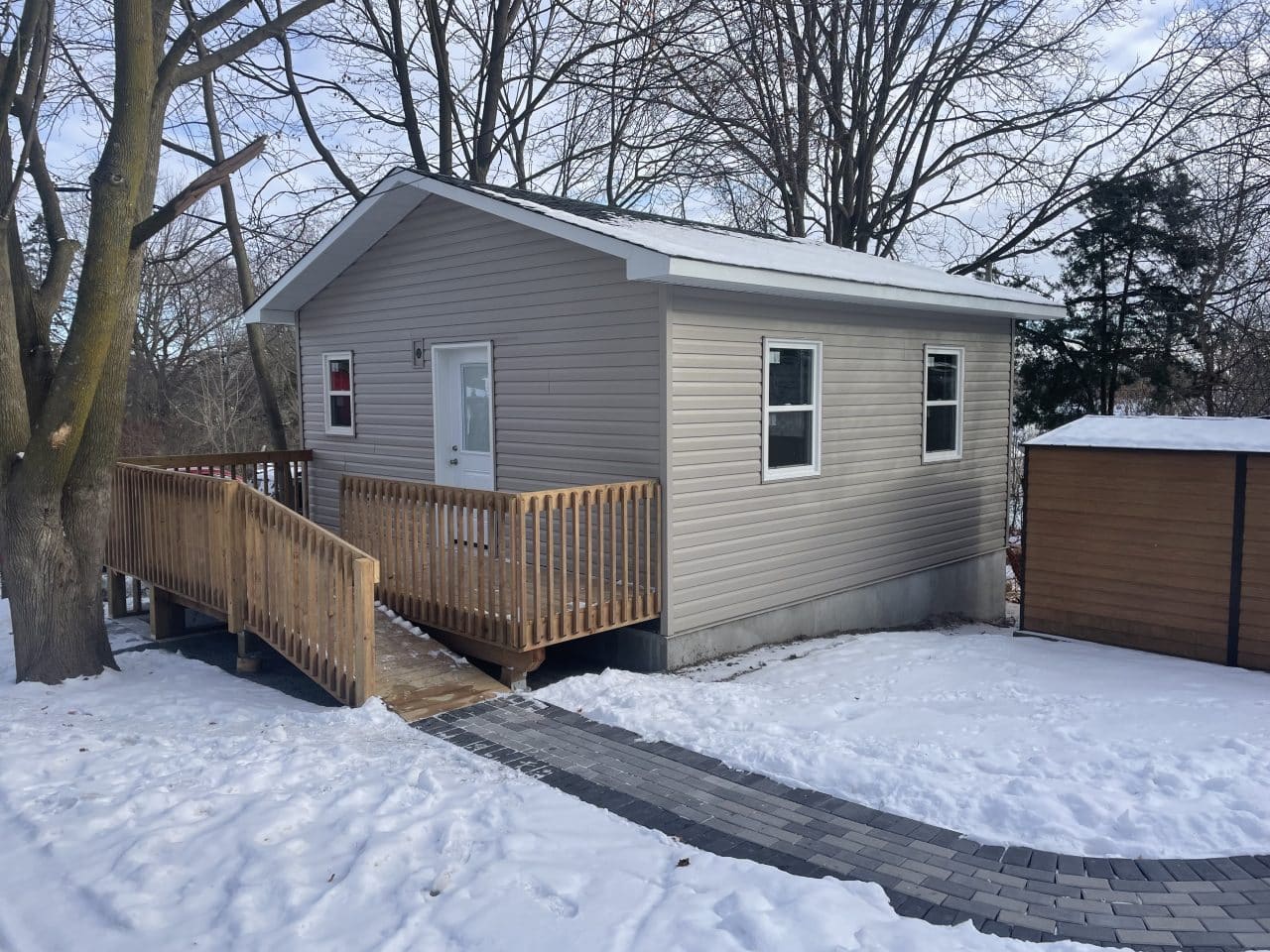
A new 400 square-foot home built by Peterborough Action for Tiny Homes (PATH) is now ready to be occupied by someone experiencing homelessness, according to a press release PATH issued last week. PATH built the home on a west-end property owned by One City Peterborough.
In addition to operating its overnight shelter at the Trinity Community Centre, One City offers supportive housing in five homes it owns in Peterborough. But this tiny home is One City’s first single-occupancy housing unit.
“There is a distinct need for this kind of private accommodation for people who are transitioning from being unhoused,” said One City’s Michael VanDerHerberg in the press release. “For many people who were previously unhoused, living in a shared space, while cost effective, is not ideal for personal recovery.”
PATH is working towards building additional tiny homes on other properties owned by One City, project manager Keith Dalton told the Peterborough Examiner.

Thanks for reading this week’s newsletter!
Peterborough Currents is free to read — but our journalism is not cheap to produce. If you value our work, please consider signing up as a monthly supporter. We need your help to keep going!
Take care,
Brett Throop
Reporter
Peterborough Currents
Thanks for reading the Peterborough Currents email newsletter! Here’s where you can sign up to have these sent straight to your inbox.
Author

Related Articles
Places for Pollinators
Turning needy lawns into gardens that attract butterflies