
Three ideas to make Peterborough’s streets safer
Including an urban planning lesson from Peterborough’s past and a proposal to help cyclists dodge Lansdowne Street

When people gathered for Peterborough’s first cycling summit since 2014 last week, the focus was on more than just bicycles. The event, organized by the Peterborough Bicycle Advisory Committee, was all about how to make streets safer for everyone, including cyclists, wheelchair users, pedestrians and drivers. Here are three ideas for transforming Peterborough’s streets from the Safer Streets for Everyone Summit:
1. Make George and Water streets two-way again
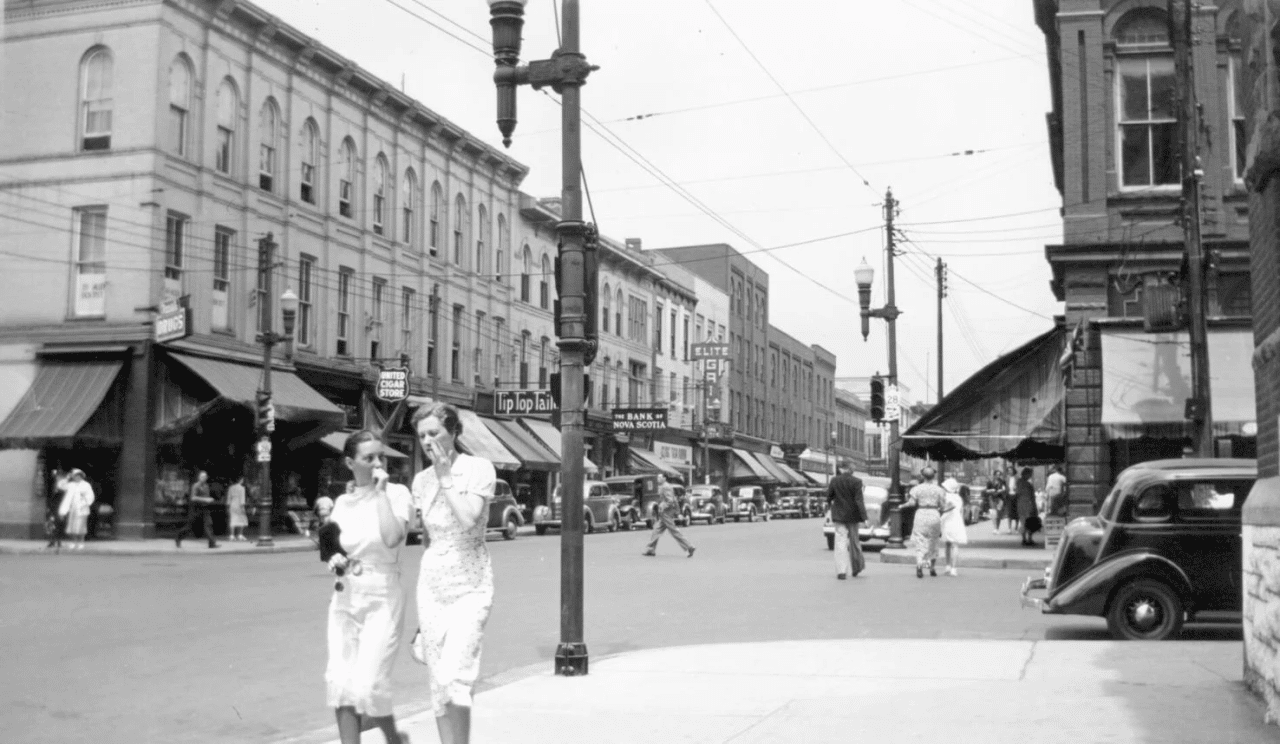
In a summer scene of downtown Peterborough captured on camera by bicycle shop owner Marlow Banks in 1938, you can see classic cars lined up on either side of George Street. Drivers at the time could drive north and south on the main drag. Since then, different people have made the case for bringing back two-way traffic to both George and Water streets. Now that same argument is coming from someone who has years of experience getting rid of one-way streets in American cities.
“From a city-making perspective, it’s hands down better to have two-way streets,” Florida-based engineer Ian Lockwood told a packed room at Showplace Performance Centre last Wednesday. Lockwood, who is originally from Canada, was the keynote speaker at the Safer Streets for Everyone Summit.
One-way streets are good for speed, but not much else, according to Lockwood. They make it easier to sync up traffic signals to move cars through a city quickly. And drivers don’t get slowed down by making turns through oncoming traffic. Lockwood’s engineering professors at Ottawa’s Carleton University in the 1990s taught him that those were good things. But in the real world he learned that if you want to create a great city people will flock to, speed is the opposite of what you want.
Over the years, he’s had a hand in bringing back two-way streets to cities like West Palm Beach, Florida, Ann Arbour, Michigan, and South Bend, Illinois. “I can’t think of one time where we have restored two-way operations… where the city didn’t get better,” he said. Getting rid of one-ways has helped local businesses in those cities thrive and has made streets more enticing for pedestrians and cyclists, Lockwood said. He also prescribes other measures to slow down traffic and make streets more vibrant, such as eliminating excess traffic lanes to make room for wider sidewalks and bike lanes.
Lockwood said he would “definitely” restore two-way traffic on George and Water streets, in part because it would make it easier for drivers and cyclists to access local businesses.
“Your businesses will do better,” he said. “You’ve got such a nice street network here. You don’t need that car-carrying capacity of one-way streets. You’re fine with two-lane, two-way streets.”
2. A cyclist bypass for Lansdowne Street

With five lanes of traffic along much of it, it’s easy to see why many cyclists steer clear of Lansdowne Street. I got into a few conversations with other cyclists at the summit about the commercial strip, and how we avoid it. Romaine Street, running parallel to Lansdowne, is a good alternative route. You can get to the Parkway Centre and points further west, such as Value Village, by first cycling along Romaine and St. Mary’s Street.
At the summit, I joined a table of people hovering over a map of Romaine Street to imagine what it could like if it became a bicycle-priority street, similar to the recent redesign of Bethune Street. The city’s cycling master plan calls for more than 20 additional streets to eventually be designated as “bicycle boulevards,” or bicycle-priority streets, including Romaine. The design my table came up with featured a raised intersection where Romaine crosses Park Street, in order to slow down vehicles. The intersection would also be painted by neighbourhood children or artists to create a sense of community ownership over this public infrastructure. We also imagined removing a few parking spaces to create a little parkette or patio space in front of the restaurant Copper Spoons.
But an alternative route to Lansdowne would be less important if Lansdowne itself was redesigned to be safer for cyclists and pedestrians. That was a suggestion of Ian Lockwood, one of the summit’s speakers. He proposed paring down Lansdowne to just three lanes of traffic to make room for bike lanes and wider sidewalks, something Lockwood, an engineer, has done in other cities.

3. Stop victim blaming pedestrians
This month pedestrians in Vancouver found a creative way to make themselves visible at a dangerous crosswalk: they waved foam bricks at drivers as they crossed the street. Vision Zero Vancouver, a group dedicated to ending traffic deaths, came up with the idea after failing to get the city to make safety improvements to the street, such as removing some traffic lanes and installing a raised crosswalk, according to CBC.
Too often pedestrians are left to their own devices to try to protect themselves on streets that haven’t been designed with safety in mind, said public health physician Dr. Sara Whitehead, speaking at the summit. “Within Ontario we see road safety campaigns that are sponsored by police departments especially, where the focus is: teach your children the rules of the road, have them wear reflective clothing, have them put on a reflective vest to be safe on the roads,” Whitehead said. But instead of dressing up kids like construction workers, the focus should be on improving street design to reduce collisions, according to Whitehead. “If we can’t move to design systems that children can be safe in rather than having them put on safety gear to go out and walk around, I despair,” she said.
Whitehead is a proponent of a “safe systems approach” to road safety. Central to that approach is recognizing a key fact about humans: we all make mistakes. Given the inevitability of human error, roads should be designed to ensure that when people make mistakes behind the wheel, it doesn’t come at the cost of a human life. That requires making design changes to limit vehicle speeds and protect pedestrians, such as narrowing traffic lanes, installing raised pedestrian crossings, and giving pedestrians advanced signals at intersections.
Author

Related Articles
Queer refugees find community in Peterborough, as Canada tightens rules that helped them arrive
“My family, my government, my religion, and the whole country is against me for being gay.”
Local event organizers navigate rising costs and red tape
Local event organizers share their struggles as costs and requirements accumulate.
Newcomers to Nogojiwanong learn Lessons from the Land
New Canadians Centre and Canadian Canoe Museum partnered to bring community together for alternative July 1 celebration.
