
Audio Why don’t these pedestrians have a sidewalk? Peterborough faces infrastructure backlog due to “funding challenges.”
Episode four of our budget podcast examines what’s in — and not in — the city’s 2024 capital budget
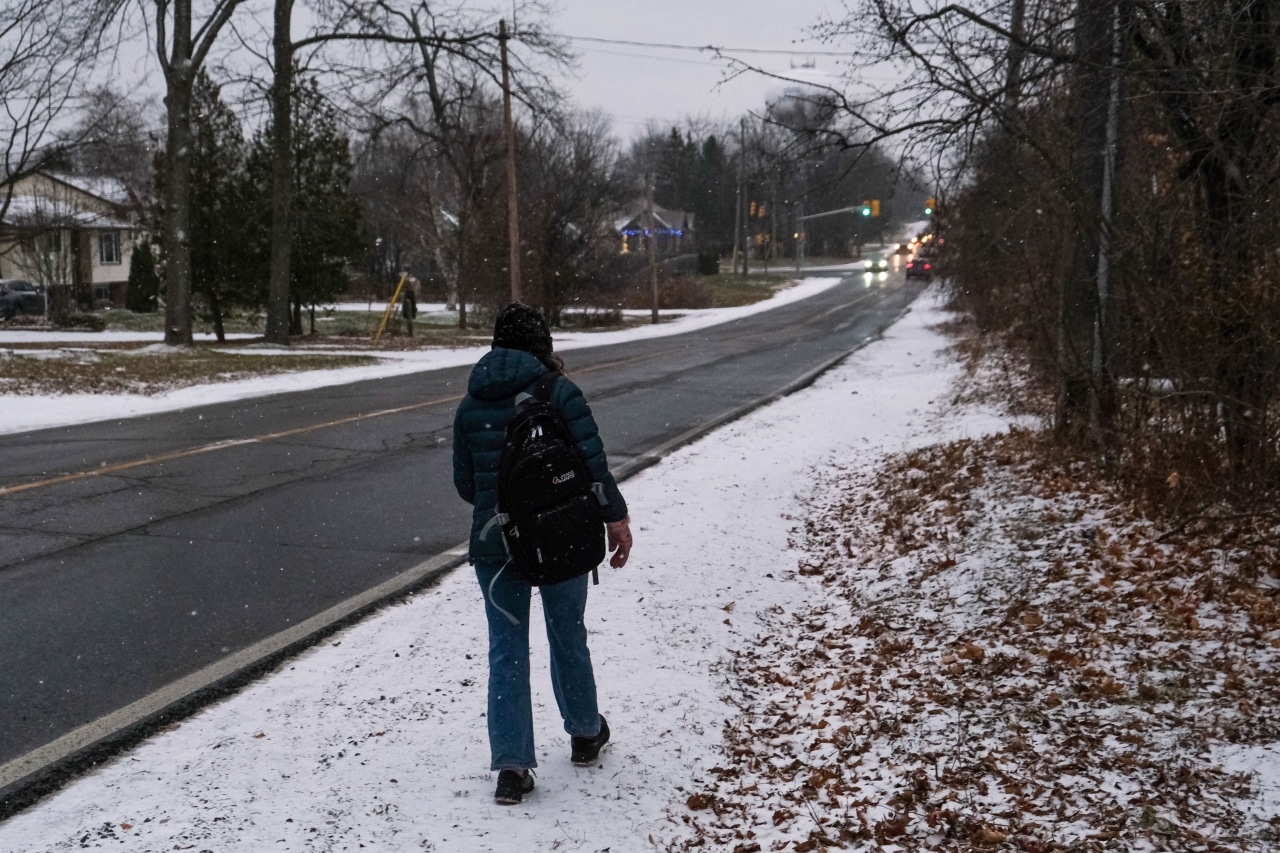
Crossing guard Mike Edwards’ job is to keep pedestrians safe. But according to him, the section of Sherbrooke Street West adjacent to where he is stationed is anything but.
“It’s treacherous,” said Edwards, who patrols the intersection of Sherbrooke St. and Woodglade Blvd. — near École catholique Monseigneur Jamot.
Sherbrooke has almost no sidewalks between Woodglade and Brealey. Edwards said the strip becomes particularly dangerous for pedestrians in winter, as snow banks pile up on either side of Sherbrooke. “They’re basically having to walk on the road.”

Councillor Don Vassiliadis, who represents the area, said he has been trying to get sidewalks built on this stretch of Sherbrooke since he was first elected in 2014.
“I’m looking for safety in this area, for the … school children that walk in that area, the parents that walk with their children,” he told city council’s finance committee last month. Along with Monseigneur Jamot, there are two other schools nearby – Crestwood Secondary School and James Strath Public School.
Vassiliadis wanted to include $1.8 million to build a temporary sidewalk on the south side of Sherbrooke in the city’s 2024 budget – but finance committee voted down that proposal during November’s budget talks.
Some councillors said the price was too high for a short-term fix. “Basically $1.8 million for a temporary solution – that’s almost a one percent tax increase all by itself,” said councillor Lesley Parnell.
City staff said Sherbrooke between Woodglade and Brealey needs to be fully reconstructed soon. When that happens, permanent sidewalks and bike lanes will be installed. But Vassiliadis said the “best case scenario” is that Sherbrooke will be rebuilt in 2029, which is why he pushed for a temporary sidewalk in the meantime.
Andrew Hinds, who walks to and from work at a retirement residence along Sherbrooke St. W., said 2029 is too long to wait.
“I know there’s a lot of kids walking to and from school,” he said. “What if someone gets hurt? It could be really, really bad.”
Hinds said he’s fallen a few times walking on the gravel shoulder of the road. “It’s awful.”
Fleming College student Anjana Silwal said she wants to see a sidewalk installed “so that not only me but everyone passing through this way feels safe.”
She lives in the area and walks along Sherbrooke to catch a Peterborough Transit bus to campus. “It’s very risky to walk sometimes,” she said.
Peterborough’s ageing infrastructure is costly to maintain. So what projects are being prioritized and which delayed?
Why does a major street with three schools nearby not have sidewalks to begin with? Can the city really not afford to build one? And what does all of this say about the way Peterborough has been developing in recent decades?
We explore these questions in the latest episode of our special podcast series on the city’s 2024 budget deliberations, which Peterborough Currents is producing in partnership with Arthur Newspaper. You can listen to the episode in the audio player below, or you can find it in your favourite podcast app.
During budget talks, councillors heard that “funding challenges” are to blame for the delay in rebuilding Sherbrooke Street. According to budget documents, the city faces a $70 million a year capital funding shortfall for road construction and other projects.
“Chronic underinvestment in preventative maintenance during the second half of the 20th -century has resulted in many existing road assets having a deteriorated condition and operating beyond their appropriate lifecycle renewal stage,” a report to councillors stated.
The funding shortfall leaves councillors to decide which projects to prioritize and which to push farther and farther into the future. In 2024, the city is prioritizing the new twin-pad arena and library branch in Morrow Park (which has been branded the Miskin Law Community Centre). The 2024 draft budget commits $24 million to that project, making it the biggest capital project in next year’s budget, by far.
In the podcast, we discuss strategies the city could implement to address the capital funding shortfall by using its existing infrastructure more efficiently.
Councillors vote to kill city’s traffic calming program
Also in this episode, we discuss the city’s traffic calming program, which councillors voted to defund next year.
Traffic calming refers to using physical obstructions, such as speed bumps or narrow driving lanes, to reduce speeding and make streets safer for pedestrians and cyclists.
Under the program, High Street was recently reconfigured as a one-way street between Frank St. and Sherbrooke St. and a protected pedestrian walkway was installed in sections that don’t have a sidewalk, according a city press release.
Finance committee voted in favour of a motion by Parnell to shrink the traffic calming budget from $700,000 to $100,000 in 2024, leaving only enough money to complete ongoing projects. (That decision, along with the rest of the 2024 draft budget, still has to be approved at a city council meeting on December 11.)
The committee asked staff to study the potential of reducing speed limits to 40 km/h city-wide as a way to reduce speeding without making design changes to streets, an idea put forward by Parnell.
But Michael Papadacos, the city’s interim infrastructure commissioner, cautioned that merely lowering speed limits is unlikely to be effective. “The primary driver of why people speed is the way that the road has been designed,” he said.
Authors


Related Articles
Riel commits to investing in buses
Would support Transportation Master Plan as mayor, despite uneven record as councillor
Councillors play “musical chairs” with city budget
The proposed tax hike for 2025 has decreased, but only because councillors approved a brand new user fee.

Peterborough arts council faces defunding, executive director hopes to change city council’s mind
Mayor Jeff Leal says the “winding down” of the arts council is part of a broader effort to bring various services in-house at city hall
