
Home construction has slowed dramatically despite Peterborough’s urgent need for housing. What’s holding it up?
Some developers blame the city for slow housing approvals. But city officials say due process ensures new builds are in the public interest.
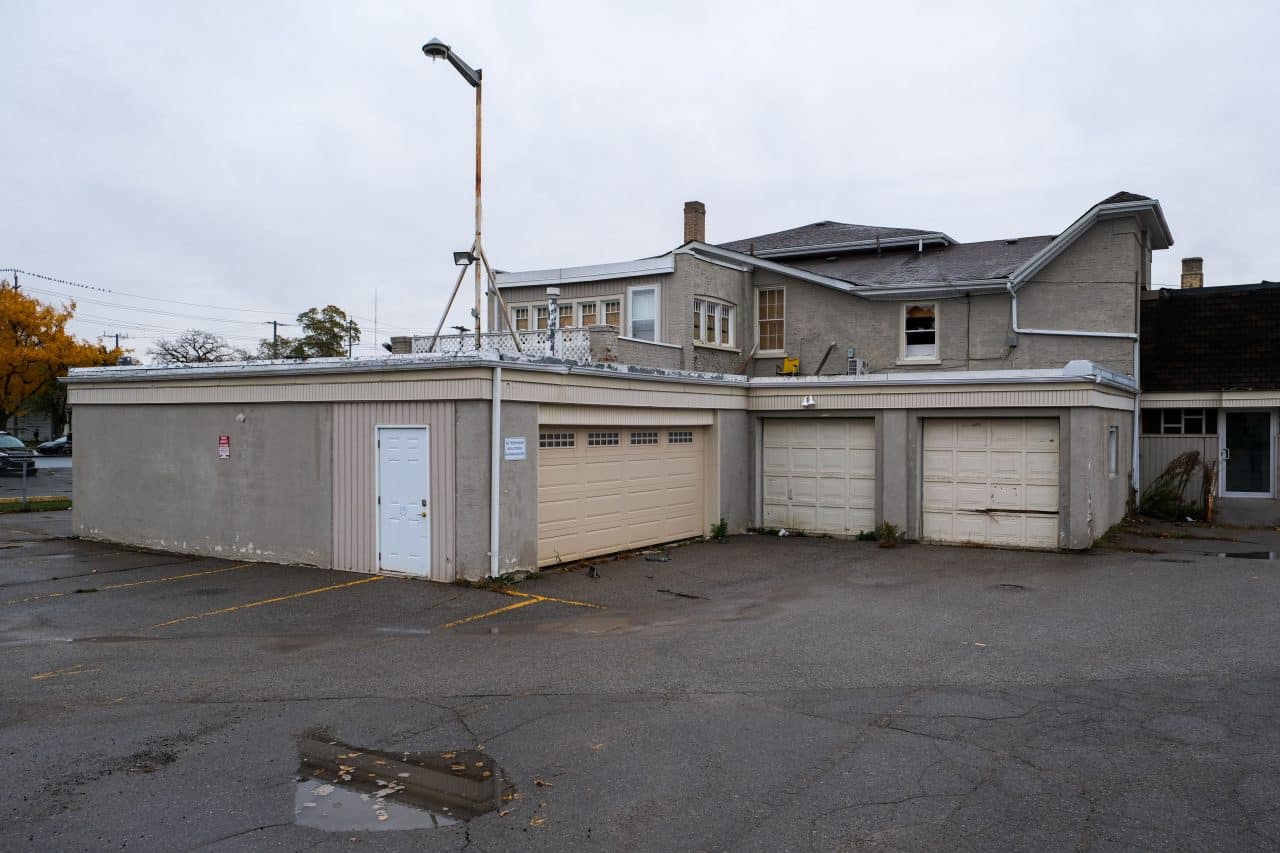
Toronto-based developer Simon Zhang hoped to start construction on a new six-storey apartment building at 539 George Street North this past summer.
City council approved the 95-unit development, which Zhang said will include about 19 “affordable” apartments, in April 2023.
But getting shovels in the ground has proven difficult.
Zhang said after getting council’s approval for a zoning change and an official plan amendment in the spring, he got a surprise from the city’s heritage department. He was told he would have to conduct an archaeological study of the property before he can get the final greenlight to start construction.
“It’s such a big uncertainty right now for us,” Zhang said.
The project is in limbo until crews can dig up the site and determine if there’s anything of historical significance buried underground, he said. In a statement, the city said the property must be assessed because it is in an area of “high archaeological potential” and Peterborough has to adhere to provincial policy in protecting “archaeological resources.”
The archeological dig requirement is one example of what Zhang said are many “strict” rules holding up the construction of new housing in Peterborough. Another is minimum parking requirements. Zhang’s company had to petition city council to allow his project to go ahead without enough parking spaces for every prospective tenant. Councillors approved that request, but Zhang said the city should update its parking rules to avoid such an issue holding up future developments. (The city is currently reviewing its residential parking requirements).
Meanwhile, Zhang said rising interest rates have driven up the cost of financing construction. “That’s one of the things holding project[s] up,” he said, adding that other developers in Peterborough are also delaying building because of high interest rates.
New data from the Canada Mortgage and Housing Corporation shows housing construction has fallen dramatically in the City of Peterborough this year. The city counted only 50 housing starts between January and September 2023, down 70 percent compared to the same period last year.
Peterborough isn’t alone. New housing construction has slowed slightly across Ontario this year, dealing a blow to the Ford government and its much-touted goal of building 1.5 million new homes by 2031.
Few urban areas in the province have seen as sharp a decline in housing construction as Peterborough. But Mayor Jeff Leal is pledging to turn the trend around. The City of Peterborough’s share of the provincial target is 4,700 new homes by 2031 — a goal Leal has committed to in exchange for receiving so-called strong mayor powers from the Ford government.
Amid the push to build more homes, developers are calling for a speedier, less onerous process at city hall to approve new construction. But city officials say they are trying to strike a balance between speeding up and maintaining due process.
Due process ensures developments are “financially, environmentally, and socially sustainable,” city official says
It took nearly two years from the time Zhang’s company, ZZY Property Group, first submitted its development application to the city, in May 2021, until it was approved by city council, according to a staff report.
Zhang said that’s too long. “If we were able to get the zoning and get things going more quickly, we would have already been built,” he said. He blamed the delay on a lack of staff in the planning department to look over housing applications.
The City of Peterborough has not released statistics on how long it takes for development applications to be approved. Brad Appleby, the city’s director of planning, development and urban design, said “admittedly, in the past, we’ve not done a great job of” tracking the time it takes for development applications to wind through city hall.
But he said that will soon change thanks to new software the city is phasing in to make it easier to submit development applications and collect data.
In an interview with Peterborough Currents, city officials agreed that staff need to find ways to speed up development approvals. But they said they still must follow processes that are in place to protect the public interest.
“We want to facilitate development that is … financially, environmentally, and socially sustainable for our community,” said Michael Papadacos, the city’s acting infrastructure and planning services commissioner. “And we want to do that as fast as we possibly can.”
He said cutting corners to fast-track housing construction can have negative consequences.
“I don’t think you have to look very far across the province to look at examples where you might see due process being thrown to the wind … in the name of getting housing built,” he said.
In October, the RCMP announced it had launched a criminal investigation into the Doug Ford government’s now-aborted plan to open up Ontario’s Greenbelt for housing development.

Papadacos also said that some of the factors holding up development are outside of the city’s control, such as interest rates, construction costs and labour shortages. “What we’re hearing routinely from the same people who complain about how long it takes to get a permit approval or a planning approval, is that they’re actually not planning on building anytime soon due to market conditions,” he said.
Developers also frequently submit incomplete applications, which can drag out the time it takes to get those projects approved, Papadacos said.
“Say we get an application, and there’s issues with it, and that goes back to the applicant. The clock is still running,” he said. “[But] that file is now out of our hands. It’s sitting with them.”
Mayor Jeff Leal agreed that part of the onus falls on developers to submit full applications in a timely fashion. “It is a two way street,” he said.
In Zhang’s case, it took more than a year for his application to be deemed complete after he first submitted it, as he had to file additional materials multiple times to fulfill the city’s requirements, according to a staff report.
Mayor’s task force aims to jumpstart housing construction
For its part, the city is working on a number of measures to speed up approvals of new housing projects, Papadacos said. “There’s no delusions at city hall about this fact – that there is a [housing] crisis. And we are more than willing to step up and play our role.”
Last year, the city received $1.75 million from the province to help. Some of that money was used to hire temporary staff to clear a “backlog” of applications and to write new “standards and guidelines” to ensure developers are clear about the city’s housing approval process, according to a staff report. Some of the money was used to create the city’s new Plan-Build Peterborough customer service desk, an initiative championed by Leal, which is meant to be a one-stop shop for inquiries about development applications and permits. (So far the desk only handles applications for small construction projects, such as garages, but the plan is to scale it up to assist with housing applications, officials said).
Now, Leal is putting together a task force made up of local developers and builders to chart a path toward the city’s target of 4,700 new homes by 2031.
Leal said he is still finalizing the list of task force members, but said it will be made up of people with experience developing different types of housing, from apartment buildings to single-detached homes. When asked, he said the task force “could well” include representatives from the non-profit housing sector.
“The goal, of course, is to make sure that we get opinions and hear experiences from the whole swath of housing,” he said.
The task force will take a look at the city’s own processes, Leal said. But it will also examine “barriers to accelerating housing starts that may be outside of municipal control,” according to a city press release.

One idea Leal said holds potential to spur more housing construction is “eliminating exclusionary zoning,” which refers to rules that allow only single-family homes in certain neighbourhoods, thereby limiting how much housing can be built in a city.
The Ford government has already passed legislation that allows up to three residential units – such as basement apartments and laneway suites – on one lot in most residential areas. But Leal said the city is considering going further by also allowing four-plexes on residential lots without first requiring a zoning change.
Mississauga Mayor Bonnie Crombie declared this month that she will use her newly-acquired strong mayor powers to allow four-plexes anywhere in her city. Leal called that move “a very positive initiative to get housing to the people that need it.”
If Peterborough wants to access funding through the federal government’s $4 billion Housing Accelerator Fund, the city may have to follow Mississauga’s lead. Crombie said she recently received a letter from the federal housing minister that said Mississauga would be denied $120 million from the Housing Accelerator Fund unless that city acts “expeditiously” to allow four-plexes.
Leal said being open to an “innovation” such as allowing four-plexes city-wide could help Peterborough’s bid for housing accelerator funding.
The mayor pointed to the urgent need to pick up the pace of housing construction, noting that Peterborough has one of the lowest rental vacancy rates in the country, at 1.1 percent.
On top of that, Peterborough’s rental market is the 10th most expensive in Canada, with the average rent for a two-bedroom apartment sitting at $1,993, according to a recent report by the classified ad site Kijiji.
“Those two numbers I think are an indicator that Peterborough’s challenges are up there with Vancouver and Calgary and Toronto and Montreal and Halifax,” he said. “And we’re just a city of 83,000 people.”
“Finding… a roof over one’s head is becoming a greater challenge each and every day,” Leal said.
Author

Related Articles
Tension, uncertainty ahead of potential public housing redevelopment
Planned $47.2 million redevelopment on Hilliard Street leaves current residents with questions about what happens to them
In line for a shelter bed on a cold night
The Trinity Community Centre’s overnight shelter has reached capacity nearly every night this winter and had to turn people away

Can PATH’s sleeping cabins be used at the Wolfe Street modular housing community?
Mayor Leal wants to explore the idea. But a PATH representative said the nonprofit still wants to build its cabins on Lansdowne Street and is “disgusted” city councillors rejected the group’s proposal.
