
This article was originally published as the cover story for the Spring 2025 issue of the Peterborough Currents Magazine, which Currents released on May 12, 2025. The magazine is free or pay-what-you-can, so if you prefer to read long, in-depth stories such as this one in print, feel free to grab a copy. More information here.
Andrea Dowey, 52, ties a blue-and-white Toronto Maple Leafs apron around her waist, and begins cracking eggs into a bowl.
“I’m in my retirement,” she says.
Dowey, who has a developmental disability, cleaned and wiped trays at McDonald’s on Lansdowne Street in Peterborough for 27 years before retiring in 2019.
Now she spends most of her days with her roommates at Casa de Angelae, a home for four women with developmental disabilities in the city’s west end.
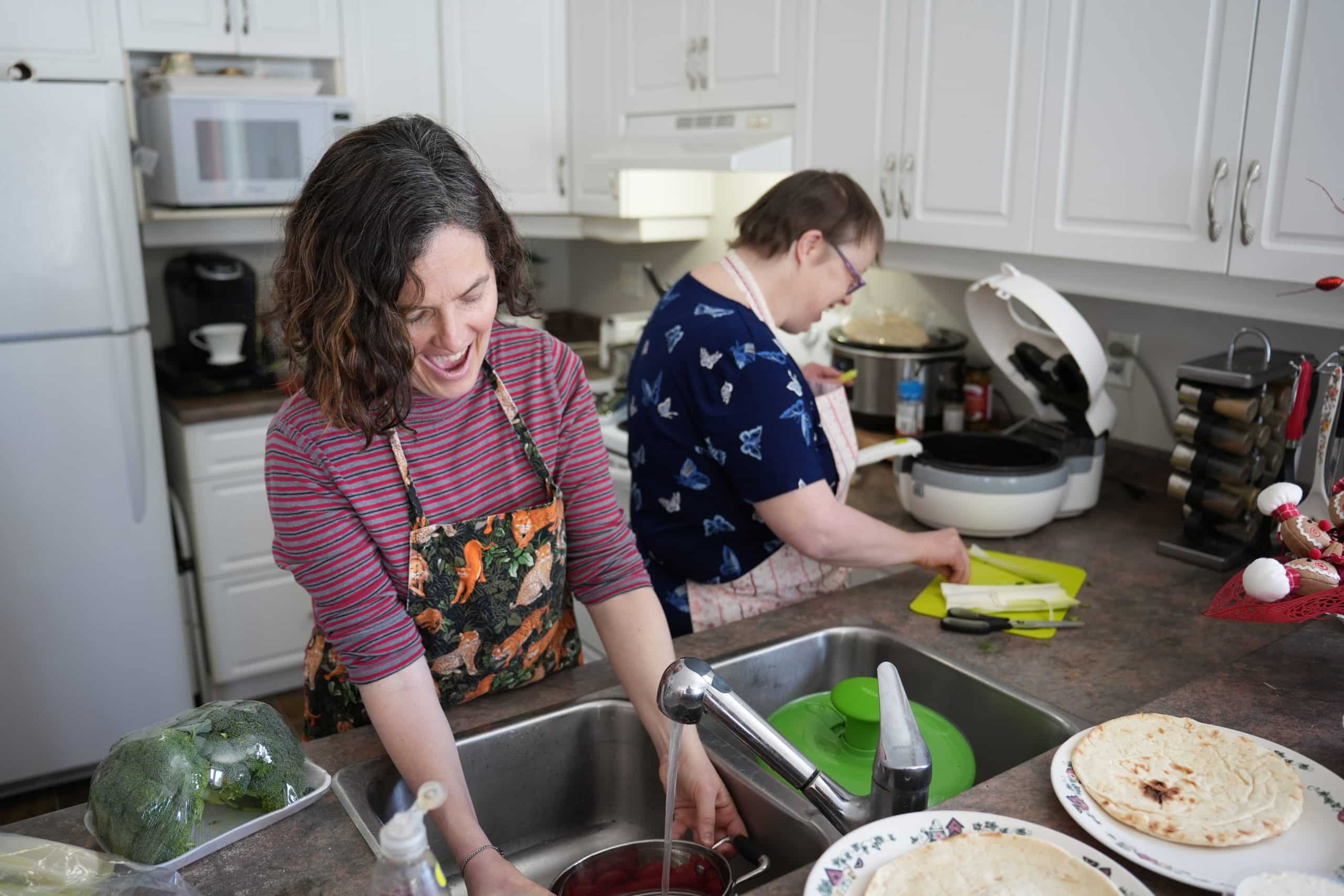
This morning Dowey and her roommates are busy preparing lunch in the large, sunny kitchen. One of the women, Katie Galloro, reads them a hand-written recipe from a small notebook.
Galloro, who is in her late forties, loves singing, dancing and the TV show Power Rangers, she says. The women regularly get together in the evening to sing in their cozy living room, and Galloro doesn’t hold back on those nights, belting out her favourite Disney and classic rock tunes. “I’m a Van Halen fan,” she says.
“The main thing is we’re like a family,” says Amy Nolan, another resident of the house. One of her favourite activities: going bowling with “my girls” from Casa de Angelae, she says.
Nolan, 49, has shoulder-length brown hair, glasses and a warm smile. Her job this morning is to shred cheese for the chicken parmesan they’re making. She gets help from the women’s live-in mentor, Judy Robbins.
Robbins has an apartment unit above the home’s garage, so she’s always close by if one of the women needs her. On weekends, the women stay with their families to give Robbins time off.
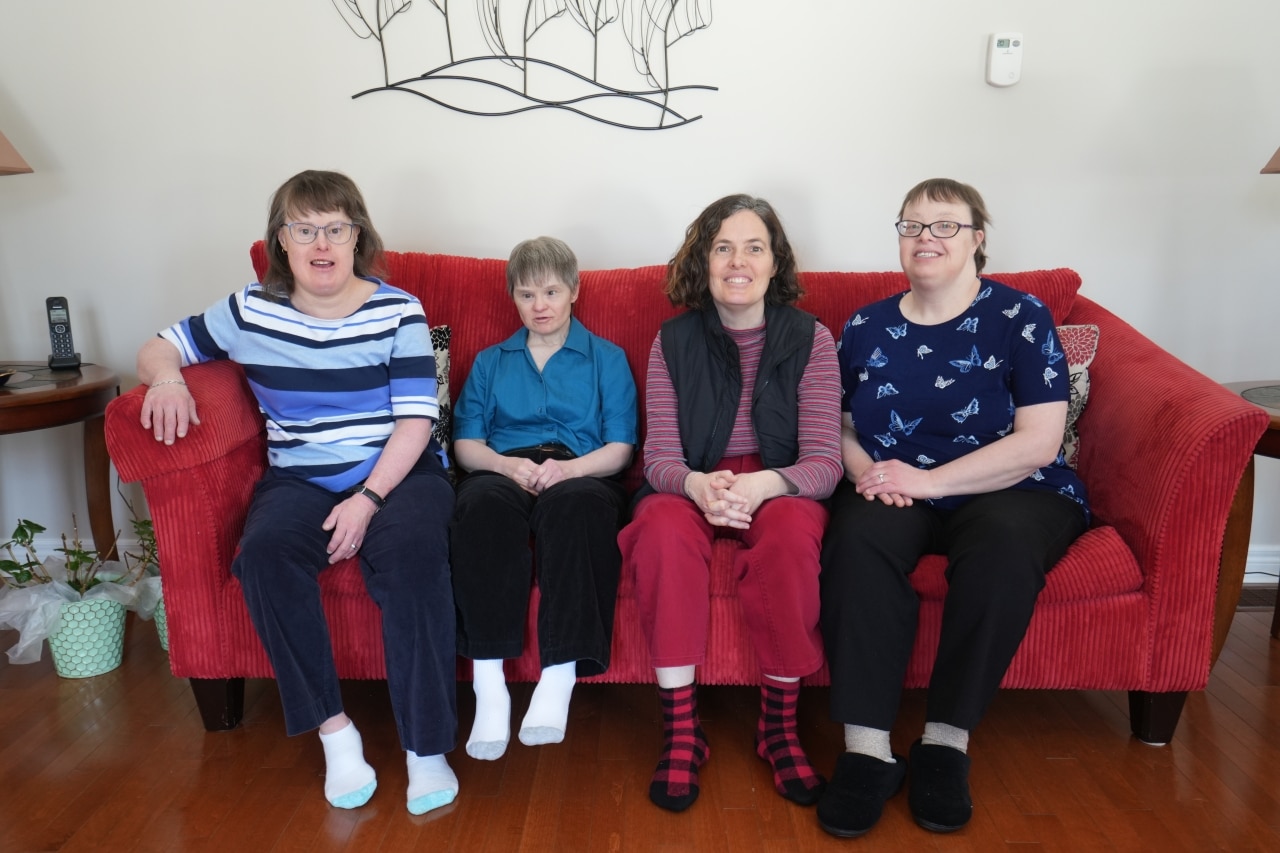
Community Living Peterborough (now Community Living Trent Highlands), bought this spacious, five-bedroom home almost 15 years ago, in partnership with the parents of the four women who now live here.
The parents got fundraising help from supporters, including the late Peterborough politician Peter Adams, to start paying off the mortgage and hire a mentor, and the women moved in on Canada Day in 2011. The fundraising has never stopped since then, with the money going to pay Robbins’ salary and upkeep the home each year, explains Kim Aubin, chair of the board of directors that oversees the home. They also get a small amount of provincial funding, which covers about 10-15 percent of expenses, she says.
Casa de Angelae isn’t perfect, says Andrea Dowey’s mother, Brenda Dowey. The women sometimes rub each other the wrong way and get into arguments. But in the end, they always work things out. “They love each other,” she says. “And they miss each other if they’re not there.”
It took almost a decade for Casa de Angelae to become a reality, starting from when some local parents came together to discuss their children’s futures in 2002. They were warned at the time that finding appropriate housing would be a struggle.
There are government-funded group homes for people with developmental disabilities, but spaces are limited. Aubin says the parents were told that when spots do come available, they often go to those who require the highest level of care. “Because these girls were considered higher functioning, it would be harder to get them into a group home,” says Aubin, who used to coach the women through Special Olympics Peterborough.

Like the other parents, Brenda Dowey, 75, knew her daughter couldn’t live on her own. So she was left worrying where Andrea would end up when she was no longer around to care for her. She had a painful glimpse of what Andrea’s future might look like when she visited a long-term care home years ago. She says she remembers seeing another young woman with an intellectual disability living there.
“She didn’t belong there,” she says. “She just didn’t seem like she was in a happy environment for her. It’s just a place to put her.”
That’s not the future Brenda wanted for her daughter. And it’s not what the other parents who founded Casa de Angelae wanted either. So instead of crossing their fingers for group home beds to become available, they took matters into their own hands, fundraising to found a non-profit home for their daughters themselves.
Nowadays, Brenda Dowey has peace of mind knowing her daughter is surrounded by friends in a place where she can hopefully live semi-independently for the rest of her life.
But the caring, stable home the women at Casa de Angelae have found stands in stark contrast to the reality a growing number of people with developmental disabilities in Peterborough and across Ontario are facing.
More than a decade after Casa de Angelae was founded, there are even more barriers to housing for people with developmental disabilities. Ontario’s supportive housing waitlist is longer than ever, putting highly vulnerable people in increasingly desperate situations, with a growing number falling into homelessness, according to multiple people in the developmental services sector Currents spoke to for this article.
Tired of holding their breath for their adult children to move up the waitlist, more local parents are following in Casa de Angelae’s footsteps and creating their own housing solutions. Some have found success. But advocates say the housing challenges for people with disabilities are too big for a handful of dedicated parents to fix on their own.
Ontarians with developmental disabilities placed in long-term care and hospitals amid housing shortage
In 2017, a Timmins, Ontario father launched a class-action lawsuit on behalf of his non-verbal adult daughter, alleging that she and other adults with developmental disabilities faced unreasonably long waitlists for government-funded support services. Other plaintiffs joined from across the province. Years later, their legal battle is still ongoing. But the problem their case brought into the provincial spotlight has only gotten worse.
Since the suit was launched in 2017, the number of people with developmental disabilities waiting for government-funded supportive housing has ballooned by more than 50 percent, reaching 28,000 in the 2023/2024 fiscal year, according to a report from the province’s financial accountability office (FAO). At the same time as the number of people who need supportive housing has increased, the number of people who have access to it has decreased, according to the FAO’s numbers.
Teresa Jordan, executive director of Community Living Trent Highlands (CLTH), said many young people with developmental disabilities who are currently in line for supportive housing will be on the waitlist for decades. If a crisis, like the death of a parent or other caregiver, occurs before they get a spot, they could be placed in long-term care, she said.
Some 1,509 Ontarians with developmental disabilities under age 65 lived in long-term care facilities between January 2018 and March 2021, according to Ministry of Long-Term Care data that Community Living Ontario obtained through a freedom-of-information request.
In a 2019 study that followed almost 65,000 Ontarians with developmental disabilities from 2010 to 2016, nearly 10 percent of participants between the ages of 50 and 65 spent at least one day in long-term care.
Chris Beesley, CEO of Community Living Ontario, said most seniors who go into long-term care usually do so for a relatively short period of time near the end of their lives. But people with developmental disabilities are often placed in the facilities at much younger ages, and then stay for decades. “That’s not right,” he said.
People with developmental disabilities in these facilities find themselves isolated from their peers, Beesley said, with few opportunities to go out and participate in the community.
On top of being isolated from the community, living in long-term care also exposes people with developmental disabilities to a lot of grief and loss, since they are surrounded by people who are approaching the end of their lives, according to Jordan. It’s hard for Community Living to help people find a sense of belonging and create opportunities for them to build friendships when they are stuck in a long-term care home, she said.
Others face even worse situations, according to Jordan. She was recently part of a case conference about a person with a developmental disability who, as of late 2024, had spent about 13 months in a hospital bed in Haliburton County. The person was initially admitted because of a health crisis, but couldn’t leave because there was nowhere else for them to go, she said.
It’s not an isolated case. People with developmental disabilities were more than five times more likely than the rest of the population to spend time in hospital after they were deemed ready for discharge, according to that 2019 Ontario study.
Ontario Ombudsman Paul Dubé is currently investigating the problem of people with developmental disabilities being inappropriately housed in hospitals due to a lack of support services in the community. In one case, a 22 year-old man with autism and a history of self injury stayed in hospital for three years, Dubé reported last year. The man was kept in restraints for most of that time, and hadn’t had a bath in three years by the time Dubé’s office intervened and a home was finally found for him in the community.
Local agency warns of a “rising crisis in homelessness” among people with developmental disabilities
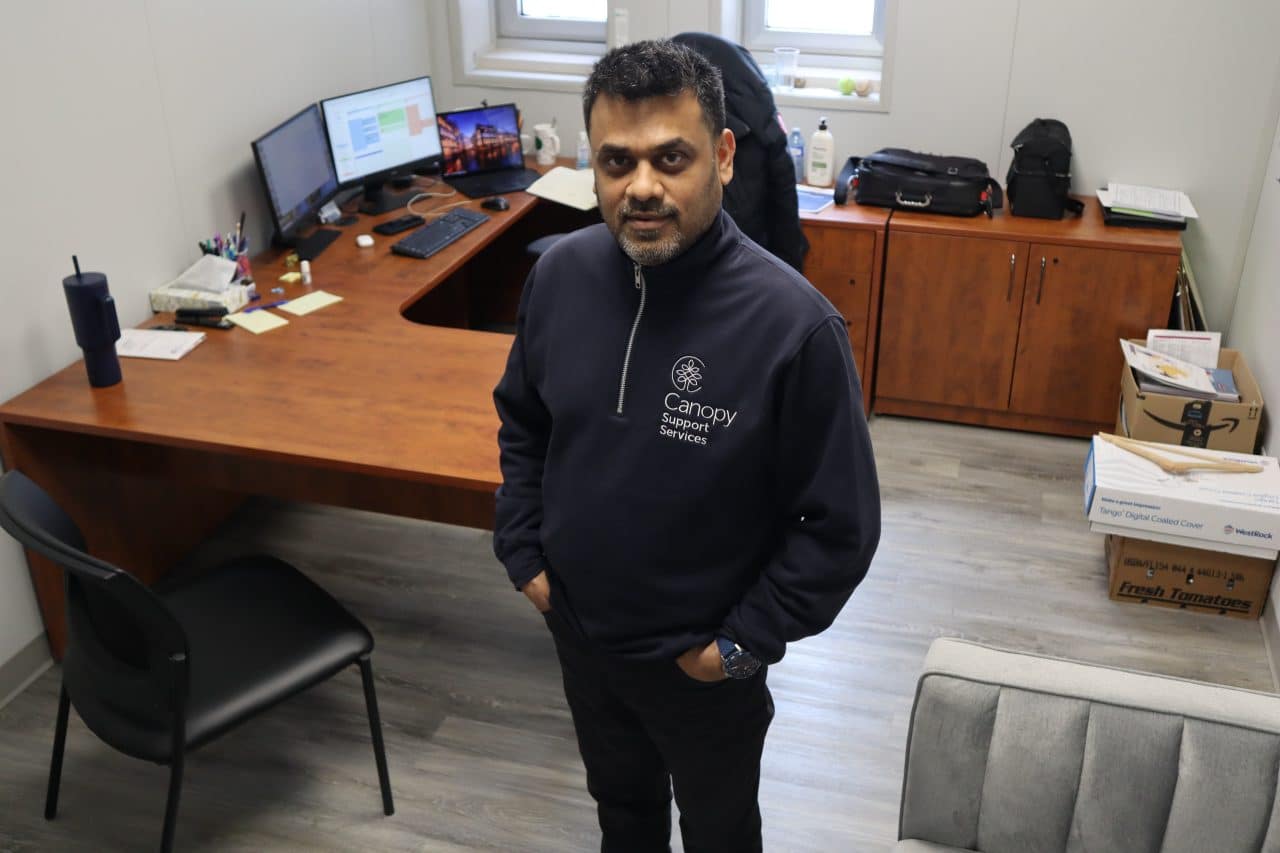
Still other people with developmental disabilities are falling further through the cracks, and ending up in homeless shelters and sleeping on the streets, according to Peterborough-based Canopy Support Services. The organization, which provides services to people with intellectual and developmental disabilities, warned recently that there is a “rising crisis in homelessness” among the population they serve.
Between July 2022 and February 2025, 85 people with developmental disabilities who were unhoused or at risk of losing their housing were referred to Canopy, said the organization’s CEO, Himanshu Shah. Some were sleeping rough, while others were couch surfing or staying in emergency shelters, he said. Others were at risk of becoming homeless because a parent had passed away or become ill. “Hearing those stories is heartbreaking,” Shah said.
The emergency shelter at the Trinity Community Centre in downtown Peterborough is one place unhoused people with developmental disabilities are turning to.
“We see quite a lot of folks who have developmental disabilities,” Tammy Kuehne, director of support services with One City Peterborough, which runs the shelter, wrote in an email.
One City also has a 27-space supportive housing program for people transitioning out of homelessness. Some people with developmental disabilities use that program, Kuehne said, but often they need more support than it can provide.
“We see people ending up in our shelter, or we do our best to serve them in housing, knowing we’re not ultimately the place that can provide them the right level of care,” she said. The organization is in the early stages of exploring ways to better support people with developmental disabilities, she added.
Homelessness among people with developmental disabilities is not a new problem, but Ontario’s housing crisis isn’t making the situation any better, Shah said. A 2018 review of international research on the subject estimates that between 12 and 37 percent of people experiencing homelessness may have an intellectual disability, whereas only one percent or less of the general population is estimated to have one.
In February, Canopy hired a housing support worker for a pilot project aimed at helping clients facing homelessness, thanks to a $100,000 grant from the Ontario Trillium Foundation. The goal is to help clients access housing subsidies and provide life skills training to those who can live independently, Shah said. The housing support worker will also reach out to landlords to try to convince them to rent to people with developmental disabilities and work with other local organizations to tackle the issue.
The pilot project is just a first step to addressing this problem, which has been “long overlooked” in Peterborough and the surrounding area, according to a release on Canopy’s website.
“Governments just don’t care enough to do the right thing.”
Why are so many people with developmental disabilities unable to get the supportive housing they need? The question is a personal one for Beesley, with Community Living Ontario. He has a 30-year-old son with a developmental disability who still lives with him. His answer: it boils down to indifference.
“If you don’t care about somebody or a group of people, then you don’t address the issue appropriately,” he said. “This is just a case [where] people, and by extension, governments just don’t care enough to do the right thing.”
The right thing in this case would be for the provincial government to invest a lot more in supporting people with developmental disabilities, he said. Instead, people with developmental disabilities face a “contracting” system of supports that serves fewer people than in the past, Beesley said.
“There is just a fundamental lack of recognition of the problem, lack of valuing people, and lack of commitment on both the government and society’s part to put [in] the amount of funding that’s needed,” he said.
Currents reached out to Ontario’s Ministry of Children, Community and Social Services for this story. The ministry’s media team did not answer when asked why fewer people with developmental disabilities have access to supportive housing today than in 2018. Nor did they address why the housing waitlist has grown by more than 50 percent since that time.
However, the ministry’s emailed statement said that people with developmental disabilities can receive some financial assistance to live independently through the province’s Passport program. The program “helps adults with a developmental disability participate in their communities and live as independently as possible,” the statement said. More than 67,000 individuals currently receive Passport funding, an increase of more than 42,000 since 2017/18, according to the ministry.
People can receive between $5,500 and $44,275 per year through the program, with the level of funding determined based on “individual risk assessments,” the ministry said. But almost half of those receiving Passport funding get less than the full amount they’re entitled to based on their level of need, according to the FAO.
Meanwhile, the ministry said the province has put an additional $1.2 billion into developmental services since 2018. That brings total spending up to approximately $3.5 billion this fiscal year. (Those figures are no different from what the FAO projected last year. However, the ministry took issue with the spending numbers put out by the office. “The FAO’s opinions are not representative of actual government spending as the FAO uses a different methodology, including their own analysis and projections of Ontario expenses,” the ministry statement said.)
Beesley said the additional funding isn’t enough. The amount the province spends on services, including housing, for people with developmental disabilities would probably need to double to meet the high level of need, he said.
But there is no quick solution, Beesley said. Even if the province answered his calls for more funding tomorrow, there just isn’t enough housing stock available to get everyone off the waitlist quickly. Ontario is in a housing crisis, after all. The pace of new construction is too slow to keep up with the province’s growing population, and people with developmental disabilities are one of the groups suffering the consequences, Beesley said.
More affordable housing stock is needed to give people with developmental disabilities the option to live independently with supports, he said. More group homes are needed, too. But until Ontario figures out how to boost housing construction overall, while keeping a healthy share of new housing affordable, the situation isn’t going to get any better for people with developmental disabilities, Beesley said.
“This is a societal issue, and people with developmental disabilities need to be part of the conversation,” he said.
Local parents fundraise to build housing for their daughters with disabilities
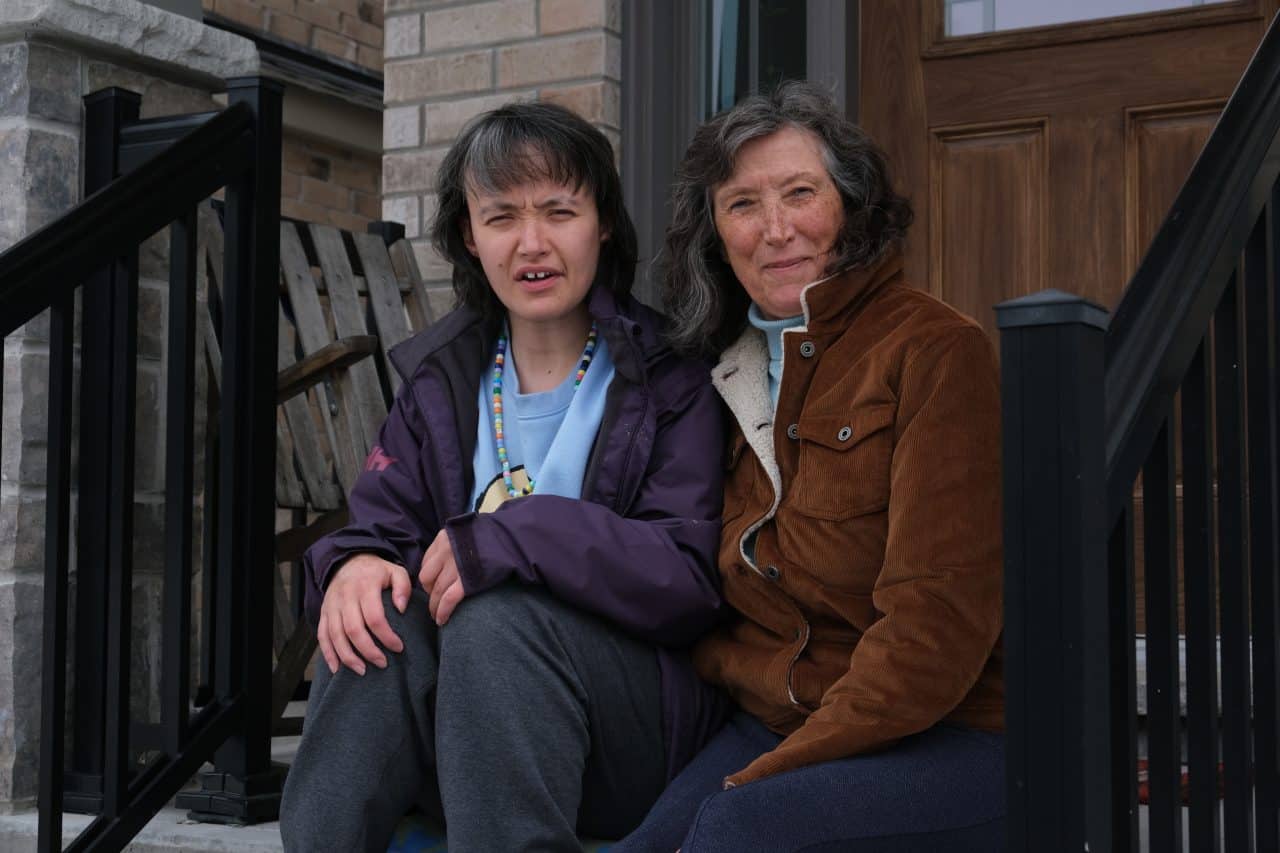
One day in June 2023, Jane Bischoff drove into the parking lot of Alternatives Community Program Services in Peterborough’s south end, where her daughter Jenny Lucas, who has autism, attends a day program for people with disabilities.
Bischoff had been casting an anxious eye to her daughter’s future, knowing that Lucas, 31, is not able to live alone. “I’m a single mother,” Bischoff, 67, said. “If I keeled over there’s nobody here to look after her.”
After walking her daughter inside that day, Bischoff got back in her car but didn’t go anywhere.
“I basically sat in the parking lot and watched other parents walk in with their daughters, and then walked over and gave them an invitation to meet with me,” Bischoff said.
The invitation had a smiling picture of Lucas printed on it, and an appeal to get together to brainstorm ways to find housing for their daughters.
One of the parents Bischoff approached in the parking lot that day was Lori Steers, who was dropping off her daughter Helena Steers. Steers said she broke down in tears and hugged Bischoff after she read the invitation.
“I was just overwhelmed with joy because I had the same problem,” Steers said. Steers said Helena, who is in her mid-twenties and has down syndrome and autism, had already been on the waitlist for supportive housing for six years. And she knew that if a spot eventually opened up, it could be far away from home.
“It might be a group home in Orangeville or something,” Steers said. “My daughter is very connected now in Peterborough. She has friends here. She has a day program here.”
She didn’t want Helena to be torn away from her community. So she was eager to work with Bischoff to find a way to keep both of their daughters close to home.
Bischoff said she kept returning to the parking lot for weeks to look for more parents. Out of those initial conversations, a small group formed. More soon joined, and before long, a plan started to form.
A conversation with Susan Zambonin, CEO of Habitat for Humanity Peterborough and the Kawarthas, led Bischoff to a vacant plot of land in East City. The property is on a quiet street, close to the Rotary Greenway Trail. “I thought, ‘Wow, this is the perfect setting,’” Bischoff said. She immediately had visions of building a home for her daughter and the other women there. And she looked into buying an electric tricycle so the women could go for bike rides on the trail.
In February 2025, Habitat’s board of directors agreed to partner with the parents to build a duplex for seven women with developmental disabilities on the property, Zambonin said. It will be called Our Daughters’ Home.
After the duplex is built, Zambonin said Habitat will sell it to a non-profit organization the parents of the seven women have founded, also called Our Daughters’ Home. Once they move in, their daughters will pay rent using their monthly Ontario Disability Support Program (ODSP) payments.
High construction costs mean the duplex could cost as much as $1 million, the group estimates. There’s no way Our Daughters’ Home would be able to qualify for that big of a purchase alone, Zambonin said. So the parents plan to take out a private mortgage to cover as much of the purchase price as possible, and then Habitat will hold a second mortgage for the rest, she said. The second mortgage won’t be payable until the first one is paid off, making the project more affordable for the families, she said. Zambonin said she hopes construction can start in summer 2025.
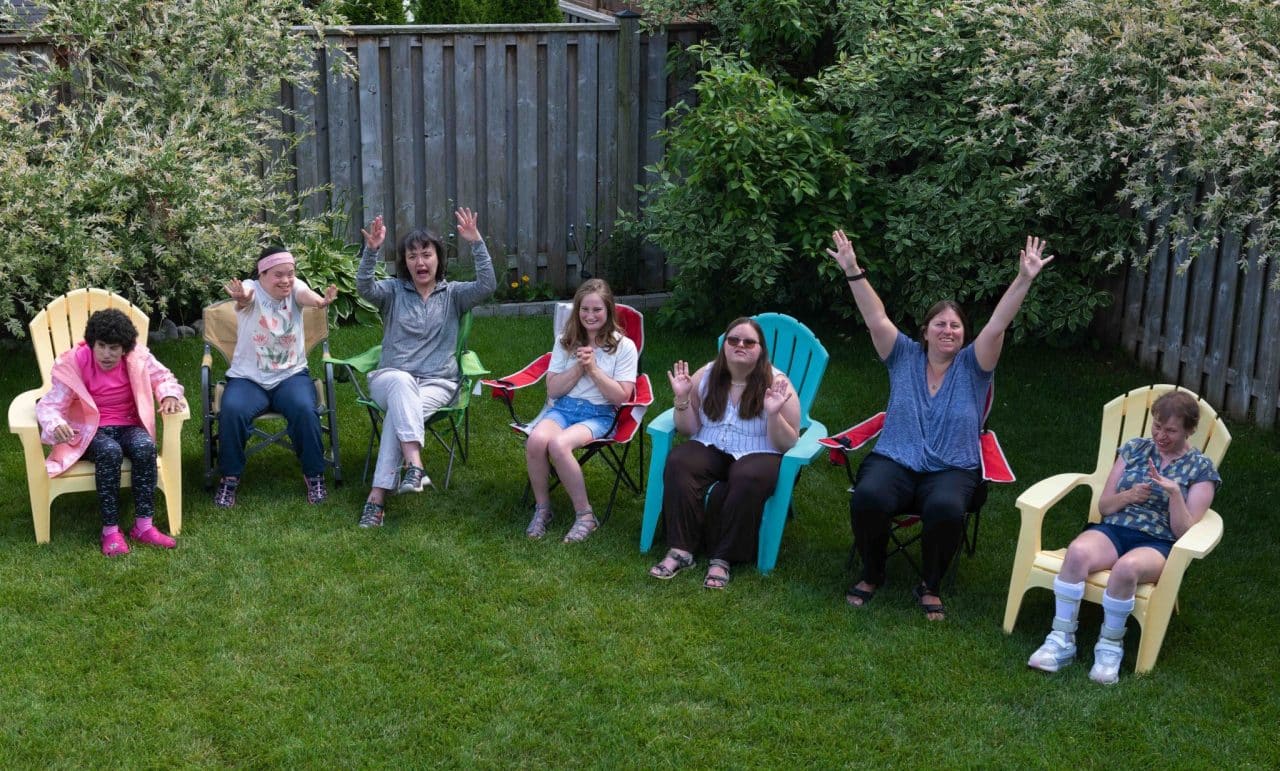
A brochure about the project says it’s about building a “forever home” for the women where they can live with “dignity, independence and stability for life.”
“This is not just about housing – it’s about ensuring that these women always have a place to belong, with the care and stability they need to thrive for life,” it reads.
Bischoff and the other parents are trying to fundraise $250,000 by the end of 2025 to go toward the cost of the mortgage. But their efforts won’t stop there. The women will need around-the-clock care once they move in. So their parents will also need to fundraise to hire staff for the home. The women do get financial assistance from Ontario’s Passport program, but it’s not enough to cover all the costs of the women’s care and running the home, Bischoff said.
Advocates say government, not families, should pay for supportive housing
Our Daughter’s Home isn’t the first local group to follow in Casa de Angelae’s footsteps. In 2021, five men with developmental disabilities moved into a custom-built suite at the Mount Community Centre where they live with 24/7 support. Their home is called Shared Dreams for Independent Living. It took the men’s families years of sustained effort and advocacy to find funding for the construction and the ongoing support services.
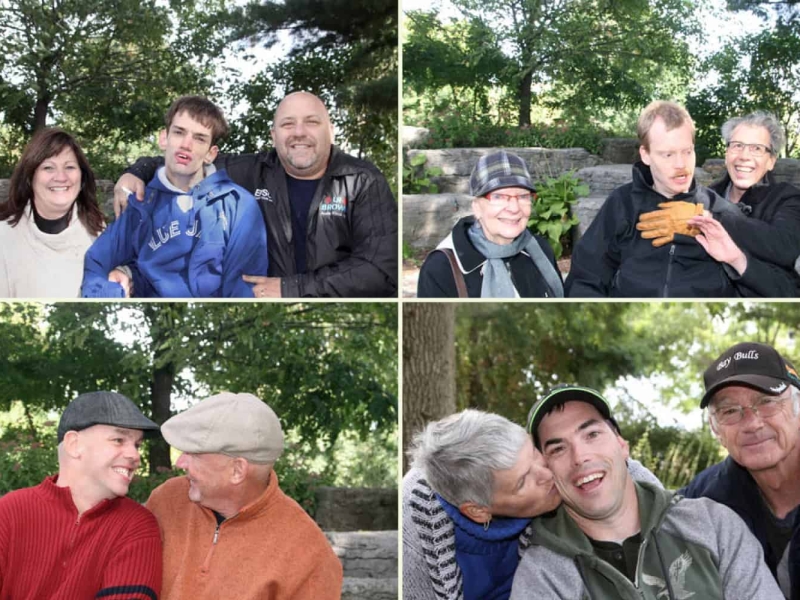
Jordan, from Community Living Trent Highlands, said the shortage of government-funded supportive housing is forcing many parents to fundraise to buy homes for their adult children with developmental disabilities, and then fundraise some more to provide them with support services so they can live independently.
It’s a burden that should fall on government, not parents, according to Beesley, with Community Living Ontario. The fact that it’s the other way around is an “indictment on our government and, frankly, on our society,” he said.
Disability rights advocate Anthony Frisina said people with disabilities and their families are always stepping up to find ways to get by in a world where their needs are regularly ignored. Families banding together to make up for the lack of supportive housing is just one example of that, he said.
“People with disabilities, including myself… really have to take matters into our own hands due to the lack of attention or intention to support people with disabilities overall,” said Frisina, director of media relations with the Ontario Disability Coalition.
It takes years of fundraising and hard work to make family-led supportive housing projects, like Casa de Angelae, a reality. That’s too big of an undertaking for many families, according to Frisina.
“The lack of support from the government is very disappointing,” he said. “It’s frustrating and it’s sad that people with disabilities are not being seen as assets. [They are] more so right now being seen as liabilities.”
Jordan agreed that family-driven initiatives alone won’t move the needle on the housing crisis facing people with developmental disabilities. But she said she applauds every time one more person can get into safe, stable housing. “It is a sector of one solution at a time,” she said.
Correction: The name of Casa de Angelae’s live-in caregiver is Judy Robbins, not Collins, as was written in an earlier version of this article. It has been corrected.
Author

Related Articles

Alderville First Nation grants legal personhood to Rice Lake
Exploring an alternate solution to climate change, and a growing international movement

After a year under an Ontario-appointed supervisor, Peterborough’s Children’s Aid Society won’t say if its budget is balanced
The Ford government appointed a supervisor last year to “reinstate good governance and fiscal sustainability” at the society
Two short stories about strong mayor powers in Peterborough
A legal challenge against the City of Peterborough is dropped and “the mayor’s budget” is passed
